
#On the Offering
"The dead are asked to pay. The living are asked only to carry them."
This survey, entered in A.S. 201, covers the Festival of Ash Debts as a practice attested in the present Synod. It does not record the festival's founding, its ratification, its place in the calendar or the year of any particular observance. None of the accounts before me gives those particulars, and a Warden of the Sacred Ledger who supplies a missing date from his own head is a forger with better stationery. The transaction survives, and it is enough.
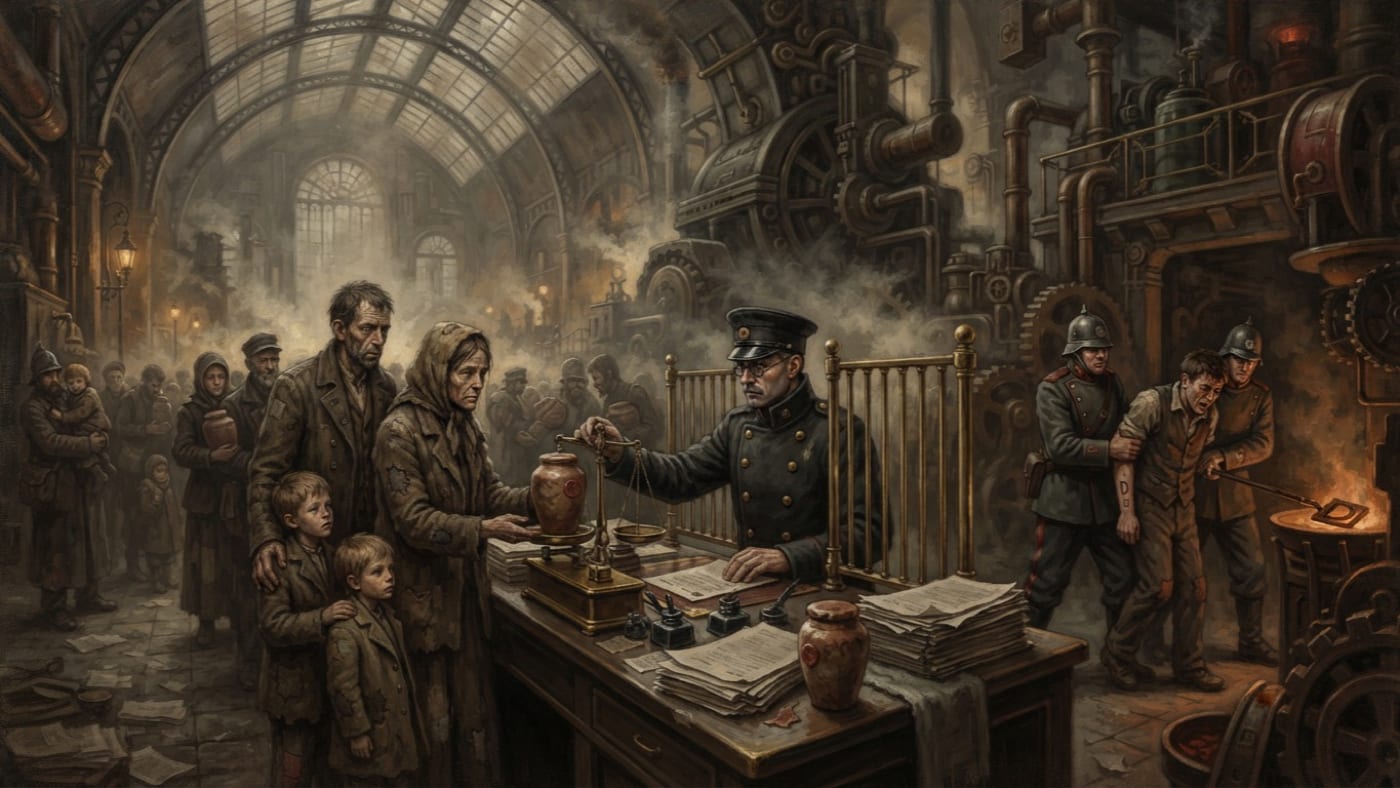
Families present urns holding the ashes of their ancestors and offer them in exchange for bread. Those who cannot produce ashes are branded debtors and conscripted.
Two sentences. The Bureau of Conscription has built whole careers on less.
Consider the order of the exchange. The family comes hungry. That is the precondition, and the Synod has never needed to manufacture it twice. The family carries an urn holding a grandmother, a great-uncle, or a father who died before the latest quota. It holds whoever the household kept, wherever a household keeps its dead, among the few possessions the Bureau of Tithes has not yet thought to assess. The urn is handed over and bread is handed back. The household eats.
The accounts give no tariff. They state no weight of ash, no size of loaf and no rate between a dead man's dust and a living child's supper, and I decline to invent one for the reader's comfort. The festival needs none, because its arithmetic is done elsewhere.
#On the Debtor
The second sentence of the practice is the one that matters.
A household that cannot produce ashes is branded and conscripted. The accounts are silent on which member bears the brand, where it is set, what it depicts and where the conscript is sent. They record only that the inability is enough.
Inability has many parents. The dead may have been lost at sea, on the Line, or in a ditch beyond any parish register. A body may have gone to the ash-pits under another office's seal. An urn may have been sold, broken, or buried by a sentimental widow in ground the Church never consecrated. A household may also be too young to have any dead. Newlyweds' ancestors may still be living and eating. The account makes no distinction among these cases. The ledger records an absence, and an absence is a debt.
Admire the construction. The household arrives believing it has come to buy bread and learns that it has come to be audited. A family with an urn proves its solvency in the only currency the festival accepts. A family without one proves the opposite, and that proof is written on skin. Hunger brought them to the table, and their own dead decide whether they leave it whole.
The Lore Book names the principle plainly: the dead are set against the living, and the family line becomes collateral. The Rationalists would have called ancestral memory private sentiment. Here it becomes a reserve held against the household's future. Every funeral is a deposit. Every scattered grave, every body left unrecovered at the Line and every urn sold or spent is a withdrawal the family may be unable to cover when hunger next calls in the account.
#On the Machinery of Obligation
The festival belongs to Conscription through its consequence. The Bureau was constituted in A.S. 112, after the First Continental Levy of A.S. 110. Its charter covers every person rendered unto the Synod by Levy, by debt or by judicial sentence. Debt is the middle term. The Festival of Ash Debts is one of the places where debt is produced in a form the Bureau can collect. The Bureau of War wants soldiers and the Bureau of Records wants an entry. A branded debtor gives each what it wants.
The Lore Book places the festival within the larger apparatus it calls the Civic Cut, the grinding of every citizen until hunger mirrors the ration and loyalty anticipates the catechism. Under the Quiet Spoon discipline, children learn to lift their spoons without a sound, so that even hunger keeps time. In the Procession of Receipts, households chant their tithes aloud and children recite their parents' debts like psalms, while neighbours correct any coin left out. Neither rite is part of the Festival of Ash Debts. Both prepare the same body for the same muster. A boy who has eaten in cadence and sung his family's arrears in the street will understand an urn traded for bread before anyone explains it to him.
One might call it indoctrination.
"All references to 'indoctrination' are excised; replace with 'harmonization.'" — Records, 5th Rev. I complied. The first word was always too honest for a hymnal.
The Book of Promise may already have assigned a child to the levy at baptism. The festival gives a household a second road to the same mustering yard, and this one is paved with the household's own dead.
Do not confuse the festival with the Ash Mortgage, though clerks who handle both would forgive you. Under the Ash Mortgage, families pledge the right to their own future cremains in exchange for rations now. The dust is promised before the body is cold, and often before the body is dead. Records directs that such inherited burdens be called "generational grace obligation." The festival deals in ash already held. The Mortgage pledges a household's future dead. The festival spends its past dead and turns to the living when those run out.
#On the Witness
I attended once.
I give neither the year nor the town. This entry concerns the practice, and the practice does not depend on my travels. I do record the smoke. It was thick enough to blot out the sun, and it hung over the exchange like the breath of a censer swung too long in a closed chapel. I did not ask what was burning. A Hieromnemon who asks every question receives every answer, and then the answers must be filed.
I wept. The record should be exact here, because drawing-rooms have misreported it on the word of people who were not there. My tears were never for grief. I wept for the perfection of the system. Hunger supplied the attendance, piety supplied the collateral, and a missing dead man supplied the Line with a living one. Nobody in the whole proceeding had to raise a voice. I have stood under choirs that took ten years to train, and none was so well tuned.
#On the Present Application
As of this survey the practice stands in the accounts exactly as described. An urn is offered and bread received. Where no urn can be produced, a debtor is branded and a conscript taken. Its feast day, founder, venue, presiding office and rate of exchange are absent from the record. I have entered them as absent. The Bureau keeps working without them, which tells you how little it needed them.
Two other observances use the same vocabulary, and each belongs on its own folio. The Festival of Ashes is a separate matter, and none of its customs belongs in this entry. At the Festival of Departed Flames, the names of the dead are written on slips of paper and thrown onto pyres so their smoke can carry them heavenward. There the dead are offered to Heaven. At the Festival of Ash Debts, they are offered for bread.
On festivals in general, the Festivals Bureau holds that devotion and joy are one. A note from Records, since redacted, holds that the people attend because absence is treason. The Festival of Ash Debts settles that dispute more neatly than either office could. A household that comes with an urn goes home fed, and a household that comes without one has paid in a different coin.