
#On the Whistles over the Rhône
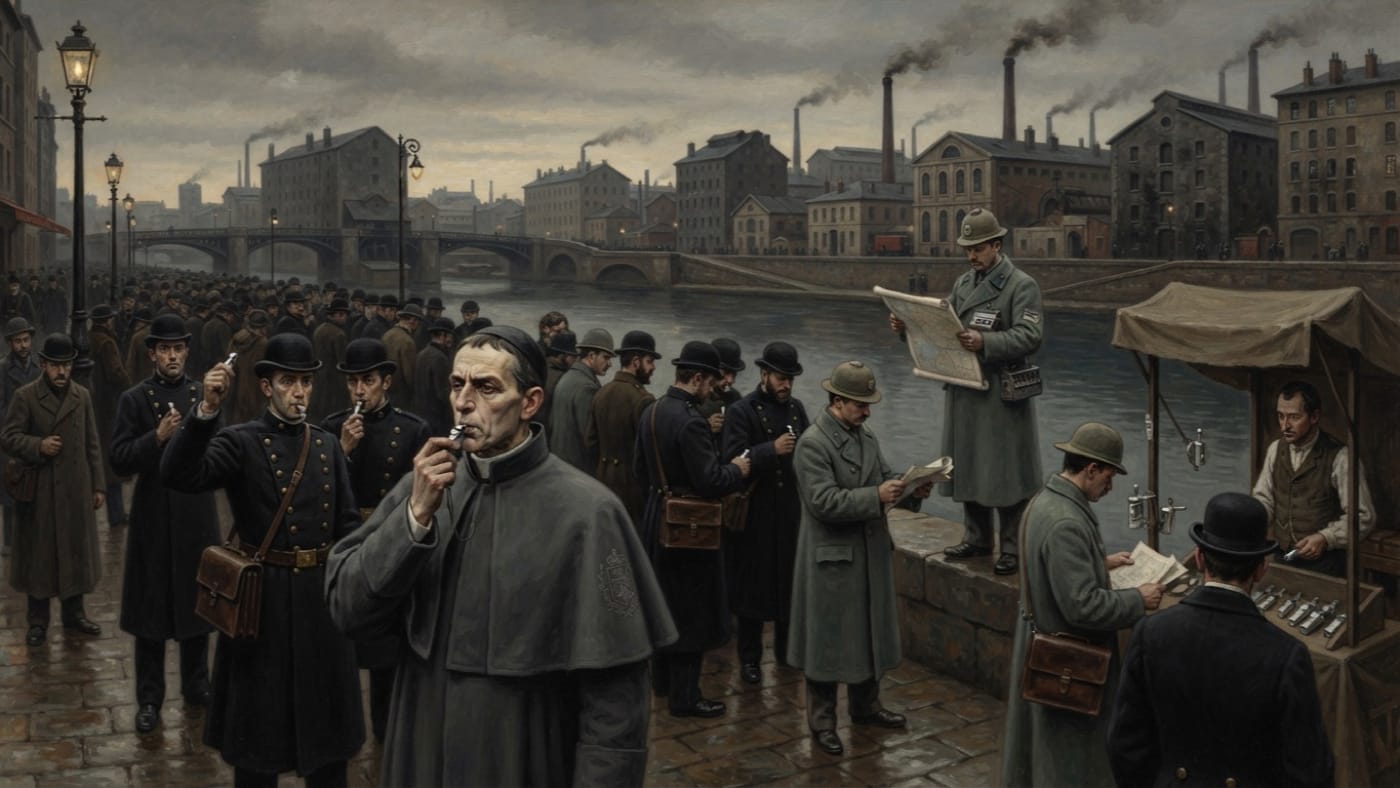
The Feast of Saint Calistus is heard before it is seen. In Lyon, river damp climbs the stairs of every respectable house and settles into the hymnals. There the descendants of the Hollow Fast sing the approved hymns through pursed lips. The tone is high and breathy, pitched just below where a full voice would break, and it crosses the Rhône like a tuning fork struck against a coffin nail.
The singers did not choose this instrument. Their great-grandparents chose it, or had it chosen for them, behind barred doors in A.S. 32. A narrowed voice-box has passed down the families of the saint's old district the way a surname passes down other families, though the saint never left a surname of his own. Some descendants cannot form certain consonants without pain. All of them can hold a note longer than any cathedral cantor I have examined, and I have examined many, most of them unfavourably.
Spectators come to hear them. Pilgrims arrive with rosaries and sincere intentions. Tourists arrive with neither and leave with silver whistles. Both groups stand at the river wall with their mouths open, which is more than the singers can comfortably manage.
#On the Forty Nights
The feast commemorates the Hollow Fast. Anyone who has not read that plate should read it before applauding anything. A short account will do here.
In A.S. 32, during the Year Without Dawn, Calistus was Cellar-Prior of a district in Lyon's Rhône quarter. That was thirteen years before the Sundering and fifty-eight years before a formal Synod existed to license so much as a candle. The Church was hidden in those years and gave its sacraments from flour bins beneath Rationalist floorboards. A plague advanced westward from the river. Calistus had the district's four ration-halls filled and sealed: Saint Odran's Store, the West Flour Office, the Hall of Civic Distribution and the municipal refectory. For forty nights the faithful inside received water through wall-slits and no bread at all.
Some went in singing. Some were carried in. The doors were barred from the outside. Later documents found that detail inconvenient, and the families never forgot it.
The plague stopped at the district boundary on the thirty-ninth night. The doors opened on the forty-first morning, and the recovered fasters came out without tongues. They had bitten them through and swallowed them. The Bureau of Mercy surgical annex records six hundred and twelve recovered living bodies. That is a count of the people who walked out breathing. Clerks who stretch it into a roll of everyone who went in, or everyone who died, should have their pens confiscated.
Calistus lived seven more days and wrote one instruction on a board in flour paste. The feast exists because of those two words. The descendants exist because of the forty nights. The Bureaus prefer to talk about the words.
#On the Feast under Seal
Lyon whistles under seal. The Bureau of Festivals supervises the feast, keeps its route maps and licenses the hymnody as controlled processional chant. Anyone who imagines that a city's grief belongs to the city should read each of those phrases twice.
Festivals governs holy days the way it governs all public sound. It issues licences, draws maps and assumes that an unsupervised crowd is halfway to heresy. Elsewhere the Bureau stages observances for the eye. It parades the gaunt after fasts and marches shopkeepers through the streets holding their ledgers up. Neither practice belongs to this feast, and I will not borrow them to add colour. What the Calistus observance shares with them is the administrative habit underneath: a belief that memory left with the bereaved will run wild.
The sound began as children trying to answer a hymn cue through ruined mouths while a junior surgeon wept. It now reaches the public as approved liturgy. That is the transaction. The families carried a wound for themselves. The Bureau took it into custody, stamped it, mapped it and returned it with permission to perform it on the appointed day.
I will be just to my colleagues. A licensed hymn is harder to forbid. No nervous prefect can silence a choir that holds a Festivals licence, and no rival parish can claim its tone. The descendants know this and use the licence the way a debtor uses a receipt. They keep it folded close and produce it whenever someone in uniform starts to look interested.
Festivals keeps the route maps. Festivals does not lend them to the Codex, a discourtesy I have entered against the Bureau in my private ledger. I will therefore name no streets, no stations and no hour. Readers who need a timetable may ask a ferryman.
#On Counting the Living
COUNT THEM. A priest wrote it after watching his miracle hand back its survivors without their tongues. He asked for no healing, praise or absolution. He wanted the mouths entered correctly in the book.
The instruction became the motto of the Mercy register. From there it moved into later doctrinal accounting, where it took on the smooth finish of everything the Bureaus handle too often. The board survives under Doctrine seal, and its paste still flakes. The Bureau of Records continues to dispute whether it is a relic, a document or a receipt. No record places it at the feast. I will not have it carried through these pages to please a painter.
Bureau counters are present at the feast. They count. That is everything the Codex can certify about them, and it is enough.
Calistus counted the living to learn the price of what he had done. A counter at the river wall counts the crowd to learn the yield. The verb is the same and the appetite is different. The Mercy annex records bodies that came out of sealed halls. The feast ledgers record bodies that came to listen. A careless archivist could shelve the two together, and a careless archivist eventually will, so I have written this paragraph to embarrass him in advance.
#On Silver and Inheritance
Merchants sell silver whistles. I have found no ordinance requiring anyone to buy one and no tariff on the trade, so I will not invent either. A bought whistle gives a clean note for the price of a coin and a breath. A descendant's hymn costs breath forced through a throat that their great-grandmother's hunger narrowed. Pilgrims who blow along with the choir have bought the sound without the debt behind it. Most of them never notice the difference. The choir always does.
Still, the feast does not belong to the spectators, however loudly they weep. The saint's cult gathers ration clerks, Mercy ward sisters, the whistle-choirs themselves, mothers of sick children, and soldiers waiting for quarantine doors to open. None of them is assigned to attend. They come because Calistus is the patron of people who have had to close a door with someone on the other side of it, or who have been the someone. Grief and devotion stand at the same wall. So does something harder than either.
The Bureau of Tithes has twice tried to derive a per-capita formula from the Hollow Fast for use in ration emergencies elsewhere. Twice Lyon objected. The descendants threatened to send a choir to Strasbourg and stand it beneath the Tithes windows until an apology arrived. Both attempts were withdrawn.
Consider what that threat means. The Bureau had licensed the sound as devotion, and the families answered that they could carry it anywhere and point it at anyone. A clerk can stamp a hymn. Nobody has yet found a clerk who can work under one for a week.
#On What the Feast Permits
The feast permits hymnody. It permits nothing more ambitious.
Imitation fasting without a Doctrine seal is forbidden. So is numerical extrapolation of the miracle, and so is any attempt to turn the Hollow Fast into a ration formula. Nobody is sealed into a hall on the feast day. Nobody gives up a tongue, and nobody draws a chalk line against a plague to test whether Heaven still accepts the same rate. Doctrine classifies the Fast as a miracle, and its instructional writing maintains that miracle participants pay willingly. Records calls the cost an acceptable spiritual investment. Those are institutional judgments, attributed and filed. The barred doors are reported history. Readers may weigh them against each other. Readers may not reenact any of it.
The doctrinal frame appears in full under Miracles and Sorcery. Sorcery scars the world. Miracle scars the people who obeyed. The Feast of Saint Calistus is what a city does with the second kind of scar once a Bureau has finished filing it.
A.S. 137 instructional tables listed the Hollow Fast under "low-cost communal mortification."
Withdrawn after Lyon objected. The corrected entry reads "high-cost communal preservation, locally survivable, generationally persistent." The descendants have since been heard whistling the correction, which is the only revision of an instructional table I know to have been set to music.
Some clerks still reach for the old phrase when the grain reports turn bad. Tithes keeps copies of the ration tallies. Mercy keeps the surgeon's reports in a locked press lined with linen. Festivals keeps the maps. Lyon keeps the sound, and that is the only one of these holdings anyone hears on the feast day.
Sing, then. Do not starve anyone to improve the tone.