
#On the Western Reserves
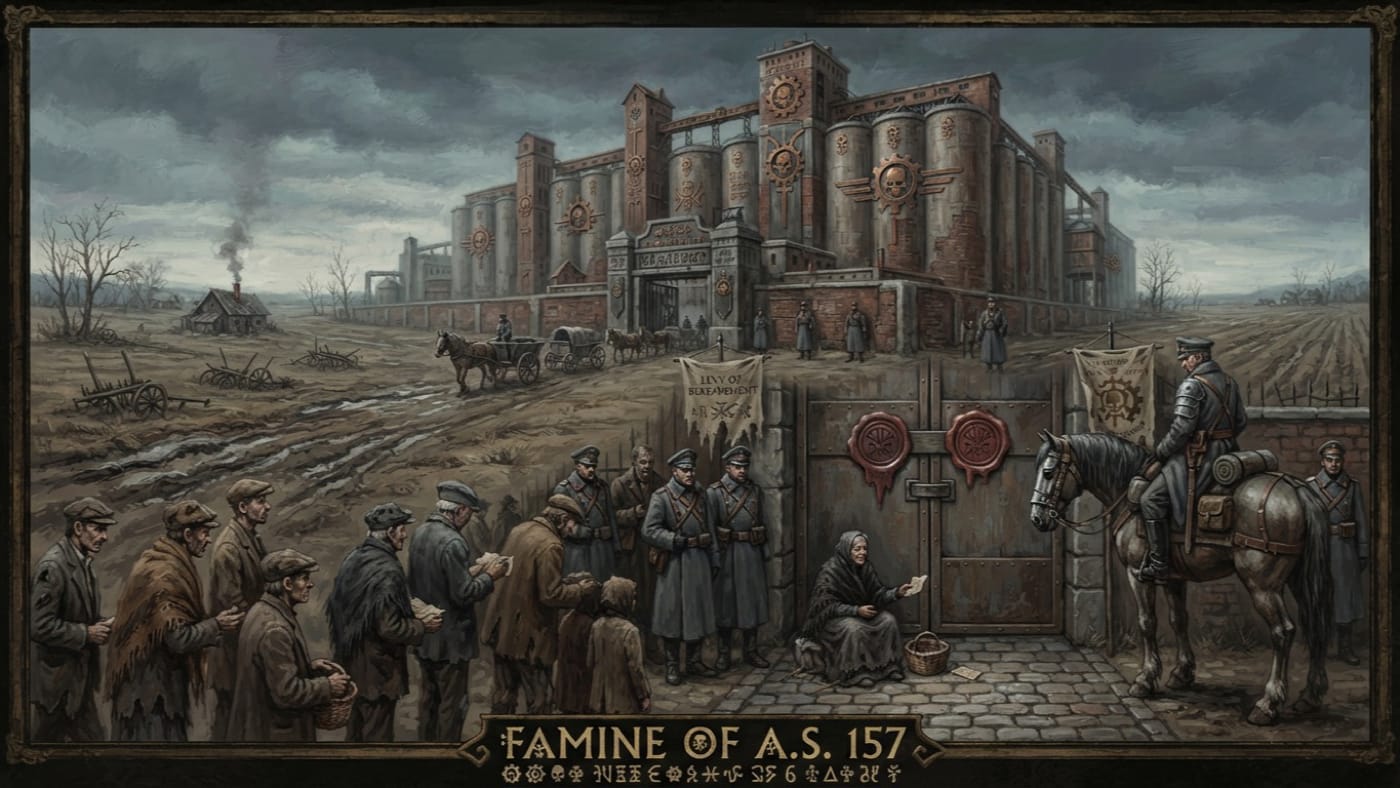
The Famine of A.S. 157 belongs to the western reserves: the granaries of Iberia, the districts they had fed, and the year the unconverted almanacs still number 1867. No army fought it. Several offices administered it.
Its ancestry is short. The Laugh Riots of A.S. 153 marked Seville as a city requiring correction. The Subjugation of Seville supplied that correction in A.S. 155, when War, Purity, Tithes, Festivals, Records and Doctrine entered under writ, each carrying its own instrument. Readers who want the bells and the shortened calendar may consult that file. This one concerns the fourth day, when the Bureau of Tithes inventoried the western granaries and declared them more urgently needed elsewhere.
The grain went south and east, by the corridor through Marseille and along the military roads toward Bastion-Constantinople, the southern anchor of the Line, where soldiers enjoy the distinction of being counted before they are hungry. Each sack routed coastward paid its fee under the Salt Dues of Marseille, so a single requisition fed two appetites, the bastion's and the fee schedule's.
The justification was military priority. Military priority is never wrong in a requisition order. It is wrong only two years later, at a granary door.
#On the Custody of Grain
Two failures met in A.S. 157, and the Ledger has spent forty-four years filing them as one.
The first was arithmetic. The Iberian campaigns had stripped the western stores, and supply allocation stayed bent toward Constantinople long after the processions in Seville had ended. The reserves were emptied by lawful order and correct entry. Every missing sack has its receipt.
The second was rot. The grain that remained sat in official silos under seal, and under seal it sweated, heated, greyed and began to crawl. Custody had been divided with exquisite care. Engineering had built the facilities. Rites had blessed them. The Bureau of Records had inspected them. The Bureau of Agriculture owned them. No Bureau had accepted responsibility for ventilation. Four offices held the keys; none held the air.
Each office's defence is preserved, and each is correct as far as it goes. Engineering built to the drawings it received. Rites blessed what was presented for blessing. Records inspected the seals, which were intact, and nobody had asked Records to inspect the wheat. Agriculture owned the silos the way a man owns a house he may not enter without three countersignatures. The wax held. The mould never consulted it.
The spoilage has its own partisans and its own file, the Weevil Year, where men who never went hungry argue its particulars. For the present entry it is enough that sealed grain and absent grain look identical on a manifest.
Agriculture was charged with managing what remained, and it answered with a report of seventeen pages recommending patience and prayer. Patience was the one commodity the western districts had in surplus. Prayer is addressed to the Creator, who keeps no granary keys and was not on the distribution list.
#On the Levy of Bereavement
Tithes answered the famine differently. It revived the Widow's Pennies.
The instrument was old. It had first been levied in the famine of A.S. 65 by tithing offices that the Ledger now files under Tithes as a retrospective courtesy, a quarter-century before there was a formal Synod to own them. Afterward it was laid aside. The grounds are not recorded. I suspect embarrassment, which in those years still carried minor administrative weight.
In A.S. 157 it came back with a schedule. Widows of soldiers were exempt. Widows of heretics paid double. Widows of clerks paid triple, since a clerk was expected to have foreseen his own death and filed accordingly. The soldiers' exemption was subject to verification, and verification is a queue. Arrears left unpaid passed to the surviving issue, so that a child could inherit a father's absence, a mother's debt and the Bureau's continuing interest in both.
Bereavement became assessable, like a hearth or a mill-wheel.
The levy was announced as emergency grain relief. Its receipts funded the Widow's Pennies Exchange at Griefgate, which stands beneath a triple arch on the Pilgrim Roads and weighs coin, passage and loss. It is a toll station. It has never stored a sack of wheat. The widows paid for relief, and relief arrived on schedule, at a road several provinces from their kitchens.
#On the Unrecorded Stores
While official grain rotted behind unbroken seals, the western districts ate grain that did not exist.
The Grain Keepers were at their trade before A.S. 157. The famine simply brought them more customers. They kept their caches small and scattered and never built one hoard, because one hoard is one confession. They entered sound grain as spoiled and carried it out the back door under that heading. They swapped ration chits. They turned wheat into bread as fast as the ovens would take it, because a loaf is harder to inventory than a sack, and they passed the loaves through bakers and parish alms until any trace of where the grain came from had been blessed out of them.
By statute they were criminals. In practice they fed the people the ration system had already entered as fed.
Some did it from mercy. Others did it for a debt, for influence in the ward, for a daughter's silence or a name moved up a list. The Keepers' own proverbs admit this, and I prefer them to the Bureau's, which admit nothing. A family fed by a Keeper was alive and owed. The Church has never produced a cleaner definition of a parish.
Throughout the famine, Tithes denounced hoarding as heresy, in language I am professionally obliged to admire. The districts that survived survived on hoards. Had the Bureau succeeded in rooting out the Grain Keepers in A.S. 157, it would have had a great many more widows to assess.
#On the Dissolution
The Bureau of Agriculture was dissolved in A.S. 158. The registers I have read give no date for the end of the famine. The dissolution is dated to the year.
Its disposition was tidy. Its records went to a Bureau of Records sub-registry, where I have handled them. They are dry, which is more than can be said of their subject. Its staff were sent to the Paper Mines of Ulm, a posting in which they might at last produce something the Church could use. Its authority over grain allocation passed to the Bureau of Tithes, which had exercised that authority in practice since the fourth day in Seville and now received the seal to match.
That closed the account. Tithes requisitioned the grain, assessed the widows, funded the toll and inherited the granaries. Agriculture had owned the silos, written the report and lacked the grain, and it carried the accountability. Engineering, Rites and Records kept their seals.
Seville remained corrected, and its granaries remained depleted. Bastion-Constantinople ate.
The dissolution of the Bureau of Agriculture in A.S. 158 was once entered as "post-famine administrative streamlining."
Corrected. Agriculture was dissolved after a famine it had been charged to manage without the grain to manage it, and the grain had already been placed in the hands of Tithes. The entry describes a transfer of title. The previous owner was sent to Ulm to make paper.