
#On Targeted Replacement
"It wants the chair, the stamp and the key. The face comes with them."
Face-Thieves are demons of Morwen, the Weeping Host, that select one particular person and replace him. Her other servants feed on whoever stands nearest. A Face-Thief chooses. The countermeasure reviews of the Bureau of Records describe its quarry by function: an officer, a chaplain, a supply clerk with access to the ration manifests. These are examples of the kind of person taken. They are not the names of the dead, and the reader who goes through the casualty rolls looking for them will find only his own anxiety.
Observe the list. Command, absolution, bread. A Face-Thief does not covet a man's cheekbones. It covets what the cheekbones are permitted to sign. Whoever wears the officer's face issues his orders. Whoever wears the chaplain's face hears confession. Whoever wears the clerk's face decides which company eats on Thursday.
There is nothing remarkable about its appearance, and that is the whole complaint. It arrives in issue wool with its buttons dulled to regulation and its cap set at the angle its victim favours. It queues for broth. It is late with its laundry. At Bastion-Irongate the Danube grinds through the gorge, and mud has already made every soldier look like every other soldier. The Face-Thief need only resemble one of them better than he resembles himself.
#On the Preparation
The study takes weeks or months. The reviews give no fixed term, only a range wide enough to frighten anyone who has worked beside the same man for a season. In that time the Face-Thief learns its target the way a novice learns the Hours. It learns the cough after cold meals, the two fingers tapped before answering a superior, the particular contempt he keeps for one sergeant, the dead brother he mentions only when drunk. It learns how he holds a mess-tin. It learns which hymn he mumbles because he never learned the second verse.
Then it takes his place. Every account agrees on the worst of it: a finished replacement convinces the family. The mother embraces the copy. The wife writes to it. If the original survives the exchange, he becomes the stranger at his own door and the disputed claimant, a man whose protests sound exactly like what a demon would say.
The dedicated lore goes further, and I report it under protest and with attribution. Documents are said to change to accommodate the replacement. Memories are said to alter to include it. Purity interrogators describe replacements who have lived stolen lives for many years, and others who seem to have forgotten they were ever anything else. I do not explain the mechanism. Doctrine has not explained it to me, and guessing would not improve on its silence. Nor does the craft rewrite every page in the Synod at once. If it did, there would be no confirmed discoveries to count, and Records would have nothing left to file except its resignation.
The taxonomy is untidy, so the comparison will be short. Hollow Ones absorb whoever is near. Mirror-Stalkers come out of reflections, improved. Echo-Kin imitate badly and fail at arm's length. The Worn are crowds wearing one coat. The Beloved use the faces of the dead and the grief of the living. A Face-Thief picks a name and does its homework. The categories blur at the edges, nobody has shown that one kind becomes another, and the reader may not infer a lifecycle from a list.
Morwen's cults run a similar trade. Their Collectors compile dossiers on chosen targets, and their Mirrors assume the identities they have studied. The likeness to a Face-Thief's method is plain. Any kinship between them is unproven, and I leave it unproven.
#On Evidence That Agrees
Irongate's answer to all this is the Ledgers of Self. Each one records a person's appearance, gait, scars, voice, handwriting, habits, fears and sins, along with the private memories called Bone-Lines. The dead sister's nickname and the yellow dog behind the tannery were chosen because nobody else should know them. An examination begins with recognition phrases, moves to personal history, and ends with the bone-lines.
The countermeasure reviews state the result plainly. Recognition rituals catch poor copies. Echo-Kin stumble, and hasty impostors forget which sergeant their man despises. An accomplished Face-Thief has spent months learning exactly those answers. It attends the ritual and passes with distinction. Some copies know bone-lines that the original swears he never told a soul. Doctrine says it cannot determine how and has forbidden speculation. I obey, with a visible effort for which I trust the reader will give me credit.
Early Ledger manuals described bone-lines as "copy-proof."
Corrected after Sector Nineteen, A.S. 193. Bone-lines are copy-resistant. The correction is reprinted here because a Face-Thief is the creature most likely to make a clerk forget it.
Records relies on custody. Every Ledger exists in three copies. The field copy travels with the unit in a brass-bound packet, the sealed copy rests in the Irongate archive, and the dead copy lies in Strasbourg under a misfiled heading. Three copies give the court three things to compare. They also give a forger three places to work, three sets of custodians to bribe, and three shelves where a reported alteration might settle overnight. When a claimant agrees perfectly with his Ledger, the court has proved only that the claimant and the page agree. If the page has been altered to fit the claimant, the agreement proves how thorough the thief was.
Every other demon fights the evidence. If the reports are right, the Face-Thief enlists it.
#On the Irongate Record
The Bureau's published account records three confirmed Face-Thief replacements discovered in the Irongate garrison between A.S. 190 and A.S. 198, which is 1900 to 1908 in the common reckoning. That figure counts discoveries. It is not a census. Records has released no names, no individual dates of discovery, and no estimate of how long each replacement served before someone noticed. The Bureau suspects there are more. It has not audited the whole Line to find out, because a Line cannot fight and count itself at the same time.
The same interval includes A.S. 193 / 1903 CE. That was the year of the Sector Nineteen inquiry, the formal adoption of Mirror Discipline and the revision of the Ledgers. I mention the year because it falls within the count, and I will say nothing more about it. Nothing in the files I have seen classifies the returned platoon as Face-Thieves. A bestiary that puts each horror in whichever cage is nearest is a menagerie for children.
The Twinning proceedings at the Hush Court followed in A.S. 199 / 1909 CE. There, pairs of claimants recited the same private clauses before the same open book. Afterwards the Bureau withdrew its older language. Ledger confirmation was no longer called absolute assurance. It became operational assurance, which is enough for duty, rations and provisional absolution. In the same season the official description of the Singleton Doctrine changed from protection to comfort.
#On Containment and the Second Claimant
Mirror Discipline restricts reflective surfaces. Soldiers count three seconds aloud before looking away, shave by assigned barbers, and see themselves only in warped tin. The protocol keeps the garrison from offering its faces to whatever waits behind polished brass. That closes one road. A Face-Thief already in the barracks has no need of it. It looks away on the count of three like a model recruit and passes inspection with a better collar than the man it replaced.
Purity Circular 193-M stated that Mirror Discipline "prevents identity theft."
Clarified. Mirror Discipline reduces exposure to reflection-mediated approach. It identifies no one already present.
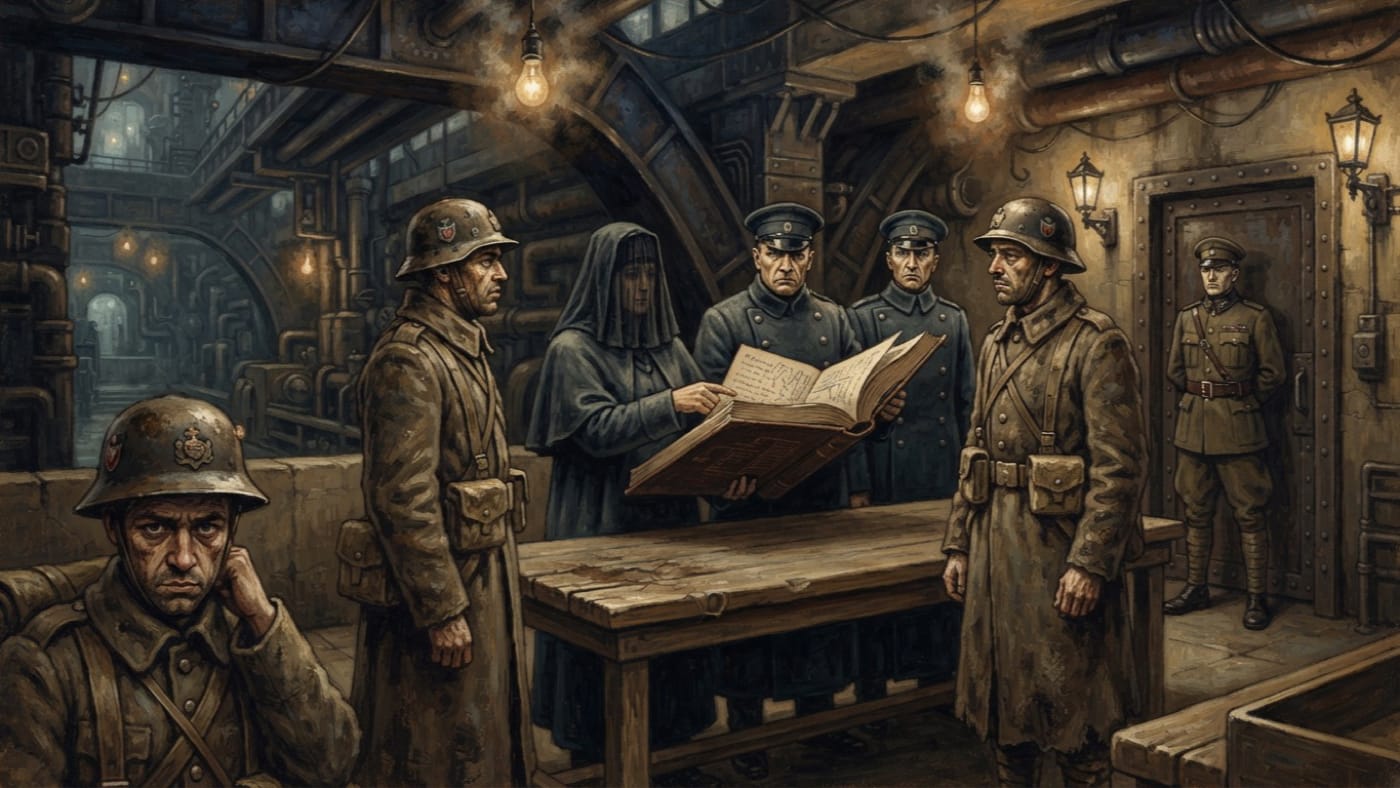
When doubt arises, the claimant is taken down beneath the Transit Spine. A gloved and veiled Records clerk opens the Ledger. A chaplain watches for doctrinal fracture, a Purity officer watches the eyes, and an officer of the Bureau of War watches the door. The questions run from public particulars to witnessed particulars to bone-lines. A claimant who agrees with the book receives a dated chit reading IDENTITY ACCEPTED. One who disagrees is detained. When two claimants are equally supported, the court proceeds to the Twinning, and the standard resolution of an unresolved duplicate is the execution of both.
The Bureau has acknowledged the consequence and filed it. Morwen's agents can expose a copy at a chosen hour, and the court will execute the man it copied along with it. The officer, the chaplain and the clerk are each removed as cleanly as the demon would have removed them, and with better paperwork.
#The Ratification
The Face-Thief is entered in this Codex as a hostile category of the Weeping Host. It is active against Bastion-Irongate and anywhere on the Sagittal Line where a name carries a key. It prefers targets whose identities open storerooms, pulpits and chains of command. It is detected by Ledger concordance, which is provisional, and by Mirror Discipline, which is partial. Beyond those lies the Twinning, which is final in the wrong direction. Doctrine teaches that the Creator knows each soul singly. The Hush Court knows what the book says this morning.