
#On the Recognition Granted
An Equivalence Letter is a single sentence with a seal on it. As the Paper-Only faction circulates it, the sentence permits one relic's local authentication to be honoured under another jurisdiction's devotional necessity, provided no universal claim is advanced in the presence of an adverse witness. Every clause matters. Remove one and the instrument becomes either a lie or a riot.
The letter belongs to the smallest branch of the Femur-War Broker trade. These men refuse by custom to touch a relic, and they sell the papers that tell a relic where it may be believed. A parish that cannot obtain a bone may obtain recognition of someone else's. A ward chaplaincy that lacks a saint for its feast may borrow the saint's standing for the length of a procession. The bone stays where it lies. The candles are bought anyway.
Anyone who has counted a collection plate can name what the letter decides: who may hold a procession and when, which shrine keeps its precedence and its revenue, how a custody quarrel ends, and now and then whose body is left lying in a feast-day street.
#On the Precedent of the Neutral
The brokers say they inherited the method from Elder Noxa, called the Neutral, a former registry scribe who learned at her desk that the stamp counted for more than the bone. In the Triplicate Femur Incident three reliquaries were certified as holding the same saint's leg. The riots that followed killed more people than the siege. Noxa never ruled on which femur was correct. She separated the claims by calendar, writ, audience and custody language: one feast here, one procession there, one congregation instructed under this writ and another under that. At Bastion-Brest, where the Brass Ribs carry the Line across the Bug, she left the ward-niche femur untouched in its niche. Once the claims stopped meeting, people stopped dying.
The Paper-Only men call this their inheritance. The Peace Brokers claim the same woman as the source of their quiet, and the Profit Brokers claim her as precedent. None of the three can produce a letter in her hand. No surviving record shows that Noxa wrote, signed or standardised an Equivalence Letter. What the trade inherited from her was a habit of keeping claims apart.
The brokers trace the letter's vocabulary to two later episodes. The first is the Port-Seal Reforms. When the customs shrines standardised crate seals, a black market grew up in what dockside clerks called "equivalent sanctity." The second is the Quiet Concord of Lantern Row, where two rival saint-cults were allowed to coexist by being kept apart in place and in time. Someone eventually wanted the habit to travel and wrote it down. Nobody knows who first did so, and the brokers prefer it that way.
#On the Sentence and Its Packet
The clauses should be read in order, as a canonist reads a decree, with suspicion.
Local authentication. The letter assumes an authentication already exists and cannot create one. Authentication is the work of a Relic Authenticator acting under the Bureau of Relics. That work covers intake, examination, response testing, grading, notarisation and disposition. The broker borrows the verdict without having seen the object. A relic locked in a quarantine cabinet stays there. A Contaminant grade does not become Ward-safe because a broker's wax has passed over it. The letter adds no new grade, and it does not lift a quarantine.
Another jurisdiction's devotional necessity. The receiving side has to show a need: a feast without its saint, or a chaplaincy whose ward rites name a relic it does not hold. The receiving party attests to its own need. Brokers will sell it the attestation too, at a separate rate.
No universal claim. The bone may not be proclaimed as the saint's femur everywhere, with every rival femur declared a fraud. Cologne's seventeen femurs of Saint Aldebrand, all notarised and all equally holy, survive because nobody in Cologne is allowed to count them aloud.
In the presence of an adverse witness. No instrument this Office has examined defines the adverse witness, and the brokers prefer it undefined. The phrase stays open because whoever gets to define it controls how the letter is enforced. One thing is settled in practice. An absent witness does not license a shrine to shout universal identity in what it takes to be an empty room. The room is never as empty as the shrine thinks.
The letter never travels alone. It goes out with extracts from the provenance chain: discovery note, custody ledger, transfer witness, Examiner certificate, blessing record and parish display permit. It also carries witness-name slips and counter-seal rubbings, so that a sceptical reader can see that someone, somewhere, was in a position to know. Each paper in the packet answers its own question. The authentication certificate says what the object is. The custody record says where it has been. The inspection-delay writ says when nobody may look. The Equivalence Letter says who may kneel to it from somewhere else.
This Office's earlier working gloss described the Equivalence Letter as "a certificate that two relics are one relic."
Retracted. The letter says nothing about the bones themselves. It covers recognition of an authentication that has already been made. Two femurs remain two femurs, and the Bureau simply arranges that they never meet.
#On the Passage Between Offices
What follows is the usual sequence, compiled from practice, and describes no particular case.
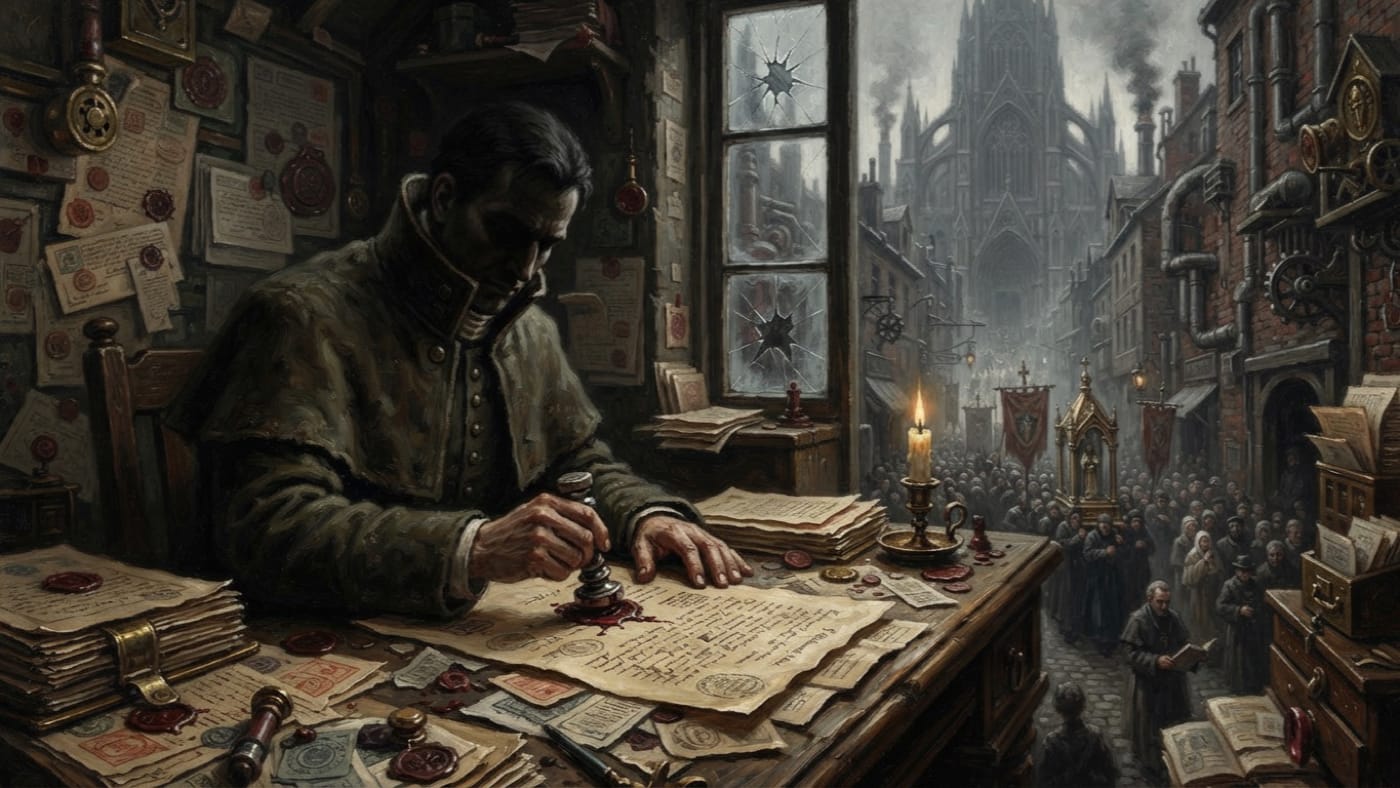
A receiving chaplain wants a saint for a feast. The saint's femur rests in a sealed case three provinces away, under a custodian who would not lend it to the Creator without a transport clearance. The chaplain goes to a broker. The broker never goes near the case. Through a clerk of the Bureau of Records, whose office preserves, reconciles and corrects documentary claims, he obtains abstracts of the femur's authentication. He drafts the letter, names the receiving jurisdiction and the feast, and attaches witness slips. Then he takes the packet to a notary booth with a cracked window and a candle that is always too short.
The notary seals it. The notary did not examine the bone and does not consider that the notary's business.
The packet reaches the chaplain's back office and is read once in the vestry, aloud, to the people entitled to hear it. Then it is filed beside the parish display permit. On the feast day the saint's name goes into the litany, votive candles are sold under the saint's patronage, and the procession goes out with the instrument's authority behind it. The femur never moves. The recognition is what travels.
Records then has to reconcile a parish ledger that honours a relic it does not hold. The clerks file it as recognition, which is a different entry from custody, and they cross-reference the source shrine. They do this so cleanly that one might think they had designed the system. They did not design it. They have simply put up with it longer than anyone else.
#On the Witness and the Collision
Letters fail when they meet. Two packets arrive on one auditor's desk, each honouring a different authentication of the same saint for the same feast in neighbouring jurisdictions. Either packet would pass alone, but the two together cannot both be honoured. Auditors who know the trade check registry entries and seal numbers first. Next they look for provenance gaps. Last they compare the witness packets, where the same transfer witness may turn up in two cities on one feast day, apparently in perfect health.
Forgery is the other way a letter fails. Forging equivalence letters is a known side business of the broker trade, and the Seal-Forgers who supply it rarely trip over the wax. They trip over the story: a canton named after it was renamed, an Examiner certifying a year after he was dismissed, a counter-seal rubbing too clean to have come off any seal that was actually used. The first forgery an auditor looks for is always the story.
Clients make it worse. A noble house that pays for a letter wants it to say more than the letter is allowed to say. A shrine wants the proviso left off, or worded so loosely that a herald can read it as triumph. A broker who agrees has written a universal claim and put his client's name at the bottom of it. Then a rival custodian walks into the nave, or a White-Mantled Inquisitor attends the feast. Nobody calls it a clerical slip after that. The Inquisitor calls it a doctrinal offence against the Bureau's settlement of the Femur Wars, and an audit, a confiscation or a purge follows, whichever the Inquisitor needs that season.
Crowds are less patient than Inquisitors. A procession told its saint is honoured elsewhere does not go elsewhere quietly. A crowd sent to the wrong gate by a mishandled packet meets the right crowd there. The Paper-Only man never touched the bone, and the trampled child was never told that his hands were clean.
#On the Present Convenience
As of A.S. 201 the letter is in use wherever Paper-Only brokers work across Zones 1–5. Its standing is the same in every one of them: tolerated in practice, unsanctioned by any charter, and denied whenever someone asks about it. No treaty governs it. Nobody keeps an honest count of how many have been issued. The Relics Bureau relies on the letters to keep its arithmetic from blowing up. The Records Bureau files them in a column made for the purpose, and the Bureau of Doctrine accepts their logic as long as no criminal says it aloud.
The brokers call themselves heirs of the Neutral. They sell her caution by the folio, with wax and witness slips included and the bodies billed separately.