
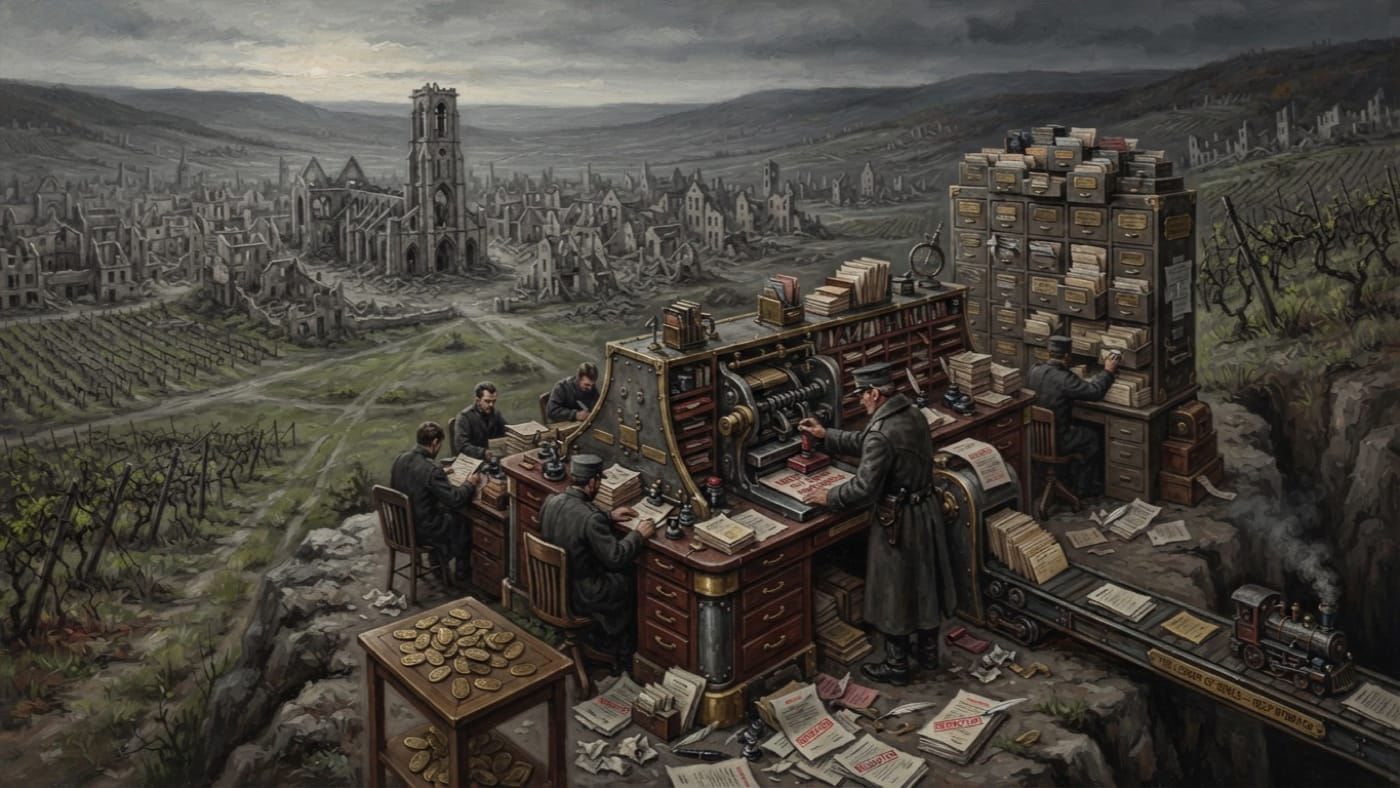
#On the City Entered
Epernay was a city. I put the verb in the past tense under protest, because the Bureau of Doctrine would prefer I used no verb at all. It lay in the wine country of Champagne, on the roads that run toward Reims, and it was prosperous in the dull, respectable way the Ledger likes best. There were vines on the slopes and carts on the roads. Pilgrims passed through on their way to somewhere holier and, as pilgrims do, left their coin behind.
It kept a modest cathedral. Nobody has ever claimed it was a great one. Its bells rang on the quarter-hour. By them the vintners knew when to break for bread, the confessors knew when to open the screen, and the tithe-clerk knew to the minute how late a debtor had come.
I can tell you what Epernay was because I can tell you what was taken from it. Like every city of the faithful, it existed in the Great Ledger of Souls. Baptisms were entered at the font. Marriages were witnessed and sealed. Property deeds were copied in iron-tanged ink, tithe receipts were filed against each household, and census entries counted every head under every roof, the duplicates going down to the vaults of Strasbourg. When a child was born, a clerk wrote it down. When a vineyard changed hands, a clerk wrote that down too. The bells told the hour, and the registers told the Bureau of Records who had lived through it.
So far as Records is concerned, that is the whole of a city. The stone is incidental.
#On the City's Removal
In A.S. 103, Archon Benedict Veyrault struck Epernay from the Ledger. He had once been a monk of Dijon, and by then he was the man who had made Records what it is.
He did not burn a single page, because burning leaves ash and ash is evidence. He reclassified the entries instead. The baptisms, the tithe receipts, the marriages, the deeds and the census all went into a filing category that does not exist. Junior scribes, with more curiosity than sense, have asked me which cabinet that is and on which floor of which vault. The question is badly formed. A category that does not exist has no cabinet. It has the entries that went into it, and it has the city that never came back out.
The Redaction of Epernay gives the full account of the operation, and I send the reader there rather than repeat it in a place entry. Here I need only record why it happened, which means recording three Bureaus that disagree.
The Bureau of Purity holds that Epernay had fallen into doctrinal deviance. The Bureau of Tithes holds that it owed levies it never paid. Doctrine holds that the outcome was ordained and that asking about causes is impious. All three claims are on file and none has been proven. A city guilty of real crimes would normally have those crimes on record, and anyone who knows what Records did with the rest of Epernay's papers would be a fool to expect that here.
The writs authorizing the removal of Epernay from the Ledger remain sealed under Ninth-Ratification. Every signature that stands with Veyrault's is withheld: ████████████████, ████████████████. Even the number of names is classified. The bars above are a courtesy and should not be counted.
The Bureau admits, with some pride, that Veyrault's hand carried out the removal. The seal does not tell a Hieromnemon whose hands stood behind his. I hold keys to more vaults than any cleric outside the Archon's own household, and this vault is not among them. I enter the fact here for the record. I am aware that the record is the problem.
#On the Empty Roads
The residents did not flee. No column of refugees reached Reims with its carts piled high, and no dispossessed vintner ever stood at a registry desk to plead. The Bureau's account is plain and I give it plainly: the people of Epernay ceased to cohere.
Consider what that means inside a single household. A wife has no marriage entry. A child's baptism is filed nowhere. A man walks to the tithe-house with his receipt, and the clerk cannot honour it, because there is nothing on the clerk's side of the counter to check it against. A citizen is a name in a register with a body attached. Take away the name, and the Bureau holds that the body has no further standing to remain.
Within a season the buildings stood vacant. The doors still hung on their hinges, the presses still sat in the cellars, and the cathedral nave was empty at every quarter-hour. Within a year the approach roads had grown over. The carts stopped coming because no one remembered where they were going, and vine and thorn did to the untended roads what vine and thorn always do. Within a decade, by the Bureau's reckoning, the name Epernay survived in no living memory at all.
The sequence matters, and I will not let some pamphleteer flatten it into a thunderclap. Epernay did not vanish in an hour. It went the way a parish register goes when the ink is cheap: one season faded, then another, until the page was clean and no one could say when it turned.
The Bureau does not record what became of the people. No form issued by my office has a field for the answer.
#On the Tokens at Reims
Doctrine's position is categorical: Epernay never existed. It is a clean position, and like most clean positions it has a market problem.
The Bureau of Pilgrimage reports that every week indulgence tokens bearing the name Epernay turn up in the markets of Reims. The name is legible and the stamp is sound. The authorities classify the tokens as forgeries. No forger has ever been identified.
Epernay never existed. — Bureau of Doctrine
Corrected to read: Epernay has no entry in the Ledger. The Bureau of Pilgrimage reports indulgence tokens stamped with its name in the markets of Reims every week. Their provenance is unestablished. Their classification as forgeries stands.
Pilgrimage also claims that the tokens predate the Bureau's founding. Pilgrimage has not said which Bureau it means, and I will not say it for them. If a forger working today strikes tokens older than the office that condemns them, that forger is either very patient or very poorly described. Authenticity is not mine to certify. I note with some irritation that nobody else has certified it either.
Consider the procedure at the desk. A clerk who receives one of these tokens must log it, and the log requires a place of origin. To fill in the place of origin, the clerk must write the very word Doctrine says names nothing. The clerk writes it and files it under forgery. The next week the clerk writes it again. Somewhere in the vaults there is a growing stack of entries, all in good order, each certifying that a city which never existed keeps turning up for sale.
#On the Present Condition
The valley is empty. Grass covers the old approaches. If anyone tends the slopes, no record says so. No tower stands anywhere. Locals report bells on the wind, tolling where no tower is left to stir. These witnesses are always called locals and are never named, because naming them would mean entering them, and nobody at Records wants to be the clerk who enters a witness to Epernay. None of the reports I am permitted to read says whether the bells keep the quarter-hour.
Here is the trouble an office like mine cannot avoid. To deny Epernay, Doctrine must name it. To classify the tokens, Records must name it. To seal the writs, Ninth-Ratification must at least know what it is sealing. Each act of official nonexistence produces a document, and each document carries the name. Veyrault emptied the Ledger of a city, and the Church has spent the decades since filling it back up, folio by folio, with the paperwork of its absence. This entry adds one more folio.
I have submitted it in the proper form. It will be filed in the proper place, and I am not permitted to know where that is.