
#On the Name
Every target seal issued to a shrine-platform has a space reserved for the object of fire, and that space usually holds a single word with a capital letter. The Ordnance Deacon may add a bearing, a range, a hymn-measure and a note on the wind. He need add nothing else. The word has been enough on the Danube, on the Bug, on the convoy roads below Sibiu, and in at least one river town whose inhabitants did not know they had been entered under it until the first toll of the bell.
I have searched the archive for the decree that coined it. There is none. The Enemy entered the Church's vocabulary the way soot enters a hymnal: through use, on every page at once, and impossible to remove without removing the page. The Bureau of Doctrine uses it as a collective noun for every power that opposes the Creator's order on this earth. The Bureau of War uses it as a column heading. Both spell it the same way, and both put the same seal under it.
This entry concerns how a thing beyond the Line and a person on the wrong side of a form come to answer to the same word. The question is administrative. The Bureau maintains that all questions are.
#On the Powers Behind It
At the summit of the word stands the Great Deceiver, remote and sovereign. No soldier of the Synod has met him, and no inquisitor has deposed him. Doctrine teaches that he cannot enter the world in his own person and governs it through proxies, much as a bishop governs a diocese he has never visited. I have countersigned that teaching, and I am in no position to contradict my own signature.
Beneath him Doctrine names the seven Sin-Generals, each a primary manifestation of one of the Deceiver's appetites: Kargath of Gluttony, Maldrake of Wrath, Velmora of Greed, Syrion of Sloth, Velkara of Lust, Atheron of Pride and Morwen of Envy. Doctrine adds that the lesser demons are manifestations of the generals in turn. That makes a chain of derivation as orderly as any Bureau's chain of signatures, and about as easy to check.
The men on the walls feel the generals as they feel weather: rot, fire, fog and price. None of them has seen one. The Bureau sends men who claim otherwise for rest, and then for questioning.
Seven names leave two sectors unaccounted for. Opposite Königsberg presses the Grey, which the garrison calls the Host Without Name. Opposite Brest presses the Nameless Tide, which does not assault so much as accumulate. Neither has been assigned a sin or given a name. The reports concerning both are sealed at the classification the Bureau reserves for matters it would prefer you stopped reading about. This paragraph complies.
#On Those Who Serve
Most of the Enemy is human. I say so because the Bureau of Purity would prefer it went unsaid, and because anyone who has counted the dead after a sortie already knows it.
Actual demons are few. They have bodies. When killed they stay where they fell, and the Bureau's anatomists can measure, crate and dissect them, which they are glad to do. The Synod cannot confirm whether a slain demon re-forms somewhere east of the Line. Doctrine has opinions on the matter, but an opinion is not an entry.
Influence-demons are rarer still: a shadow, a drift of smoke, a voice in a doorway. They cannot be caught or chained, nothing reliably destroys them, and they do not seize a man. They make him an offer: a cure for a child, coin for a debt, relief from hunger or grief or the plainness of his own face. The gift works, and that is the whole difficulty. The man becomes grateful, then dependent, then useful. When his usefulness ends, the shadow moves on and the gift shows its price.
Then there are the rest. Some are willing, some deceived, some desperate. Others are held in chains in the occupied provinces, where they are burned as fuel or bolted in as ballast in machines no demon could build and any demon can befoul. Doctrine is precise on one point: none of these people has lost the power of choice. A pact binds no one. A mutation is a wound and passes no sentence. A collaborator may turn back at any hour he likes.
The Synod generally hangs him anyway. His repentance is a matter for the Creator. His rope is a matter for the quartermaster.
#On Its Fronts and Methods
The Sagittal Line runs from Königsberg in the north to Constantinople in the south, and each bastion along it faces a different side of the same word.
Constantinople, the southern anchor, is the only bastion that faces two generals at once. Kargath's rot reaches the supply columns before they reach the gates. Grain blackens in the sack, water sours in the cask, and marsh roads swallow carts to the axle. Maldrake comes in campaigns of fire and slag. The garrison counts the two generals' contempt for each other as the city's second wall, and it maintains that wall with prayer, because that is all it can do.
At Sibiu, Velmora seldom bothers with assault. She buys. Gold from the Transylvanian veins becomes a quartermaster's silence, a convoy master's wrong turning, a customs clerk who signs whatever he is handed. Sibiu's garrison stops more bribed convoys than it repels attacks. Every bribed man on those roads is a Synodal subject who chose, freely and for a price, to become a column heading.
At Irongate, where the Danube cuts through living rock, Morwen sends things that borrow. Echo-Kin follow the sentries and copy them: posture, gait, even the cough a man gives before he speaks. At a distance, through smoke, a defender cannot always tell whether the figure on the far ledge is his comrade or the copy. The longer a man is watched by one, the reports say, the less sure he becomes of his own habits.
Velkara holds no sector. Her work turns up in infirmaries, mess halls and pilgrim hostels, inside every bastion and traceable to none. That makes her the Bureau's favourite explanation for anything at all.
The Enemy does attack walls. It would rather attack the bread, the wells, the ledgers, and one sentry's confidence in the man beside him. A wall can be rebuilt with stone. A garrison that suspects its own cook is already half taken.
#On the Sanctioned Target
On a shrine-platform the word becomes a procedure.
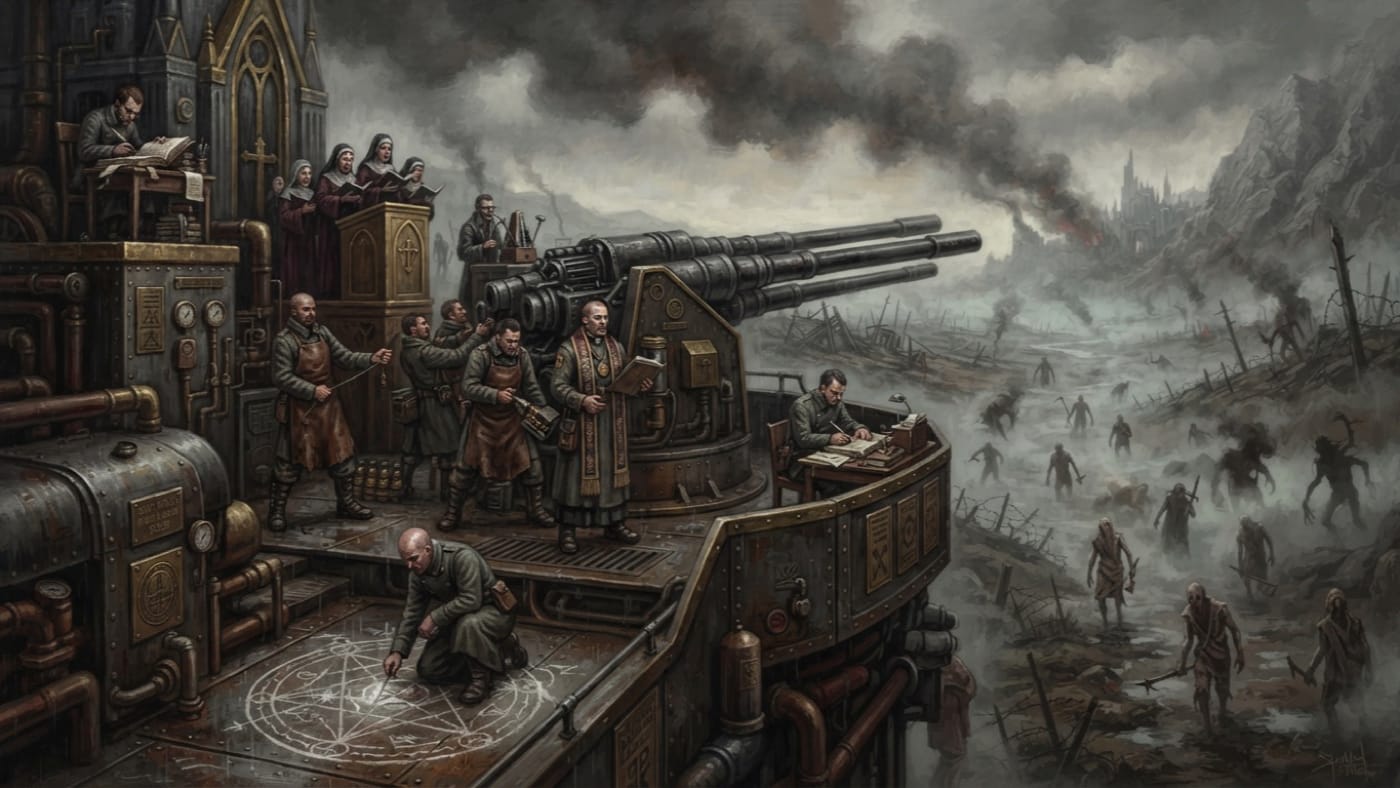
Doctrine supplies the interpretation: what the Enemy is today, and in which direction it lies. The Ordnance Deacon presses the seal. The Shrine-Deck Crew load and fire on the toll of the metronome bell, in measure with the choir, inside the chalk-and-ash rings the Ward-Chalkers renew after every rain. The shot-ledger takes the entry before the barrel cools: shot type, time, seal, measure and purpose. The Bureau of Records keeps the result for as long as Records keeps anything, which is to say for good.
So there are four acts: naming, authorizing, firing and recording. Different men perform them under different Bureaus, and no man performs more than one. The Bureau calls this a safeguard. A Powder Acolyte cannot fire on his own judgment, and it follows that he cannot be blamed for anyone else's.
The purpose column holds one word. The gunner's sight holds a great deal more. Across the water he may see an Echo-Kin wearing a sentry's stance. He may see men in rags carrying rifles stripped from a dead garrison. Or he may see men in rags carrying children. The seal does not tell him which. It tells him when, and the bell tells him the measure.
The record is less forgiving than the gun, because the record can be revised and the shot cannot.
The Irongate discharge recorded in the entry on the Shrine-Deck Crew was attributed in earlier editions of that entry to "enemy provocation resulting in defensive discharge."
The Bureau of Doctrine has revised that assessment. The discharge was "administrative in nature." The refugees were "reclassified." The revision does not say what they were reclassified as, or from.
The crew have their own account of the Enemy, and the ledger has no column for it. When cue and cadence separate by half a measure, they say, the deck goes hollow, as if something underneath were striking it like a drum. A Ward-Chalker will tell you that a gun whose ring has failed still fires, at whatever happens to be listening. Some of the older hands insist the listening thing is the Enemy. Others say it is the guns. The Pilgrim's Ladder men will not discuss it at all. The Bureau of Silence keeps a file on what the crews call the third voice. The file is sealed, and the Bureau has not told me what is in it.
#On Present Vigilance
The Enemy's present application is fourfold, and every part of it carries a seal. The Line contains what lies east of it. Convoy guards and well-wardens protect the supply. The Bureau of Purity looks into infiltration wherever a cook, a clerk or a convoy master has grown unaccountably comfortable. Where the first three fail, a sealed order authorizes fire, and the word goes in the purpose column as it always has.
The faithful should know the Enemy when they see it. The Bureau will tell them what they saw.