
#On the Surviving Account
This survey of the Empty Throne Affair was made in A.S. 201. It covers the accounts that survive and the administrative handling those accounts claim for it. It does not chronicle the event, because no chronicle exists. The year of the affair was never supplied. I searched every heading where a year might hide, and I will not invent one to comfort readers who like their scandals numbered.
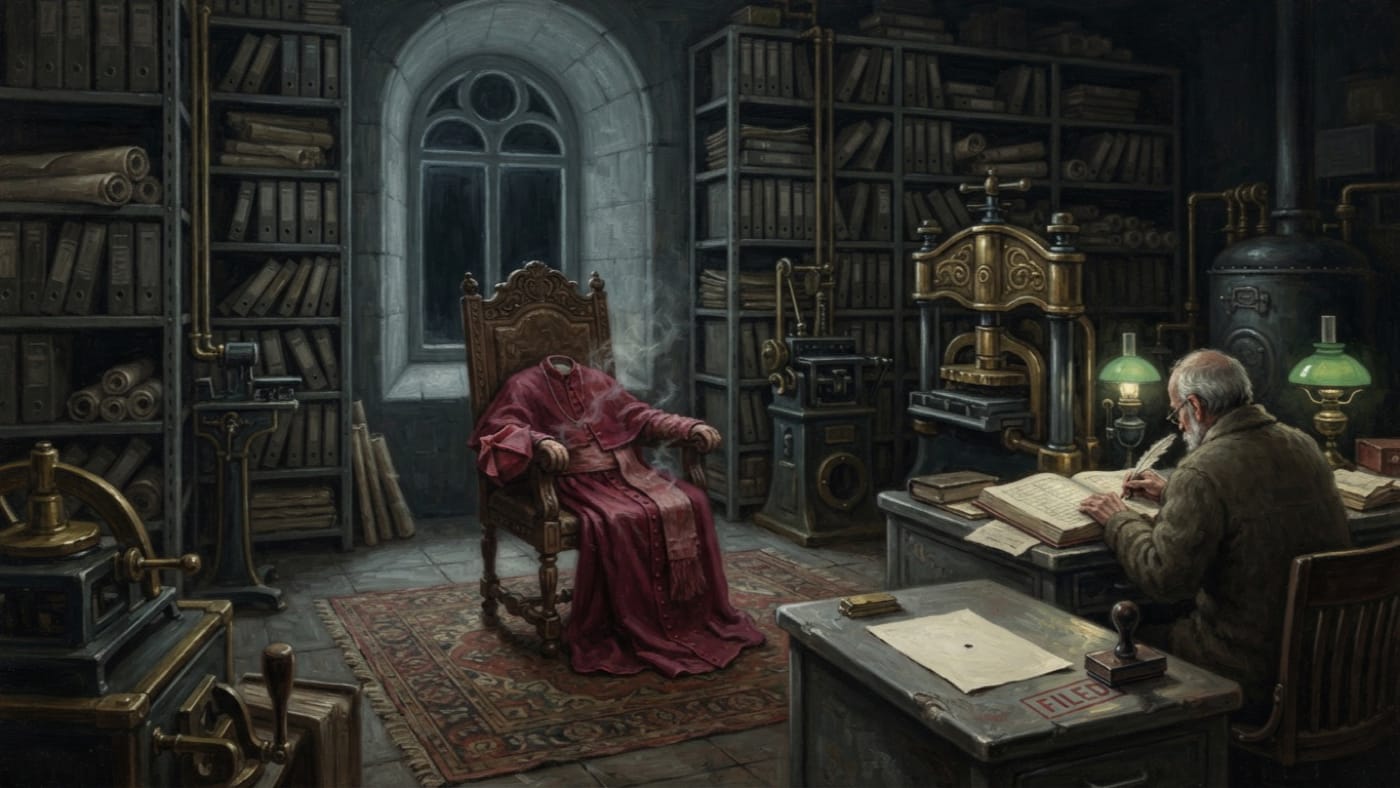
The surviving material says this much. A high cardinal was absent from his chair. His cassock was reportedly on that chair, and was reportedly warm. Those two reportedlys carry the whole affair. The report appears in The Council of Veils and again in The Hierarchy of the Synod. Neither gives the cardinal's name, where his body went, how it went or whether anyone found it afterwards. The name of the affair has survived intact, and every other part of it has gone.
A named affair is a convenience of the archive. An explained affair is a different thing entirely, and this one remains unexplained.
#On the Chair and the Cassock
"Count the objects. Then count the persons. Note the difference."
The inventory runs as follows. There was one chair, its make, chamber and city unrecorded. There was one cassock, of a rank high enough to be called a cardinal's. There was one quality of warmth, which no named witness reports. The owner was missing.
This chair is a different chair from the Seat of War, and I record that plainly because the mistake is tempting. The holder of the Seal of War has not appeared in public session since A.S. 107. That chair stands draped in white, and the Bureau of Records lists its occupant as engaged in contemplative duties. The Empty Throne Affair shares the word throne with that older vacancy and sits next to it in the rumour-books, so the two are discussed together. Nothing in the surviving accounts makes the missing cardinal the Hierarch of War, and nothing dates his absence to 107. Each case concerns its own empty chair.
One version of the story has the absence discovered mid-sermon. It names no preacher, no congregation and no sexton who first saw the vacant seat. I give the sermon exactly as that version gives it, as a bare circumstance. I have not furnished it with a pulpit, a gasp or a fainting deacon, because the account itself furnishes none.
The warmth is the detail everyone repeats and nobody can measure. No account records a hand laid on the cloth, how long the cloth had lain there or whose palm judged it. It lasts in the retelling because it is the one detail that makes the affair alarming. Without it the story would be a cardinal who left his robes behind, which happens. With it, the cloth seems to suggest that he had only just gone, and the accounts never say where.
#On the Punctured Minute
The second version brings in the Council. It holds that the Veils, if they exist and if they minute anything at all, recorded the relevant session on a single clean sheet pierced once through its centre. Records then stamped that sheet FILED.
That report contains three separate things, and careless readers run them together. The first is the object: a clean page with one hole in the middle. The second is the authorship. The attribution to the Veils comes from the account, and the page makes no such claim, since it bears no signature, seal or letter. The third is the act: a Records stamp, reportedly applied. Of the three, only the stamp belongs to an office I can name, house and audit.
A pinprick conveys no command. The hole can be read as an order, a sentence, a receipt or a clerk testing a nib, and the paper fits every one of those readings without confirming any. Ink would have offered a hand to compare. A seal would have offered wax to match against the die. A hole offers only the paper around it.
The Council's standing is conditional. Both parent articles grant it that much and no more. It is said to keep minutes in ash on self-emptying censers and in smoke on cistern water beneath Strasbourg. Those are traditions, passed along by attribution and never produced for inspection. The punctured sheet belongs among the same claims. It shows no power, no order and no hand moving across a chamber to take a man out of his robes. What it shows is a hole.
#On Clerical Reassignment
The sermon version supplies an official description for the absence: clerical reassignment.
I admire the phrase the way a locksmith admires a door with no keyhole. It treats the absence as a change of posting and the missing man as a transfer still in progress. It allows the chair to be empty without becoming a scandal, and the cassock to be warm without becoming evidence. With those two words an office can enter a disappearance in its books as a personnel matter, which is far easier to file.
The phrase is all the version contains. It names no receiving parish and no order of transfer. It produces no successor, no letter of appointment and no countersignature from the officer who supposedly sent the cardinal somewhere. Ordinary reassignments leave all of those papers behind. I have handled thousands, and every one came with enough correspondence to cover a refectory table. This one came with nothing.
So the description shows that an office spoke. It does not show that the cardinal moved. The surviving record holds an official explanation, and I have not found a single document that the explanation rests on.
The version does not say which office spoke beyond calling it the Bureau. I will not choose one of the Holy Bureaus to blame on the basis of the wording. The Bureau of Shadows would be the easy choice and is usually guilty of something, but this survey runs on paper, not appetite.
#On Accounts That Refuse Agreement
"Two witnesses who agree are a conspiracy. Two who disagree are an archive."
There are two versions, and I keep them on separate leaves.
The first places the discovery during a sermon and supplies the reassignment wording. The second places the absence in a session, connects it to the Veils and supplies the punctured sheet and its Records stamp. The surviving material does not establish whether the sermon and the session were the same occasion, the same room or even the same day. Merging them would produce a richer story, and I would have written that story myself. Writing it now would be counterfeiting.
The Council article admits that its account survives in several incompatible forms. It adds that there was no blood, no struggle and no farewell note. I report those details as part of that account's telling. They are not the results of any examination, because no examination is recorded.
In an earlier entry I described the cardinal's body as irreversibly absent. That word was a flourish. The surviving accounts do not settle whether he died, fled, was taken or is merely late. Fine prose does not make a man dead, so I leave his fate open.
The sermon version also records a rumour of a hidden Virtue General behind the vacancy. The Synod declares the Virtue Generals myths spread by heretics. The rumour names no General, describes no intervention and offers nothing in this matter beyond the mumbling of whoever repeated it.
The surviving correction to Council terminology also exists in more than one form:
Council of Veils smoke minutes
Replace all references to "Council of Veils" with "High Censor's Advisory." Strike mention of smoke minutes. Friction is fuel.
The instruction does not govern this affair's accounts, which still name the Council openly. What it shows is how carefully the Church manages the name, which matters more to it than the thing the name might describe. Older Purity lore links the Veils to the High Censor's mask. The correction would make that link the official one, and in doing so it confirms nothing.
#On the Present Filing
As of A.S. 201 the position stands as follows. The affair is named and reported. A cardinal's chair was found empty with his cassock reportedly warm upon it. One version records the official description clerical reassignment. Another records a clean sheet with a single central puncture, attributed to a Council whose existence is conditional and stamped FILED by Records. The cardinal's identity, the year, the place, the mechanism and his fate are all unknown. The two versions do not agree, and this survey has not made them agree.
The chair has presumably been sat in since. The cassock has presumably been laundered, worn or burned. I have no records of either, so the matter stays where Records left it.