
#On the Lower Post
Emergency Lateral Release Pattern 3-C is the Bureau of War's name for a knot that gate-workers already knew by another name. The name also covers the small piece of geometry the knot allows. When a lane has stalled and the crowd behind it has begun to lean, the rope at the lower post is made to give sideways, and the pressure goes with it.
That is the whole of the doctrine. Everything else is administration.
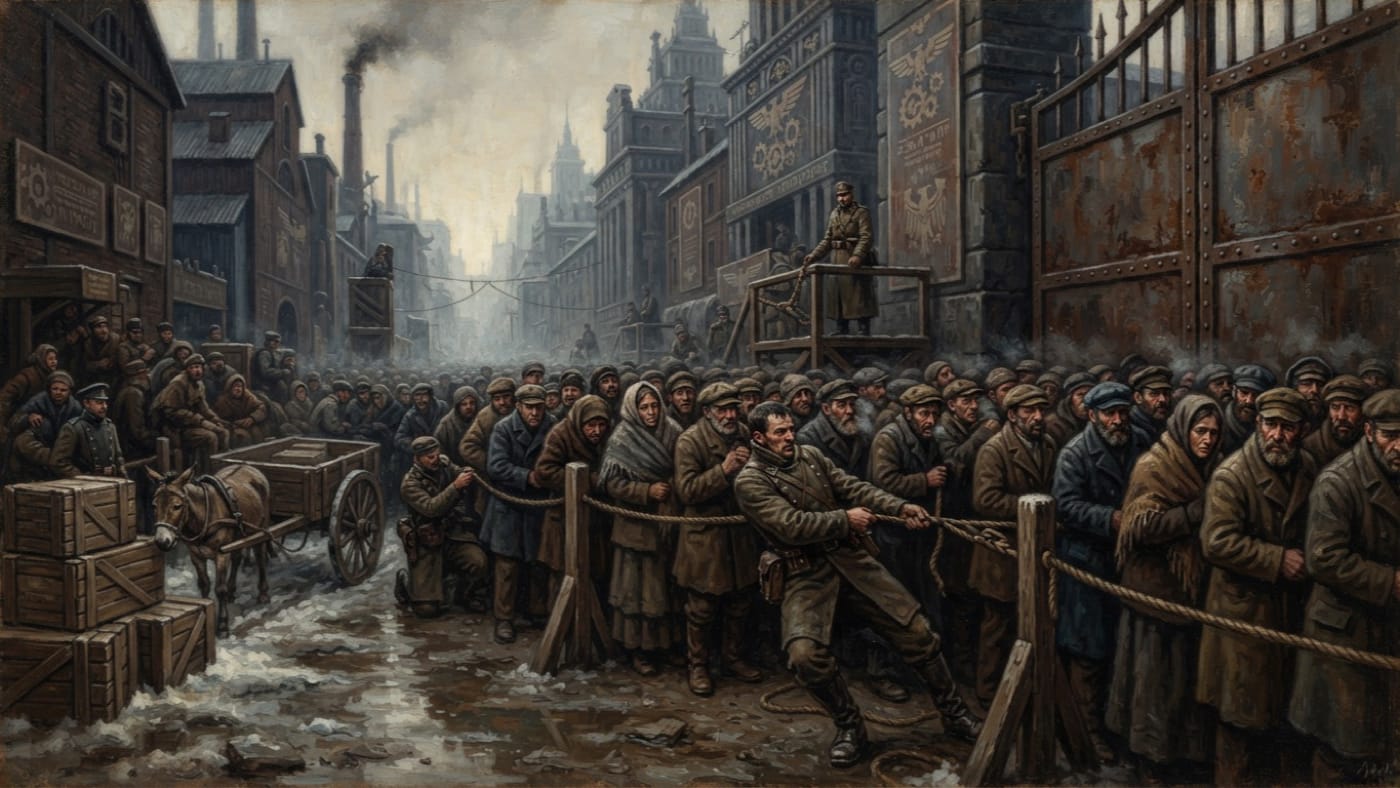
A stalled gate is a simple machine. Hunger at the back pushes. Iron at the front refuses. The forward rank is pressed between them by everyone who cannot see why the line has stopped, until breath is a negotiated quantity. Pattern 3-C does nothing to the gate. It lifts no bar, verifies no stamp and grants no passage. It gives the press a side lane to fall into. A crowd that is moving, even a few feet in the wrong direction, stops behaving like a ram.
The ledger cares about this distinction. Decompression is a physical mercy, and passage is a legal one. The Rope Tender who releases a lane has authorised nobody to enter anything. He has only excused the front rank from dying while the Queue-Marshal looks for his seal.
#On the Name Retained in the Mud
The knot is older than its number. Before the Rope Reforms of A.S. 118 gave it a designation, Marshals called it the Ravel knot, or Ravel's mercy. The name honours Ravel of the Rope, a Rope Tender whose existence rests on rope-shed testimony, one drinking song, and the stubbornness of men who outrank no one.
The telling runs thus. A forward gate, unnamed. A lane stalled on the third day of waiting. A lower post compromised and its ropes snapped. Ravel joined the broken ends, drew the lower lane into a side-loop and turned the surge into an empty cart-run. In the telling, three hundred people moved twelve feet sideways and lived. A stone found his temple afterward. The knot, the telling insists, held until dusk.
I record the figures because the Marshals recite them. I attribute them to the Marshals because no measuring rod was present. Three hundred is the number a crowd becomes when it is remembered. Twelve feet is the width of a cart-run in the mind of a man who once stood beside one.
The gate is uncertified, and so is the year. The hand that threw the stone is also uncertified, and doctrine forbids any accusation concerning it. The third day of waiting has tempted wayhouse historians to fold Ravel into the Three-Day Crush. A shared number does not make a shared event, and the Bureau of Hagiography would like the pamphleteers to stop.
Ravel's patronage is unratified. He is tolerated as an occupational emblem and suspected as a miracle cult. The Bureau adopted his knot and declined to adopt him, and nobody in Strasbourg regards the two decisions as being in any tension whatever.
#On the Release
The procedure has four parties: a loaded rope, a post that can no longer be trusted, an opening at the side, and somewhere for the opened lane to go. Remove any one of them and the knot is decoration.
The rope is loaded because the crowd is already leaning on it. A lane-rope under true pressure sings, and any Rope Tender will tell you the note rises before the post goes. The post is compromised because posts are wood, wood is wet, and the ground at a forward gate is half mud and half the dropped contents of other people's carts. The Ravel knot holds under that push. It can also be released from the side, so the rope gives way laterally and the pressed rank spills outward instead of forward into the gate-mouth. The Reform language says the knot may be cut loose. It does not say whether every form demands a blade, or whether an old hand can work some versions free with burned palms alone. I will not improve upon its silence with invented turns.
Officials forget the receiving space. Ravel's legend gives him an empty cart-run. Fill that run and the release only moves the crush a few feet to the left, where it meets a wagon and resumes its work. A side lane blocked by ration crates, stacked fencing or a sergeant's personal mule is a wall with a hopeful name. The knot redirects pressure. It cannot manufacture room.
War's Reform insert lists the knot's applications: crowd compression, wagon shear, post failure and contested ration surge. Each has its sound. Compression is wet wool and shallow breathing. Wagon shear is an axle grinding against a lane-post while someone beneath it stops screaming. Post failure is a crack, a lurch, and the rope suddenly too long. A ration surge is a rumour of grain, or bread, or a second cart, travelling backward through the crowd faster than any whistle travels forward. The Tender hears all four through his hands before the Marshal hears them through his ears. Then comes chalk on the post, a hooked pole reaching for the nearest cart without its bearer stepping into the press, and the release.
#On the Measured Cord
The Reforms placed Pattern 3-C inside a larger arithmetic. War specified cordage, lane widths, release intervals and stack geometry, and the Bureau of Records inspected the result. Reform cord carries a tarred hemp core, a red oath-thread, a black audit-thread and a waxed end-knot bearing the mark of its issuing depot.
The end-knot is a label. Inspectors confuse it with the working knot more often than their pensions would suggest. The depot mark tells you where a rope came from. The Ravel knot tells you whether the lane will live. A gate can keep the first in perfect order while failing the second entirely.
The Reforms produced a predictable market in appearances. Authentic end-knots were sewn onto inferior rope. Cord was measured dry and issued to gates where it rained. At one northern checkpoint, audit-thread was painted onto mule trace and survived three inspections before a crowd removed the paint. No release pattern, however correctly tied, survives being tied into a counterfeit. A Pattern 3-C worked into soft rope is a prayer with a depot mark on it.
Stack geometry decides where the release can go. The diagrams nailed in gatehouses from Metz to the switchback lanes of Rheinscarp show holding blocks, pulse lanes and release mouths. Read with a Tender's eye, they also show which lanes have a side to fall into. Others have only a drop, a wall, or another lane already full.
#On Instruction and Field Accommodation
Pattern 3-C is mandatory instruction. Every Rope Tender learns it, often before learning the full gate creed. Lane Sergeants insist they teach only the manual form, then check their students' hands. Queue-Marshals who have lived through a night surge tie it blind, which the manual neither requires nor forbids.
The ordinary shift absorbs it. Knots are checked at intake, ropes re-laid and stakes counted. The first lane post is touched, and the word "Hold" is said under the breath. None of this is law specific to the Pattern. It is the general hygiene of the Corps, and the release knot sits inside it as a psalm sits inside a vigil: required, rehearsed, and seldom noticed until the night it is needed.
Judgement cannot be issued from a depot. The manual tells a Tender what the knot is for. It cannot tell him when the lean of a crowd has crossed from impatience into danger, or whether the cart-run is truly clear. Nor can it tell him whether the sergeant shouting "hold" understands what he is asking the front rank to pay. The Corps calls its veterans "iron knot" and its novices "soft rope." The slang is more precise than the syllabus.
Local variation persists. The Reforms admitted as much under the term field accommodation. Old Marshals have been found in rope sheds at dawn, retying the manual form into older ones. Fence lanes and barricade mazes along the Queue Road teach the knot one way, and a scarpside toll-stair teaches it another. War tolerates this so long as the release still works and the reports still say 3-C.
Bureau of War instructional sheets once credited Pattern 3-C to "spontaneous best practice arising from collective field wisdom."
Corrected after three Marshals chalked RAVEL across the diagram during an inspection. The sheet now reads "field attribution disputed." The Bureau files the change as a clarification.
#On the Present Holding
At this survey of A.S. 201, Pattern 3-C remains mandatory instruction at the forward gates. Its common name is discouraged in formal reports and universal in speech. Rope-shed images of Ravel are tolerated as morale decoration, and candles lit before them are booked as maintenance wax. The attribution remains disputed. The Bureau of War owns the knot, and nobody owns the dead Tender.
I find the arrangement sound. I also find it contemptible, and the ledger has room for both columns. The knot keeps front ranks breathing. A Synod whose engineering annexes still offer the volley line as the alternative to lateral slack has no standing to object when the man who supplied the slack is honoured with thin beer.
The gate still opens when the stamp allows. The knot decides how many arrive alive to meet it.