
#On the Harbor Gate
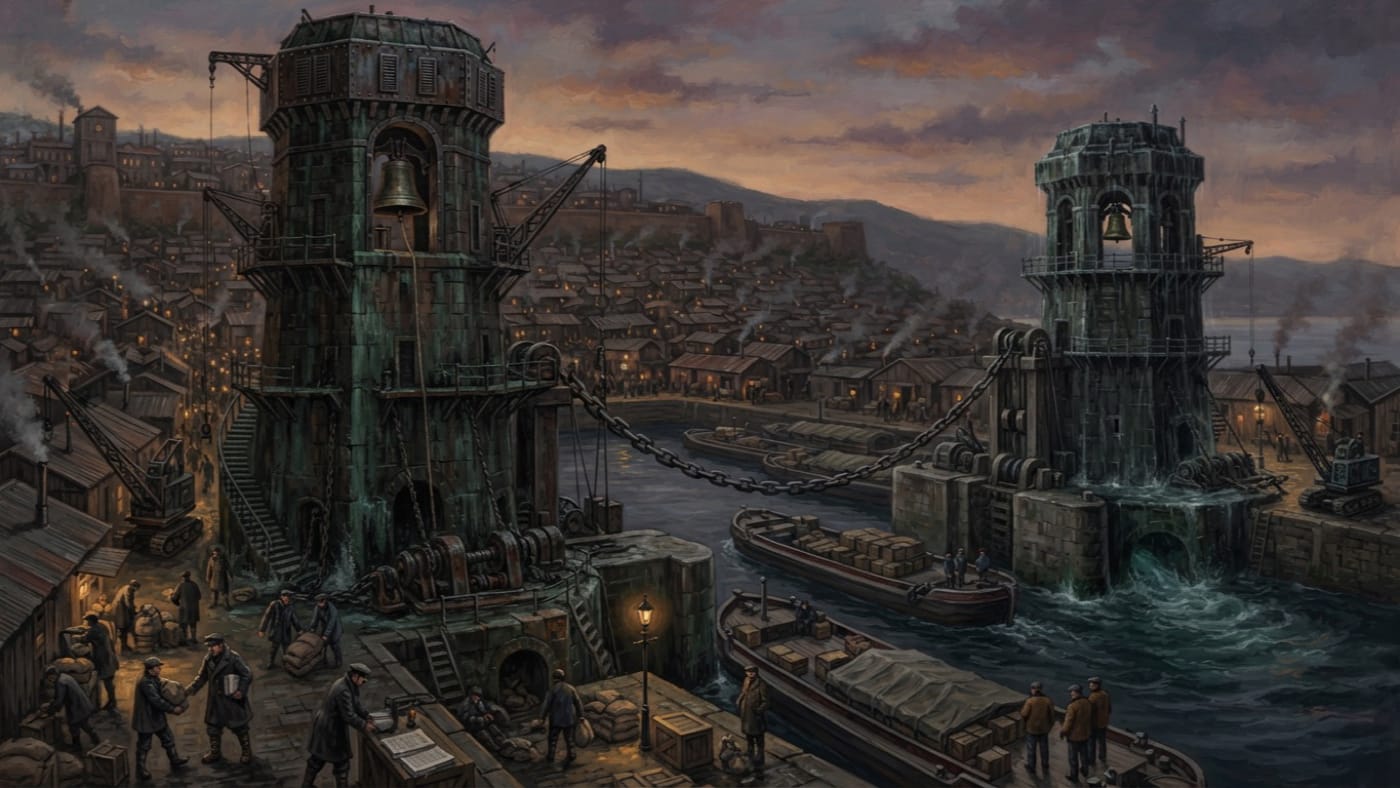
Two towers hold the mouth of Thessaloniki's Aegean inlet, and between them hang the reliquary chains that turn a harbour into a gate. The Elder Tower keeps the western headland and the primary chain-head. The Younger Tower answers from across the water and holds the secondary chain. Pilgrims who see the pair at dusk think of sentries. Sailors think of jaws. Records thinks of a turnstile with theology attached, and for once Records is closest.
The installation is a supply hinge. It is no bastion of the Sagittal Line, whatever dockside preachers claim on feast days. Constantinople anchors the southern Line. Thessaloniki feeds it, filters it, and keeps the sea out of Europa's belly. Grain, lamp oil, medicine, munitions and replacement soldiers pass beneath the chains on their way to the Sister Trenches, and nothing passes without permission rung from bronze.
Which tower rose first is a question the Chainwrights answer by spitting and Records answers by mislaying the folio. I decline to settle it in print. The names describe the order in which the towers speak, and in Thessaloniki the order of speech has always mattered more than birthdays.
#On Stone, Chain, and Permission
The Elder is the heavier presence. Its upper galleries are streaked green-black where salt has worked into bronze fittings, its outer catwalks have killed men who leaned to look at the water, and its crown-chamber holds strike authority. Below that chamber the tower descends into chain vaults, choir cellars, tide chambers, rope-law sheds and maintenance hollows. The visible stone is the polite part of the building. Everything below it is iron and ache.
The Younger is wetter and stranger. Its stone never quite dries. Strike a spanner against a collar plate on the lower landing and the tower answers from somewhere above you, late and slightly flat. Undertow pulls at its base hard enough that divers rope themselves twice before inspection. Within its walls is a small room the harbour calls the refugee-tongue memorial. Officials do not enter it during processions, and their reasons are sound ones.
Maintenance and ringing are separate offices, and the harbour survives because neither respects the other. The Custodians of the Chain keep the links, windlasses, forge piers and inspection ladders under Chainmaster Superior Kosta, whose hands look as if they lost an argument with a capstan, and under Diver-Matron Sera, who goes down where dry offices would rather not imagine. The bell-wardens, Andros Pell in the Elder and Katerin Liss in the Younger, pull the ropes. A warden can ring the harbour open. Whether the chain will let ships through is a Chainwright's word.
Bell order sets the docking and departure windows, the curfew and every lawful movement on the quays. Between peals the Harbor Ledger Office sells windows, stamps manifests, and tells every captain the minute at which his passage becomes legal. Under the chains, every crew must keep the Passage Psalm audible, even if the only voice left is a frightened cabin boy's. A ship that passes in silence has broken the law and taken a risk with the water, in that order of seriousness, according to the harbour tribunal.
The harbour charter was ratified in A.S. 72, with chain-consecration works that took nine days of rite and four drowned divers. The charter was later assigned A.S. 66 for precedent, which is the Church's polite name for forgery with incense, and re-ratified in A.S. 93. None of this dates a single chamber, bell or bolt. I mention it so that nobody else will try to.
#On the Rooms That Depend upon the Bells
The bells serve a second congregation that no job description names.
Against the city wall beneath Bellhouse Heights lie the Refugee Sheds: plank rows, tarred roofs and stove pipes, sheltering people the harbour delivered and never filed. Bellhouse Heights administers the peals and lodges the choirs. It does not house the great bells. The Sheds lie below the clerks who schedule the sound and well within range of the towers that make it.
In A.S. 145, refugee children sleeping beneath the tower stone sang through the night, and by dawn their tongues had dissolved into salt water. The ledger entered them as Port Loss (Clerical). The survivors of that Crying Choir are grey now. Their households, and children born long after, learned what the Bureaus classified later: a low, rough, shared drone keeps sleep from sliding toward the tide. The Sheds hold it by bell-time through the dark. Remove the bells and the hum has nothing to keep time by.
The Sheds' authority after dark is Aunt Velka, who holds no office, draws no stipend, and commands more night discipline than several men with seals. I will not repeat her dossier here. It is enough to record that the harbour's most fragile dependency on the towers was guarded by a woman nobody had appointed.
#On the Six Missed Peals
At dusk on 14 Ashmonth, A.S. 198, Liss struck the Younger and Pell struck the Elder. Both clappers met bronze. Both wardens felt the blow travel through rope, arm and jaw. The air carried no sound at all.
The Silence of Thessaloniki held for seventy-two hours. Six peals failed. Docking queues froze in the roads because no captain would pass under links that no bell had sounded. Crews at anchor sang the Passage Psalm for passages they were not permitted to make. The Ledger Office issued provisional legality on wet paper and backed it with nothing. The windlasses stood idle while the city argued over who had the authority to declare the hour.
Below the water, Sera put her palm to the submerged links and found them vibrating in the correct bell sequence, peal by peal, on schedule, while the towers above gave nothing. Her finding is attested and sworn. I have read it twice. Its meaning I leave to the Bureau that has been assigned it.
In the Sheds, the hum lost its timekeeping. Velka took three pot lids and a spoon, beat out a measure, and divided the night into throat-shifts: old women first, dock-lunged men second, frightened children between the singers to count breaths. The rows held through the first night and frayed on the second. On the third, witnesses report a note below the hum that made the stove flames lean toward the wall. Velka changed the rotation and did not name it. All three children who reached the shallows before dawn lived.
This plate's first fair copy credited the Shed response during the Silence to "harbour emergency measures under Bureau direction."
Corrected. No Bureau directed it. Aunt Velka organized the throat-shifts, Quarantine staff resisted them, and the harbour summaries praised them later in terms broad enough to take the credit without accepting any liability. The draft sentence was mine. I have had it burned.
The ringing returned on the fourth dawn, and the voices were exchanged. The Elder gave the Younger's note and the Younger gave the Elder's. Bell examiners checked metal, clapper, rope and chamber and found all of it within tolerance. The sound had moved and the bronze had stayed where it was.
I helped draft that sentence and remain proud of it. It names a test without naming the examiner. It confesses ignorance in a register that sounds like jurisdiction. The sailors read it differently. They say the chains hum psalms as ships pass, and that every hum is the Drowned Choir taking a new name. The Bureau records that this is what sailors say.
#On the Present Voices
As of A.S. 201 the towers work. Each rings the other's note, the harbour opens and seals, and the windows are sold. Records has printed tonal-reassignment forms so that each docket can note which bell gave which note at which hour. Captains sign them without reading them, which is how every form in Thessaloniki is signed.
Draft caption for this plate: "Both towers restored to service after the Silence."
Corrected. Service was restored. The original voices were not, and they have not returned since. The caption has been struck because a careless reader would take it to mean the bells were mended.
Each 14 Ashmonth since A.S. 199, the city keeps the Night of Quiet Bells. Taverns pour without argument. Dockhands point instead of cursing. No decree I have found created the observance; it got out before anyone could license it. The Sheds alone keep sounding, because the Choir keeps no anniversaries. The quiet city and the humming wall share one night, and neither interferes with the other.
Since A.S. 199 the Sheds' children have produced a second line beneath the drone. No choir-master taught it, and Orison cannot transcribe it without symbols the hymnal does not permit. Sera says the chain-hum recognizes it. Kosta listens and says nothing, which is his customary form of testimony.
Strasbourg's external audit is pending. It will ask whether the exchanged tones are doctrinally supervised and whether the Shed hum counts as a rite. It will receive tea in chipped cups and minutes in damp ink, and it will find the roof dripping exactly where the auditors are seated.
#Disposition
The Elder and Younger Towers stay in service as one installation. Each tower carries the other's voice, and the chain below them is attested to have kept the schedule when both bells failed. The ships depend on them, and so do the Sheds, though no budget lists the second dependency. Nobody in this harbour has petitioned to retune the bells. Nobody wants to discover what answers if the old notes return.