
#On the Northern Towers
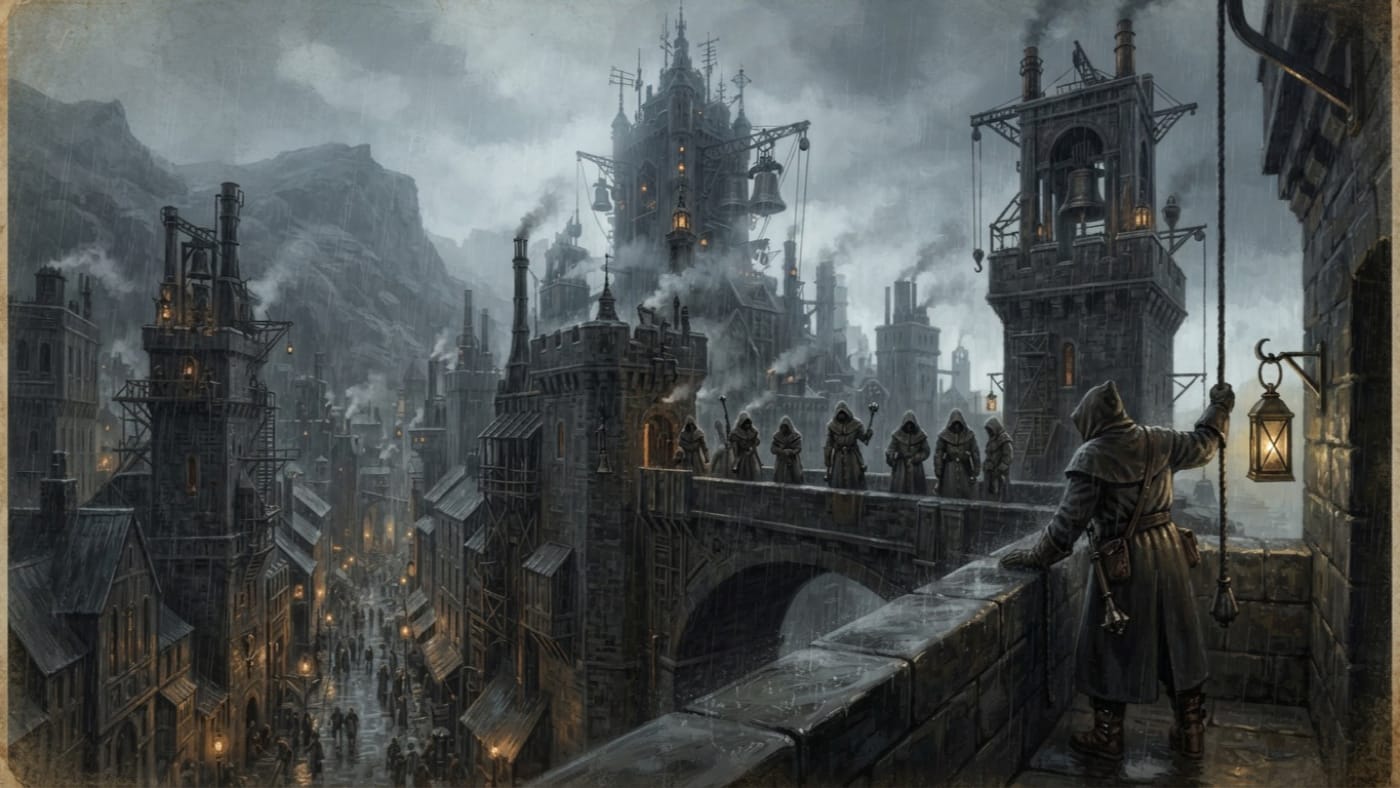
Edinburgh is a city of the British Crown, lying far to the north of anything Strasbourg administers. The Church on the continent knows it mainly as a set of towers. The towers are stone. The stone is wet. Men with maces live inside it.
That is very nearly the whole of the Synod's acquaintance. Our registers hold detailed surveys of cities we have never been permitted to enter, compiled from pilgrims' gossip and the depositions of drunk pilots, and the registers are wrong about all of them with great precision. Edinburgh has been spared even that indignity. Its entry would fit on the back of a requisition slip, with room left over for the refusal.
What can be stated is this. The Lantern-Ringers serve Edinburgh's wet stone towers under the same vow that binds their brothers at Dover and Canterbury, and the faith of the Lantern Way counts the city among those that answer. The British put it in a single line, which they recite as though it explained itself: Canterbury answers Dover, Plymouth answers the western water, Edinburgh answers the northern stones. I have turned that sentence over on my desk for some time. It does not say what the northern stones asked.
The city holds no claim to rival Canterbury. The Crown sits there with King-Warden Aldric III, the Archbishop and the Table of Nine. The Ringers' mother-house is there, and the pilgrims cross the Channel to kneel there and nowhere else. Edinburgh is a northern parish-city of the same realm, keeping the same hours under its own rain. Strasbourg occasionally dreams of a second British court that it might play against the first. The dream has no address.
#On the City Beneath the Bells
The great cities of Britain were long ago pared down to cloisters, citadels and shrines. The British have not troubled to tell us when this happened or how violently. Monks march beside Wardens. Abbots sit in council with governors. Every town is a garrison and every garrison a chapel. Edinburgh is a British city, so the description applies to it as surely as the rain does, and with the same want of particulars. I cannot tell the reader which of its streets survived the paring and which were folded into a cloister wall. I can tell the reader what governs them.
The bell governs them. In a Synod city the hour is a regulated commodity: the Bureau of Bells sets the cadence, the parish rings it, and an auditor arrives later to confirm that the parish rang what it was told. In a British parish the tower rings and the parish does what the tower says, whether the bell calls prayer, labour, watch-change, a fast, an alarm, a burial or a summons. A Warden may hear a petition in the morning, set a penance by noon and muster the watch before Vespers, and bronze in the stone announces every one of those acts. The arrangement requires no form at any stage. It requires a rope at every stage.
Picture it as the evidence permits. A tower stair is worn hollow in the middle and is too narrow for two men to pass without one yielding. A rope has gone dark with handling and northern damp. A lantern hangs on a hook at the turn of the stair and is lit for the watch. The door at the base is barred from inside. Now picture a parish built around that door. The Bureau's draughtsmen would add gargoyles. The British would add a guard.
#On the Ringers and Their Charge
Each Ringer is bound to a particular bell. The binding is sworn, entered in the record and cut into the palm, then renewed at the great feasts of the Lantern Way. A Warden may move a Ringer between towers, but the bell remains the centre of the vocation. When an Edinburgh bell was cast, a measure of its bronze was held back before consecration and made into a mace. That mace now hangs at the belt of whoever answers for the bell. The weapon is short because a tower stair leaves no room for a long one. The British have never seen why theology should argue with masonry.
The duties are the same everywhere in the order: ring the hours, ring the alarms, toll the dead and keep the parish. The last is the duty that brings Edinburgh's citizens to their Ringers most often, and that they remember longest. A Ringer stands beside the Warden at judgment and pulls the fast-bell when food is denied. He keeps the stair against anyone who would interfere with the appointed peal, and the order's law lets him kill such a person on the steps. Children in a British parish are taught to bow to the wool cloak. Drunks are taught to avoid the stair. Both lessons take.
I do not know which of the order's service classes the Edinburgh towers keep. The Ringers train for seven years for ordinary tower service, nine for cathedral carillons and twelve for sea-bell posts and chapel ships. Nobody in Strasbourg has been told which grade the north requires, and I decline to guess. Any guess entered in this Codex becomes a citation within a decade, a doctrine within two and the grounds for someone's arrest within three. The order's own article gives the fuller account of their formation and discipline, with the bloodstains properly catalogued.
#On Severity and Foreign Classification
Edinburgh lives inside a severe faith. The Lantern Way imposes fasts that run for months and practises armed penance. Under certain sentences it bricks dissenters alive into monastery walls. The Synod burns its own dissenters, yet it has publicly called the walling irregular while privately admiring the mortar. These are national customs. The Bureau holds no record of an Edinburgh wall, an Edinburgh sentence or an Edinburgh name sealed behind brick, and I will not manufacture one to liven the page. Anyone who wants horror may consult the Canterbury annexes.
Until A.S. 199 our registers listed the whole of that faith, Edinburgh's towers included, as Schismatic Heresy, Category Two. The Bureau of War then reminded everyone that British Cathedral Ships escort the grain, the pilgrims and the Channel convoys, and that a heretic is an awkward party to ask for flour. The Bureau of Doctrine revised the file to Non-Standard Observance, Diplomatically Accommodated. Nothing moved in Edinburgh. On the morning after the revision its towers rang the same hours as on the morning before. The change took place entirely in Strasbourg, where the Synod keeps most of its changes.
This file assigns the towers of Edinburgh to the observance of Schismatic Heresy, Category Two.
Superseded by the Bureau of Doctrine's revision of A.S. 199. The towers now ring a Non-Standard Observance, Diplomatically Accommodated. Nobody consulted the bells, and they have not altered their pitch. The accommodation is ours. The observance is theirs. Correct your copies.
Every Synod opinion about the city is in the same position. Strasbourg may classify Edinburgh's faith as it pleases, revise the classification when the convoys demand it and seal the revision in red wax. It cannot send a single auditor up a single Edinburgh stair. Lord-Warden Eccleston represents the Crown in Strasbourg and receives our notices with the stillness of a man watching a dog bark at a ship. Legate-Prior Mertens writes to us from Canterbury. Neither has filed a line about Edinburgh. I suspect neither has been asked, because asking would oblige the Bureau to admit how far north its ignorance extends.
#On the Present Condition
As of A.S. 201, Edinburgh's wet stone towers are still manned and their bells are still in service. Their Ringers still carry bronze cut from the metal they ring. The realm they serve remains independent: outside the Synod's reach and inside its convoy schedules. The Lantern Way remains accommodated.
The Bureau of Bells has asked the Crown seven times for British tuning specifications and has received seven courteous refusals. None was addressed from Edinburgh, and every one applies to it. The northern towers keep their pitch. Strasbourg keeps its curiosity. The rain, so far as anyone can determine, keeps everything.
Edinburgh answers the northern stones. Strasbourg, as usual, is not among the correspondents.