
#On the Recorded Term
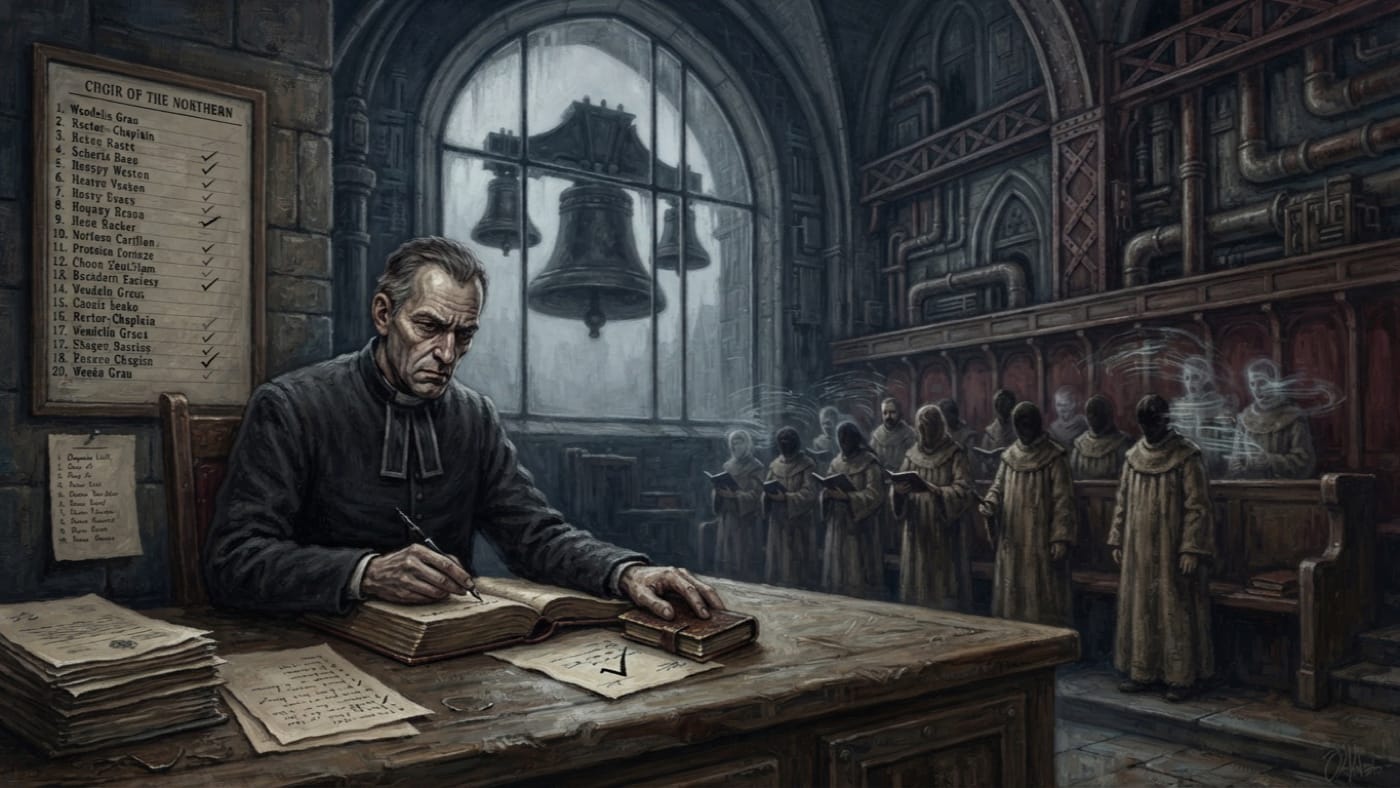
This is a survey of echo-sickness as it stands in A.S. 201, which is 1911 CE for readers who count from the wrong wound. It covers one word, one formation and one priest. The word is echo-sickness. The formation is the Choir of the Northern Standard at Bastion-Königsberg, the Baltic nail at the northern end of the Sagittal Line. The priest is Rector-Chaplain Wendelin Grau, who keeps the list.
The reader who came for a disease will be disappointed. Good. Disappointment is the first sacrament of honest filing. The record holds a label attached to a decision: a singer is removed from rotation, and the reason entered against the name is echo-sickness. The attested material does not say who first wrote the word, in what year or at whose desk. It also does not say how a choirmaster, physician or chaplain decides that a voice has earned it. The term has no recorded founding. It has a use.
I have seen better-born words do less work.
#On the Choir's Working Sound
The Choir was established in A.S. 188. That was two years after Grau took the rectorate and two years before the Bureau's first formal hostile assessment of the Grey, which presses on Königsberg from the northeast. Twenty voices serve in continuous rotation, twelve hours on and twelve off. The Bureau of Bells calibrates their hymn cycles and the Bureau of Doctrine approves them. They are sung in the Cathedral Close beside the Northern Carillon, forty-one bells of Prussian gun-bronze that the garrison logs, without affection, for answering wrongly.
The Grey sings back into that schedule. The Königsberg accounts describe returned hymns that match the Choir in note, word and timbre. They also record two occasions when a melody came back before the Choir had sung it. The Bureau filed those two under anticipatory acoustic resonance, mechanism undetermined. Grau's own testimony, sealed in his dossier, holds that the Grey knows hymns not yet written. That is his testimony. It is not this survey's finding.
This distinction outranks the shiver. An acoustic event reported around a choir is a fact about the workplace. It is not a criterion for picking a sick singer out of a stall. The record nowhere says that a singer removed for echo-sickness heard the returned hymn differently from the neighbour who stayed. It says the room is answered. It says some singers leave the rota. The Bureau would like the second sentence to follow from the first, because a cause is cheaper to file than a gap. I decline the economy.
#On Removal from Rotation
Removal is the one act the label reliably records. A singer is taken off the active rota of twenty, and the reason entered is echo-sickness. After that the record thins like Baltic light at Vespers.
The record does not say who authorises the removal. It could be Grau as overseer, a choirmaster, a garrison physician or a clerk of Bells. It also does not say whether every removal follows the same path. It records no examination, no test, no ward and no lock. On the record, a removed singer is not confined, condemned or contaminated. The label carries no Purity finding, and I will not lend it one. The record also promises no return. Some singers may have gone back to the stalls. The list does not say so, and silence on that point proves nothing either way.
The record does say that removal is followed by transfer. Some transfers stay inside the bastion's walls and some go beyond them.
#On the List and the Unanswered Letter
The whole of the attested practice follows. I set it down plainly because it needs no ornament.
Grau keeps a list of singers removed from rotation for echo-sickness. If a singer remains within the bastion after transfer, he visits them. If the singer has been sent beyond it, he writes once. If no answer returns, he enters a black tick beside the name and says the Office for Those Whose Voices Are Missing.
That is four acts and a prayer: list, visit, letter, tick, office. The rota requires none of them. It requires twenty voices and is satisfied the moment the twentieth stall is filled. For the purposes of Bells, a removed singer is a vacancy that has been corrected. Grau's list keeps the vacancy's name.
The record gives one letter, which is a long way short of a correspondence. Discipline may explain the single letter. So may prudence, or the arithmetic of a priest with twenty voices to keep singing through the night watch. The record does not say which, and I will not invent his motives.
The careless will misread the black tick, so I read it for them. It marks a letter that did not come back. At Königsberg an unanswered letter can mean several things. The singer may be dead, or alive and unable to write, or alive and unwilling to. A courier may have been lost on the Northern Corridor. A clerk may have used the envelope to steady a table. The tick establishes neither death nor disappearance. It is no evidence that anything in the fog has taken a voice for its own. It records silence, and Grau, being a priest and no coroner, answers silence with an office.
I can give the reader that office's name and the fact that Grau says it. Its text, length and origin are not in the record before me. Neither is any Bureau licence for it. I will not compose them. The Bureau of Doctrine has composed enough.
The roster and the list do opposite work. The roster forgets on purpose, which is what rosters are for, and the list remembers on purpose. Grau allows his garrison to confess fear but forbids them to build doctrine out of it, and the list holds him to the same rule. It attends to the singer and certifies nothing about the cause.
#On the Limits of the Classification
The account this survey is authorised to use does not establish symptom criteria for echo-sickness. It does not establish a cause either. The returned hymns are reported in the same Close where the singers work, but working in the same building does not make one the cause of the other. The Grey's anticipations remain anticipations, filed under a mechanism the Bureau has formally declined to know.
An earlier Codex entry on the Choir of the Northern Standard gave echo-sickness a staged course of signs, a medical appendix and a prescribed silence.
Withdrawn for this survey. The attested record of the term shows removal from rotation and Grau's follow-up. It says nothing about how a case is recognised or treated. The entry's attrition figures fall with it.
The temptation is to borrow, and Bell-sickness is the obvious lender. It is a separately documented acoustic occupational condition, with offices quarrelling over jurisdiction and a reclassification after Shipka. It remains a separate file. No source before me makes echo-sickness its subtype, its northern dialect or its synonym. I will not dress Königsberg in the Bellwardens' clothes. The relationship is unproved.
The same caution covers Purity's Iron Choir, whose Brand-Singers hold pitch while confession is burned into flesh. Their throats are listed among bell-sickness's exposed professions. They too sing for a living in rooms that sometimes answer. Nothing in the record makes the Northern Standard into Brand-Singers or joins the two choirs by office, method or transfer. Nothing records echo-sickness in the Iron Choir. Two choirs whose rooms answer them share a profession. That does not make them share a disease.
#On the Present Record
As of A.S. 201 the survey holds four things. The term is in use at Königsberg. It is attached to removal from the Choir's rotation. Grau follows those who are removed, with a visit inside the walls and one letter beyond them. Some of those letters have gone unanswered, and those names carry a black tick and have the Office said over them.
Everything else stays outside the file. That includes the first case, the first writer, the signs, the cause, any cure and any kinship with bell-sickness. The Choir sings its twelve hours. The Grey returns what it returns. The rota is full.
The rota has no use for the list. Grau keeps it anyway.