
#On the Eastern Approaches
The Eastern Corridors have no charter. I searched for one as carefully as a man who expects to find his own name in the preamble. The archive gave me dust, two misfiled mule invoices and a bestiary. The phrase comes from the field. Quartermasters use it, Factors use it, and the Rot-Oxen dossier uses it for the country where the enemy's corpse-trains are commonly seen: the eastern approaches beyond Bastion-Sibiu, and the Galicia approaches toward Bastion-Przemyśl. These are two theatres, with separate mountains, separate generals and separate griefs. The Bureau groups them because the same beasts walk both, and a filing clerk will forgive any geography that saves a drawer.
The Sagittal Line runs north to south. The Church holds the ground to the west of it. The ground to the east is contested or worse. Every road east crosses that seam at a right angle, so every road east is also a quarrel over who may use it. Armies are fed by such quarrels. So is the enemy.
#On the Roads Beyond the Bastions
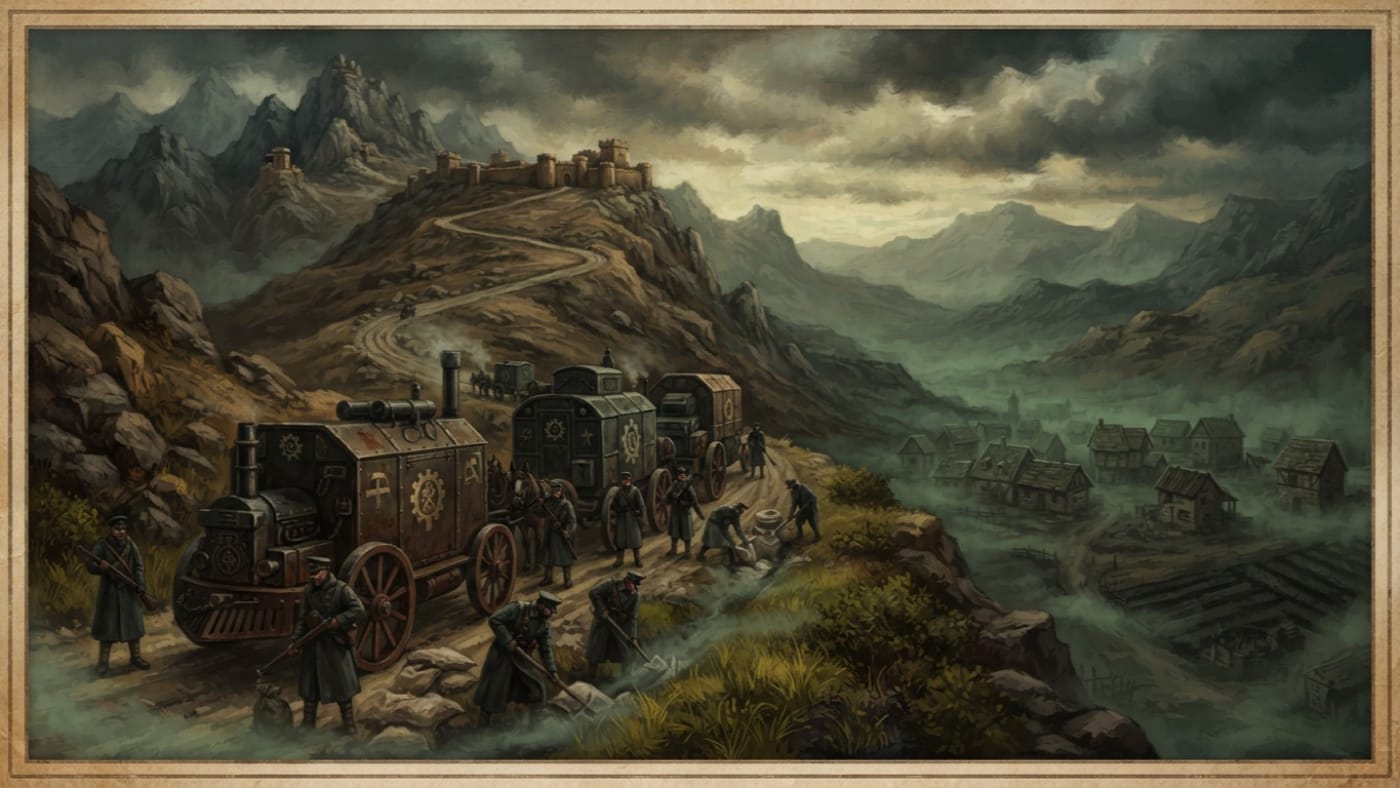
Galicia comes first, because it lies north and because it is worse for my knees. The approaches to Przemyśl climb out of the eastern lowlands into the western arc of the Carpathians. The country is ridge roads, saddle tracks and river cuts, with trench crossings laid across valley floors and villages placed where any sensible enemy would want to pass. Opposite the Wire Orchard sits Atheron, who crowns the high passes with spires and takes altitude as a personal compliment. His ridges overlook the approach. His pride does not haul freight. Something else does that.
Far to the south, the approaches beyond Sibiu press against the wall of the Transylvanian Alps. Turnu Roșu opens to the south, Bran to the north-east and Predeal to the east. I name them for orientation only. I do not certify a Rot-Ox under each of them, and any clerk who copies this paragraph into an incident register will answer for the entry. Beyond that wall Velmora works the gold-veins and buys convoys. The bastion stops more bribed carts than it repels charges.
The friendly side of the matter belongs to the Carpathian Corridor. It runs from the Budapest yards through the Bratislava approaches and the Turda ridge-gates, then makes the long climb to Przemyśl and Sibiu. Sibiu also draws supply from Przemyśl to the north and from the Danube crossings near Irongate to the south. That system has its own saints and its own lies. The Eastern Corridors lie in front of it. They are the ground beyond the gates where hostile traffic moves, and the ground just short of the gates where that traffic has left its residue across our own wheel-ruts.
There are three uses, then. The enemy's road carries corpse-freight and prepares the country for conquest. Our road feeds the bastions. Between them lies the contaminated approach, which belongs to neither side and kills for both.
#On What the Enemy Carries
A Shadow Court train moves in threes, sevens, nines or thirteens. The beasts drag bone-carriages packed with carrion rations, rusted arms and plague-cloth. That is the freight. The road itself is the second cargo.
The fog comes low and green-grey along the track and settles into every hollow the surveyors forgot. It dries the tongue. It yellows the barley and folds the stalks inward. It blackens bread in the sack and makes rivets sweat rust. It also sinks into the soil, so that a dead beast keeps poisoning the ground where it fell. A ridge road can keep every stone of its paving and lose all its use in an afternoon. The wells are still wells. The doors still hang, though the hinges have begun to weep. House, shrine and fence all stand, and behind them lie the villagers: shrivelled, black-tongued, unburned, and uncounted until someone brave or stupid arrives to count them.
This is how the enemy takes a district before it takes the district. A train's passage proves nothing about occupation. It proves the district has been made ready.
Caravan Factors read the corridors better than staff officers do, because Factors pay for what they read. They buy weather reports, cultivate checkpoint sergeants, carry seal bundles and manifests, and learn every contingency passage. Every lesson costs them a loss. The signs they watch for are small and domestic. Iron weeps at the rivets of a wagon-tyre. Bread sours in a dry sack. A lead mule that climbed a ridge yesterday plants all four hooves today and declines salvation. A sensible Factor turns the convoy at the first sign. A solvent Factor hesitates, because every abandoned sack must later be justified to an auditor in a dry room, on dry paper, with a throat that has never had reason to fear the dry.
#On the Black Convoy of Galicia
Every copy of the Galicia account that I trust is undated, and I will not invent a year to flatter a feast-calendar. The account is plain enough without one.
A Rot-Ox train was being pursued from the east toward a trench crossing, and a regiment held that crossing. Its timing was wrong by the narrowest margin a war can measure. The beasts reached the trench first, and the fog ran down into the dugouts the way water finds a cellar. The regiment did not run. It fired while the bolts still moved and kept fighting after the rust had seized them.
When reinforcements broke through, they found hundreds of men seated in order along the trench wall, rifles across their knees, uniforms intact and the men dried inside them. The troops who recovered them called them the wax saints. The Bureau of Doctrine declared them martyrs. Both names survive in the record, and only one appears beneath the woodcut.
For the purposes of this survey, the crossing matters more than the beasts. A trench crossing is a corridor in miniature: one narrow place where friendly movement and enemy passage arrive together. The side that reaches it second inherits the fog.
Earlier field instruction stated that Rot-Ox fog causes "temporary dehydration and morale pressure."
Amended after Galicia. The fog causes lethal desiccation, ration spoilage, metal failure, crop death and soil poisoning. In corridor reports the last of these governs. A soldier may walk out of the fog, but the road behind him may stay closed.
#On Denial and Cleansing
The first protocol is distance. A Factor who sees grey-green vapour on a far saddle withdraws to clean ground and waits. No one pursues a train into its own fog. Galicia already wrote that rule in a regiment's dead.
Where the beasts must be fought, the approved mixture is reliquary grit with lime and ash. It is blessed under the short rite and cast or pumped into the vapour until the air hisses and fire can catch. Doctrine calls the result the miraculous intercession of blessed lime. Engineering makes the miracle in forty-pound sacks. Then the hide is burned, then the chains and the carriage axles, and then the grass nearest the kill.
Then comes the track-bed. It is salted and burned whether the train was destroyed or simply moved on, because the soil keeps what the shadow leaves. Rations from tainted carriages are never recovered, however hungry the garrison. Fittings scavenged from a track-bed are never fitted to a wagon or nailed to a hoof. Darkened bread is burned. Villages touched by the fog are quarantined, inventoried and usually abandoned. Their wells are filled, their bread buried, and their iron melted if it can still bear heat.
None of this comes with a date for reopening. Treatment makes a route arguable again. The argument is settled by the next convoy.
The three reports go to three offices that want three different things. The Bureau of War wants position, heading and train size. The Bureau of Purity wants the dead, the wells and every bag of grain that changed colour. Tithes wants the value of the loss, signed and witnessed, before any compensation is considered. A Factor who files only two forms has survived the fog and then failed the audit.
#On the Present Passage
In A.S. 201 the enemy trains still move. Our convoys still have to travel near them, because Przemyśl eats and Sibiu eats and neither can be fed by sermon. The Creator made these ridges for goats and gave them to quartermasters.
Under current practice, a clear-looking road is a claim and needs proof before anyone relies on it. Proof is a nail checked for sweat, a loaf checked for darkening, and a mule willing to climb. A Factor who has all three proceeds. A Factor with two waits. A Factor with one turns back and starts drafting the loss form at once.