
#On the Hall and Its Office
East Hall is a penitence chamber in Strasbourg, one of the rooms where the Bureau of Purity turns a confession into something that can be read on skin. The Codex holds no founding charter for it, no mason's survey, no measured plan and no roster of the hands that have scrubbed its floor. It holds a year, A.S. 144 (1854 CE). It holds one stage of one rite, one name and one sentence about breathing. On that small inventory, the hall has become a name the trade uses the way older clergy use the names of heresies.
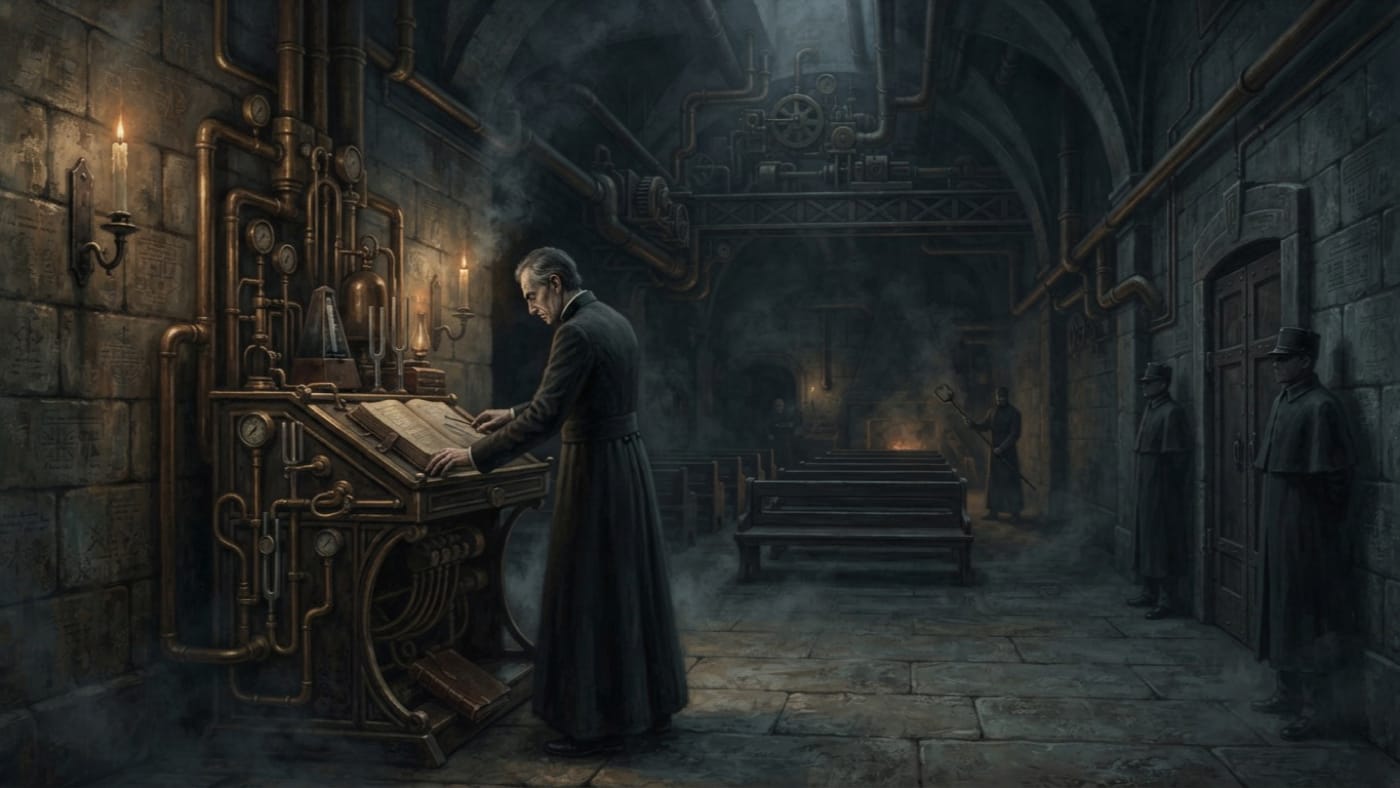
The room's office is plain. The condemned are brought in. A licensed Iron Choir Brand-Singer tunes the chamber, sets the subject's breath and holds the cadence. A Brand-Smith lays the iron to that cadence. A scribe measures the mark with slate and rule and certifies it, so the Bureau of Records can file a confession nobody may later claim to have misheard. The room is hot iron, cold stone, copper and lye, and candle smoke. Every part of it is licensed.
The stone is expected to obey. It returns what it is given, when it is given, and adds nothing. A chamber that adds a note of its own has put a second author into the confession. The Bureau does not certify co-authored documents.
#On the Opening Hymn
The rite has six movements: room tuning, the Opening Hymn, stage cues, synchronised application of the iron, the Closing Tone with its sealing silence, and documentation. Laymen assume the danger lives at the iron. Singers know better. In the Opening Hymn the voice first takes hold of the room and the subject's lungs together, and every later stage inherits whatever the hymn sets down. A slip at the opening carries forward. It reaches the iron as a crooked line and the ledger as a rebrand.
In A.S. 144 the voice at East Hall belonged to Master Cantor Vell. He was the Purity-licensed Senior Brand-Singer of the Strasbourg penitence halls, fourteen years into a tenure that ran from A.S. 130 to 147. Three years earlier he had conducted the Seven-Rite Session of A.S. 141. Its chambers, its condemned and its flawless tallies belong to his dossier and stay there. They matter here for one reason. By 144, Vell was the man the trade measured itself by. When a room answers an apprentice, the inquiry examines the apprentice. When a room answers the measure, the inquiry has to examine the room.
The extract does not list his instruments. The profession issues every Master Cantor the same ones anyway: tuning rod, bell-hour metronome token, a throat kept going on seals and ash rinses. None of them is designed for a room that replies.
#On the Response
The record's account of the event is shorter than most tavern bills. Vell sang the Opening Hymn. The hymn came back half a beat late, carrying a lower harmony that nobody in the room was licensed to supply.
The trade calls this echo weather, its term for a chamber that answers on its own timing, and each Bureau keeps a label ready. Doctrine files it as residual liturgical resonance. The Bureau of Orison and Song prefers acoustic reflection, which lays the matter at the masons' door. Purity calls it an anomaly and attaches an instruction: do not harmonise. These are vocabularies. None of them is a finding about East Hall. The Codex certifies no voice, no source and no mechanism for what came back there.
The extract survives in this form:
ACOUSTIC INCIDENT — EAST HALL, STRASBOURG, A.S. 144 Attending Singer: Vell, Master Cantor Rite Stage: Opening Hymn Unsolicited response: ███████████████, half-beat delay, lower harmony Vell action: ██████████████████████████████████ Subject condition after rite: certified / not certified / classification withdrawn Auditor note: "Do not ask why Vell stopped breathing."
Read it the way a clerk reads a ledger with pages cut out. The blacked-out bars are where the event lives. The first names whatever answered. The second is longer and records what Vell did. The subject-condition field keeps all three alternatives, and the extract does not show which two were struck. Who the condemned was, what the charge was, whether the iron was ever laid, and whether the subject lived to see the scribe's rule: the file does not say. I will not hand it a corpse to make the paragraph more satisfying.
Then comes the auditor's note. The trade keeps a corridor maxim, if the room sings back, stop breathing. Vell's own surviving imperative was different: lower your eyes and become stone. A reader of ordinary appetite will set these beside the note and consider the case closed. The file draws no such line, and neither do I. A maxim tells you what singers are taught. It does not tell you what one singer did in one room in one year, and the bar over Vell's action was put there by someone with more authority over that sentence than a reader's guess.
#On the Three Months After
The surviving record of the aftermath is practical. For three months after East Hall, Vell sang at half his former tone volume. He also corrected his timing. The record says so and does not say how. The reduction lasted three months, and the file follows it no further. Nothing in it shows he lost his voice, closed the hall or pressed a reform on his Bureau.
The Silentists were waiting. Their school was decades older than the incident. It claims formal descent from the Writ 14-C settlement of A.S. 104, and its founding story is Irena Vos and the North Annex Hush of A.S. 118, which happened in a different chamber with a different history. The method works by subtraction: minimal tone, metronome tick, whispered count, a finger tapped against slate. Its premise is that every sanctioned note gives the room something to answer. Silentists keep the rite and starve the room of sound.
Vell had publicly called them "men afraid of their own instrument." So when the most precise throat in Strasbourg spent a season at half volume, the Silentist pamphlets did what pamphlets do. They read the reduction as a confession and the confession as vindication. Vell answered them with nothing, in print or anywhere else.
The Silentist tract The Holy Hush states that Master Cantor Vell "converted to minimal tone after East Hall."
Withdrawn. Vell converted to nothing. He lowered his volume, corrected his timing, and kept using Mercy Tone, Judgment Tone and Silentist economy as tools in his own hand. The tract mistook a season of caution for a creed. Pamphleteers make that mistake about every master who blinks.
The professional dispute turns on that difference. A Silentist withholds sound as doctrine, in every room, as a standing article of faith. Vell withheld half of it as a working judgment, for a fixed term, after one room gave him cause. A master who borrows a rival school's method for a season has joined it no more than a magistrate joins the gallows guild by ordering one extra rope.
#On What the File Permits
East Hall has been worth more to the Church's arguments than to its rites. To the Silentists, it is the room that made the master whisper. To Orison, it is a masonry complaint that pamphleteers inflated into scripture. To Purity, which owns the halls and licenses the throats, it is the worst sort of precedent: proof that skill does not protect a room, set down in a file that will not say what the skill accomplished. Records has the rawest grievance. A certification field with three options and no mark is the one thing that Bureau finds harder to bear than a harmony. The Codex records no Doctrine ruling on the hall itself. Doctrine keeps its labels for echo weather in general and has not been asked, in any surviving folio, to apply them here.
As of A.S. 201 the incident is still cited wherever the schools argue: in examination halls, in recruitment hearings and in the hush-men's tracts. Nothing in the file certifies whether East Hall is still in service, sealed, repaired or simply avoided by singers who know its name. Nothing certifies the present temper of its stone, and I will not offer an opinion on the acoustics of a room I have never stood in.
Filed: one response, one master and one quiet season. The rest stays under the bar, where the Bureau keeps the things it means to remember without reading.