
#On the Eastern Entrance
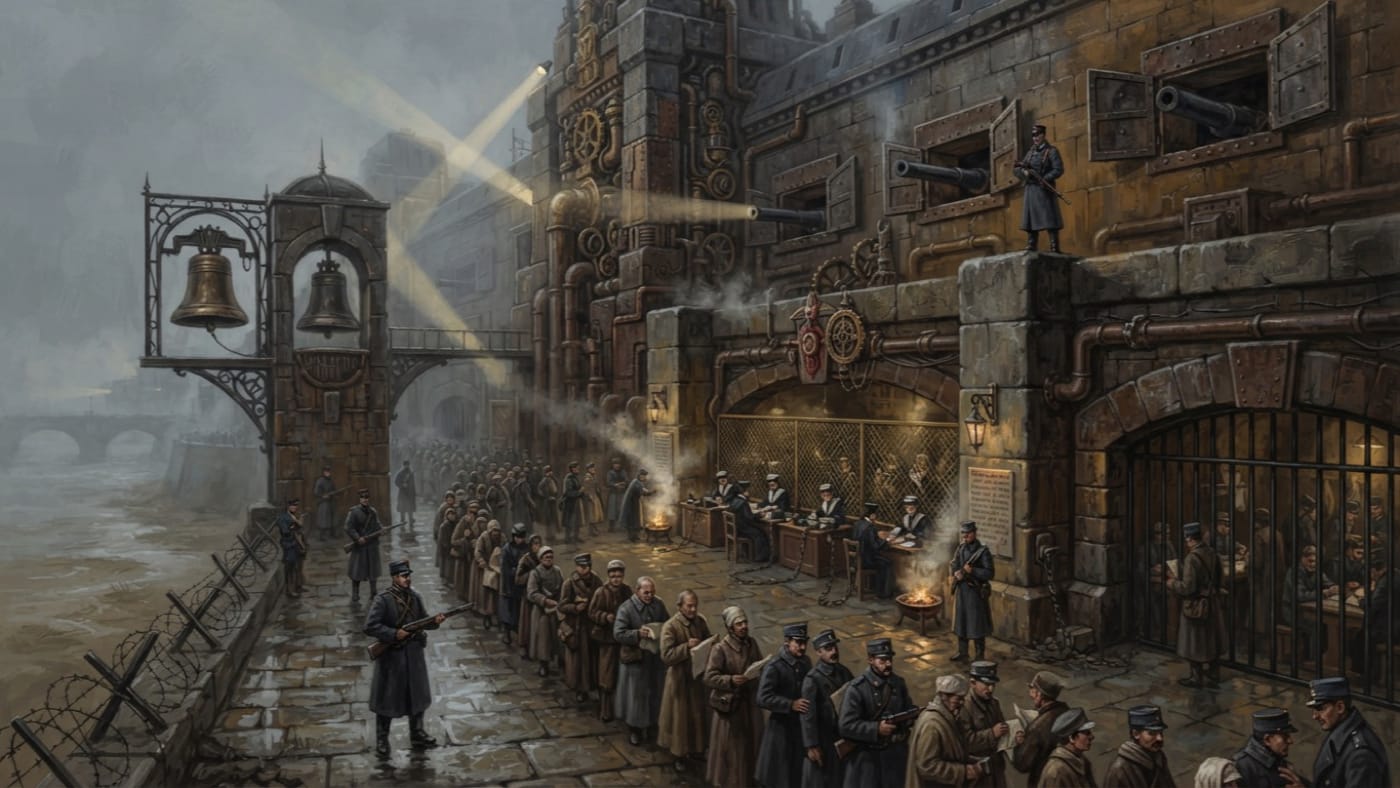
Arrival at Bastion-Brest begins with a rifle and a wet sheet of paper, and of the two the rifle has the better manners. A provost halts the column on the eastern approach road. A second provost walks its length, counting heads against the manifest. A third stands higher on the granite and watches the counting through a firing slit. He counts nothing at all. Only then does East Gate take anyone in.
East Gate is the eastern entrance of the Brass Ribs. It takes in the approach road and its wire, the provost posts, and the East Gatehouse itself, which is granite clad in iron, with firing positions facing out over the mud. Here the bridge receives arriving convoys, levy transports, pilgrim columns and prisoner details. At the far end of the span, the West Gatehouse inspects outgoing traffic and keeps the clean lane for personnel whose files Doctrine has already blessed. The West smells of gun oil and hot bread. The East smells of wet paper and vinegar, because the Bureau of Purity fumigates arriving documents with vinegar and the Polish lowlands have never once delivered a dry one.
Mist rises off the river at every hour the Creator permits, and at several hours He was not consulted about. The approach stones sweat. The iron cladding beads. Above the gatehouse the casemate shutters ease open on oiled hinges, and everyone in the queue learns, without being told, to stand very still.
#On Intake and the Stamp Room
Intake is triage. It is performed by men who were never trained as physicians and who have been forbidden to act as confessors. Wagons are separated from drivers, drivers from escorts, and escorts from the pilgrims who attached themselves for warmth. Prisoners go one way under chain. Papers go another under vinegar. At the gate a traveller answers two questions: who he is, and where he claims to be going. What he has done is a matter for the Confessional Lanes, deeper in the bridge, and the gate is happy to leave that pleasure to them.
The Crossing Bureau keeps its principal stamp room at the East Gatehouse, behind a public counter screened in brass mesh. Petitioners stand on one side of the mesh. Authority sits on the other, at twelve desks between two wax braziers. Its dies are chained to their cradles, so that no clerk forgets which of them is property. The mesh lets voices and paper through. It keeps hands out, and hands are where trouble starts.
A crossing at Brest has seven parts, and all of them must agree. They are identity, route, confession receipt, booth number, sin category, absolution token and transit mark. Different offices issue them at different hours, and at the end Hett Ruis's clerks compare them with the care of men weighing a debtor's teeth. A blot on the route line is a variance. So is a booth number that disagrees with its sin category, a token pressed too warm, or a name in Warsaw ink that ran on the road. A contested variance passes to the Bridge Tribunal. An uncontested one just waits.
Waiting has an address. The East Gatehouse holding pens take in everyone whose papers have been neither granted nor refused. The stone in them has never been dry. I once saw a levy boy of about sixteen spend two nights there because the river had blurred one digit of his regiment number into a smear that could have been a three or an eight. Both regiments existed. Neither would vouch for the smear. He was released on the third morning with a cough and a corrected file. The correction was beautiful.
#On the Three Authorities
Three powers meet at East Gate, and each one holds a different part of the traveller.
Judge Elsbeth Krail holds his legal existence. Her Tribunal rules on crossing disputes, identity corrections, and manifest irregularities that the stamp room cannot or will not settle. Standing Order 14-B, issued during the Blank-Sheet crisis, lets her seize papers and halt crossings outright. It does not give her a gun. When the Tribunal halts traffic at East Gate, the halt is enforced by men who answer to someone else.
Ruis holds the traveller's time. The Tribunal may overrule a stamp after a hearing, but the stamp decides whether the traveller ever reaches the hearing, and whether a Tribunal order reaches the gate before the bell. Ruis has never refused Krail anything. He lets procedure grow heavy and watches her lift it.
Gun-Cantor Marshal Vonn holds the gate itself. The casemate fire keys, the curfew bells and the safety salvos are all his. Ruis once filed a memorandum, his third, asking that the fire keys be registered with the Crossing Bureau. Vonn did not reply in writing. The next week Ruis corrected three artillery ration manifests, and the fuse cord arrived half a day late. Both men call the exchange routine coordination.
An administrative digest, quoted in this Codex's survey of the Crossing Bureau, described that Bureau as "subordinate to the Bridge Tribunal in all contested matters."
Corrected as it applies to East Gate. The Tribunal sits mid-span and the stamp room adjoins the gate. A contested paper meets the stamp first and the judge later, if it meets her at all. Measured across that distance, subordination is a theological position rather than an architectural one.
#On the Impression Carried Out
Irena Vale was a stamp-room clerk, trusted near the dies because she was good with her hands. In A.S. 197, during routine cleaning, she pressed approved dies into warm wax and carried the impressions out in the folds of her work apron. The guards inspected her hands, her pockets and her tool roll. No one had written the word apron on the inspection card. She walked out with the gate's authority pressed flat against her hip like a smear of grime. She was dismissed for die maintenance irregularities. Records later amended the charge to the accurate one, which was far more humiliating.
The exit inspection list now runs to six pages. It covers aprons, sashes and headwraps, and it is thorough against everything Vale has already done.
The Blank-Sheet Circle used her impressions alongside its other tools: blank paper, duplicate marks, safe-sin scripts rehearsed to satisfy a booth scribe, and help from someone inside confession processing. The breach taught East Gate the ugliest lesson a gate can learn. A genuine mark proves only that a die touched wax. It proves nothing about the hand holding the paper or the soul behind the hand. Meanwhile the guard at the gate has spent his whole working life learning to read the mark and trust the man.
None of this convicts the clerks. Most are exactly what they appear to be: tired, damp, frightened of Krail and paid late. Ruis's membership in the Circle remains unproved. The nineteen Circle-related arrests made across Brest in A.S. 201 did not include him.
#On Curfew and the Eastern Wire
At curfew, Vonn seals East Gate.
The bells divide the bridge into permissions, and East Gate gets the shortest one: none. Before the hush bell, provosts push the last of the queue either through or back. Vonn's troops hold the line with rifles and hymn-shouts, the hymn loud enough that a frightened crowd hears the tune and the rifles inside it at the same moment. Then the gate is shut and barred. Some people are still outside: those whose stamp came late, whose Tribunal order sat too long at a counter, or whose child-count annex dried a minute too slowly. They spend the night on the far side of the granite, under the guns, facing east.
Behind the seal the bridge stays awake. The Ribwalk narrows to its lantern-lit truth lanes, single-file, with mandatory confession stops. Soldiers move under bell orders. Krail's bailiffs carry sealed packets toward mid-span. The gate is closed. The rest of Brest is simply watched harder.
The east is where the Nameless Tide gathers. It does not advance in any way a sentry can report. Patrols find the approach clear, and one watch later they find the wire bowed inward with grey pressure massed against it. The gatehouse has its own symptom, recorded in the Tide's file and confirmed by every night clerk I have bribed with tea. The candles in the eastern gatehouse lean toward the wire, as if they were listening. The Bureau records the lean and does not explain it. I will not supply an explanation the Bureau has declined to purchase.
Vonn's A.S. 200 incident took place at the eastern wire, among the forward stakes beyond the gatehouse. Nothing came through the gate that night. Since then, the men who bar it at the sealing bell have done so more slowly and checked the bar twice.
FIELD NOTE — EASTERN RIB APPROACH, A.S. 200 (EXTRACT AS RETAINED) Observer: Gun-Cantor Marshal Vonn Condition: no visible advance; no bell alarm; wire displacement recorded Marginal notation: "If arrival is only visible after occupation, then █████████████████████████████." Filing: Outside Current Doctrinal Scope
Inside the bridge, the Confession Echo does quieter damage. Since A.S. 199, confessions spoken in the booths have come back through brass, pylon and shutter, sometimes under a different sin category from the one the scribe recorded. A gate depends on receipts meaning what they say. Now that the bridge itself revises testimony, every receipt presented at the stamp room carries a small doubt that no stamp can remove. Booth 77, which repeats confessions not yet spoken, is nowhere near the gate. It stands on the north side, by the third pylon from the west. Its reputation still travels faster than any convoy.
#On the Present Condition
As of A.S. 201, East Gate takes in traffic from dawn until curfew. Its stamps still decide which bodies go forward and which wait. Its pens are still occupied, and vinegar still hangs over every manifest. Krail still halts whatever she can reach. Ruis still decides how fast she reaches it. Vonn still seals the gate when the bell sounds, whoever is left standing outside.