
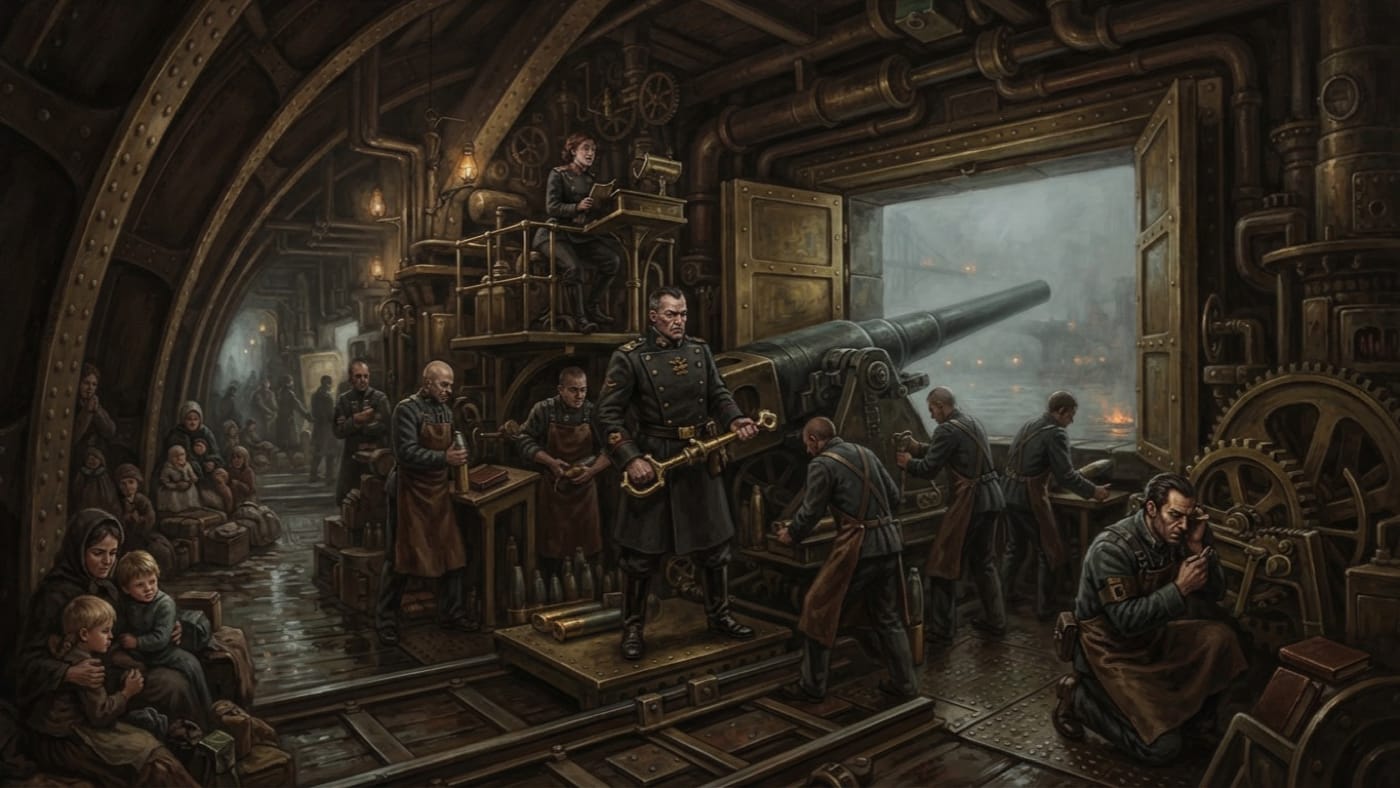
#On the Artillery Beneath the Market
"Ribs don't bend for pity." — Proverb of the Ribs
Every bastion of the Sagittal Line keeps its guns somewhere sensible: a curtain wall, the lip of a gorge, a tower raised for no purpose but to hold iron at a useful height. Bastion-Brest keeps its guns under a street. The Casemate Galleries occupy the artillery spaces inside the Brass Ribs, the riveted trusses of brass and iron that carry the span across the Bug. The Ribwalk runs above them, a market of brine-sellers, token-menders and convoy quartermasters. The Confessional Lanes run below them, where the bridge collects its toll in sin. Farther down, in and around the fourteen pylons, the Pylon Warrens house those with nowhere better to sleep. The Galleries sit between commerce and sacrament, their muzzles pointed outward and their recoil pointed inward at everyone.
The western-bank works of A.S. 67 held the crossing with earth, timber and fear. The guns that fire today belong to the bridge of the A.S. 92 Bureau of Engineering plan. That bridge was certified in A.S. 98, when the first full military crossing passed under load, with artillery, confession and tribunal supervision all in operation. The plan gave the Galleries their shape. The century since has given them their tenants.
This Codex's entry on Bastion-Brest states that the bridge-fortress was "completed" by A.S. 98.
A.S. 98 is a year of certification. In that year the Galleries were judged able to fire while the span carried a full crossing. No one judged them finished. The Brasswright Guild's unofficial shop register for that crossing records four seized shutters and two cracked recoil lugs, and work in the casemates has not stopped since. The word "completed" survives on Bureau of Engineering plates, where it costs nothing to maintain.
#On Shutters, Recoil and Range
"The bridge breathes." — Foreman Jost, Brasswright Guild
The principal gun positions stand at every fourth rib, and the ribs between them are busy. They hold the ammunition lifts, recoil dampers, range tables, chapel nooks, stretcher hooks and the listening stations where crews hear the span before they see it. A visitor who counts gun mouths and multiplies has learned arithmetic and nothing about Brest. The ribs are numbered differently depending on which office holds the pen, and I decline to publish a total that two Bureaus would dispute and the Guild would correct in chalk.
The gun mouths face east and riverward through brass shutters. A shutter opens only when the bell permits. Recoil runs back along the rails into braces that pass it to the rib, and the rib passes it to everything else: the stalls on the Ribwalk, the booth hinges below, the bunks in the pylons, and the stomach of anyone within three ribs of the piece. An unsynchronised discharge cracks shutters, shakes ceiling grit into the scribes' ink and starts a panic in the queues. A synchronised discharge does the same things, less severely, on schedule, with paperwork.
The synchronising is done by singing. Gun-Cantor Marshal Vonn recites the Litany of Correct Arc. Beneath him, Cantor-Lieutenant Sera sings the range tables, giving distance as pitch and fuse length as a held vowel. The crews set fuse, elevation and powder measure, then shutter clearance, recoil brace and the warning interval for the lanes below. The casemate bells answer. Then the gun fires.
The Galleries smell of brass polish, burned powder and wet iron. A cold draught the garrison calls gun-wind comes through the shutter seams whether the shutters are open or not. Footsteps on the deck above reach the gunners through the metal before the voices do.
#On the Keys and Their Keepers
"Brest does not break soldiers. Brest files them." — Gun-Cantor Marshal Vonn
Vonn commands Brest's artillery, its curfew bells and the authorisation of what the Bureau of War calls "safety salvos." He carries one casemate fire key on his person. Sera wears a second under her throat plate, on black cord with a wax tag. The third sits sealed in a reliquary box under armed novice guard, and the novices have reportedly been told to shoot each other if either starts humming without cause. The published dossiers describe who holds the keys. They do not describe a lock that needs all three, and I will not invent one for readers who like their atrocities mechanically elegant. People guard the keys at Brest, and people sleep, eat, confess and hear things.
The fire keys are among the very few things on the bridge the under-deck market cannot sell. Forged tokens, edited transcripts and ready-made sin-scrips for every profession change hands nightly below the Ribwalk. A fire key does not. Too many men with rifles stand too close to it.
Two civil authorities press against the Galleries without commanding them. Seal-Registrar Hett Ruis of the Crossing Bureau controls the seals and writs without which nothing crosses. He has filed memoranda arguing that duplicate fire keys belong in his stamp-room custody chain. He has also argued that the Cantor-Lieutenant's operative vocal patterns should be provisionally registered. The Bureau of War rejected that proposal in seven words: "Come register the shell in flight." Judge Elsbeth Krail's Bridge Tribunal rules on crossings, identity corrections and confession irregularities, and uses Standing Order 14-B to seize papers and halt traffic. The order states plainly that it grants no artillery command.
One office decides who may cross. Another decides what the crosser is. A third decides what happens if the crowd disagrees.
#On Repairs and Safety Salvos
"Which rib keeps you warm?" — Shibboleth of Brest; locals answer with a number
The Bureau of Engineering owns the plans of the Galleries. The Brasswright Guild owns everything the plans leave out. Working from casemate workshops, rib interiors and pylon forges, the Guild maintains the shutters, the brasswork, the recoil fittings and the machinery that holds a gun inside a truss without the truss objecting. It keeps parts in cupboards labelled as liturgical lamp fittings. It keeps its knowledge in a private book of stresses that Engineering has requested three times and never received. Foreman Jost answers magistrates in single nouns. Riveter Anya hears metal stress and marks it on the shutter in blue chalk.
The Marshal holds the key, but a Brasswright decides whether the shutter opens when the key turns. The Guild governs by delay: a recoil damper must cool, a shutter pin must be remeasured, a seam needs a second listening. Each delay is reasonable. Each is also a bargaining position, and the Bureau of Tithes has tried seven times to audit what those positions cost.
The guns face east, toward the eastern wire and the pressure the files call the Nameless Tide. They also command the deck. Brest's defence doctrine depends on interlocking casemate fire and kill-zones along the span. "Safety salvo" is the polite term for turning that fire on the crossing during riot, breach or crush. The Bastion-Brest entry describes firing into the crossing lanes. The Brass Ribs entry describes fire across or near the deck. I record both, because the Bureau of War has shown no appetite for choosing between them. The euphemism belongs to the Bureau. Whether an emergency exists is for Vonn to decide.
In convoy season, when the bridge's fourteen thousand inhabitants swell past twenty thousand and the lanes cannot clear the queue, families sleep in the Galleries between the guns. They lay their bedding outside the working clearance, because the crews will move it if they don't, and they learn the bell sequence faster than recruits do. A gunner steps over a sleeping child to reach a recoil brace. A Brasswright asks a mother to lift her bundle so he can listen to a seam. Every drill is rehearsed among people the guns may one day be turned on.
#On Voices From the Shutters
"Mist carries what mouths can't." — Proverb of the Ribs
Since A.S. 199 the Confession Echo has carried sins spoken in the booths back through the body of the bridge. They return from vents, wet rope, deck plates and the brass shutters of the Galleries. Booth 77 repeats confessions that have not yet been spoken. The Tribunal blames the Blank-Sheet Circle. Doctrine advises observation. No office has said where the voices come from, and I have no authority to say it for them.
For an artillery crew the problem is precise. Gunners are trained to act on sound: the bell, the sung table, the shouted correction. The Echo also produces sound. Vonn has barred casemate crews from confessing in the lanes nearest loaded galleries except under supervised rotation, against Tribunal routing and equal-access sacramental policy. His own office reports that misfires fell by half. Sera has revised the crews' vocal discipline twice. Repeated devotional phrases are banned in loaded galleries unless countersigned. No crewman may hum near fire-key custody. Responses are cut off after the second measure, and no gunner answers a voice from a shutter unless the speaker is visible and breathing.
I give the misfire figure as it was reported. Nobody has asked the Galleries whether the new routing caused the reduction, and I would not trust their answer.
CASEMATE ACOUSTIC INCIDENT — RIB FIVE, A.S. 201 — EXTRACT During cleaning drill, an unidentified voice sang the Cantor-Lieutenant's short-fuse range descent from the wrong end of the gallery. Visible personnel: accounted for. Powder state: sealed. Order given: answer nothing. Second voice repeated: "Lower." Result: no discharge. Filed public cause: hinge strain.
The powder was sealed because the drill schedule said so. That was the gallery's entire margin.
#On the Present Readiness
"The Tide does not arrive. You notice it has arrived. The difference is a funeral." — Gun-Cantor Marshal Vonn
In A.S. 201 the Casemate Galleries are crewed, keyed and serviceable. Vonn keeps his key and his bells. Before third watch, Sera listens to every loaded crew for the half-note drop that shows fear before any dispatch admits it. The Guild keeps the shutters moving on its own schedule and at its own price. Ruis files. Krail declines to mediate.
A rumour on the Ribwalk holds that the guns will not fire unless the bridge is absolved. It is only a rumour. No key, shutter or brace in any file I have read depends on absolution. The guns depend on powder and on brass the Guild agrees to repair. They depend on crews who must hear a command correctly inside a structure that has learned to forge commands, and on one Marshal's judgement of what counts as an emergency. Absolution would be the more reliable mechanism.