
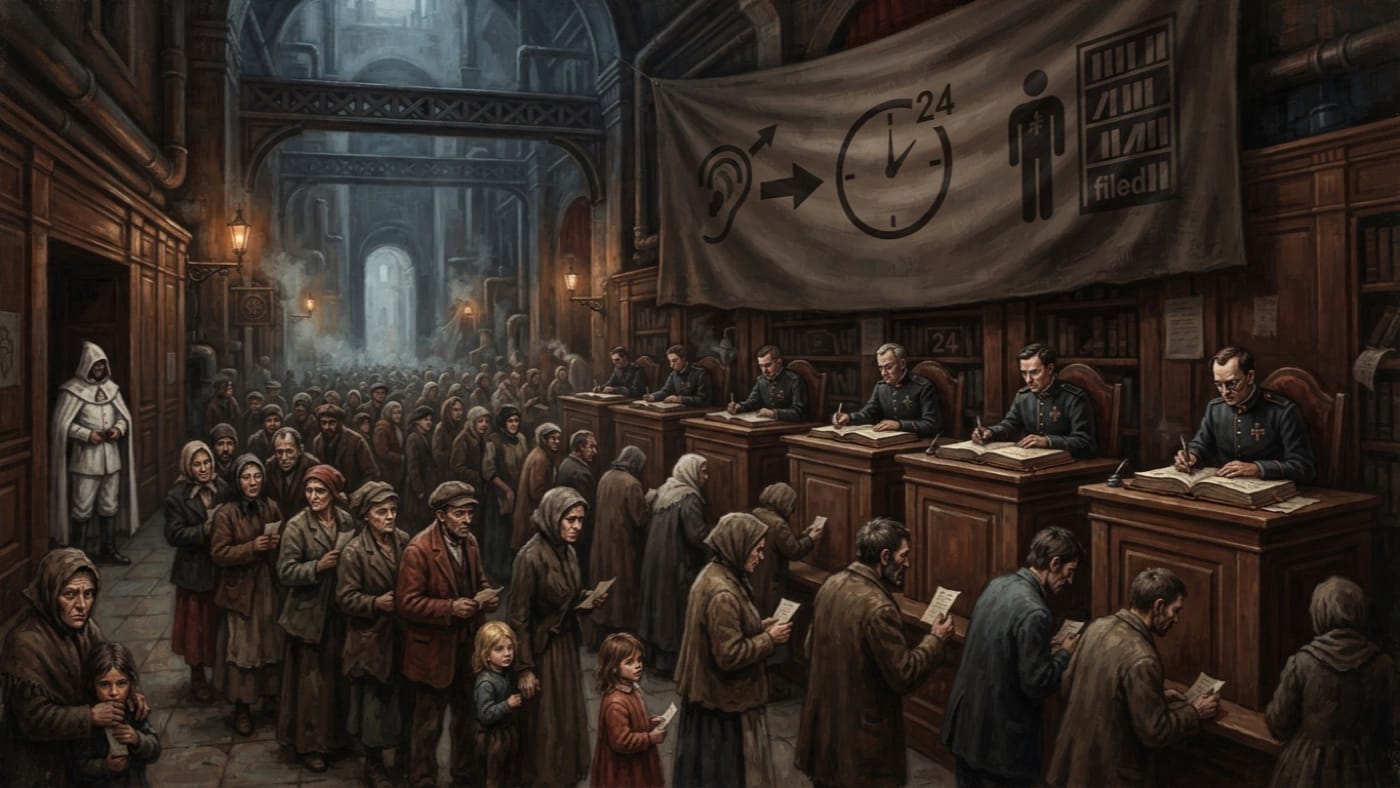
#On the Obligation to Hear
The Duty of Denunciation is the reason nobody in the Synod merely overhears anything. In A.S. 134 Severian of Mainz carried it through the Eighth Doctrinal Congress as Article 19 of the Catechism of Obedience. Since then every person bound by the Catechism has been obliged to report suspected heresy, doctrinal deviation, or spiritual unease suggesting contamination to a competent authority within twenty-four hours of observing or suspecting it. Suspicion is enough. Reaching certainty is the inquisitor's work, and the witness is forbidden to wait for it. Failure to report is participation in the heresy suspected.
The clause, its gloss and its marriage to Article 9 are laid out in the Doctrine entry on Article 19, which I commend to anyone with an idle afternoon and a strong stomach. This tract concerns the duty as it is lived: at the table, at the bench, over the school slate and across the Bureau counter. In all of these places the ear has been drafted into service and issued no wages.
#On Silence as Shelter
Severian's gloss is three words long and has outlived everyone who heard him say it: silence is shelter. It grew from Book III of his Commentaries on Faithful Severity, On Silence, where the inquisitor argued that withheld speech houses error. It gives the thing a roof, a night's warmth, a day's head start. A witness who says nothing has become a landlord.
The Article's teaching extract continues the gloss in a form every Rhineland child can recite: shelter is participation, and participation is heresy given walls. This is where the gloss ends and the operative Article begins, and a careful clerk keeps the two apart. The gloss is doctrine for memorising. The Article is the requirement: report within the day, or answer as a participant.
Severian brought the principle from Mainz. His Iron Choir had already taught him that a punishment must keep working after the sentence is read. The cages instructed passers-by. Article 19 taught the passers-by to deliver the next occupant. The economy is the same, only domestic in scale. The Synod could never afford an inquisitor in every kitchen. Severian discovered it already had one, unpaid and sitting at the head of the table.
#On the Twenty-Four Hours
The clock starts at observation or at suspicion, whichever arrives first, and suspicion usually arrives first. It may be a remark at the well, a pause after the Creed, a pencilled query in a borrowed Catechism, or a widow whose grief seems to have found a private theology. Each is reportable before anyone understands it. The witness need not know what was heard, only where to take it.
Uncertainty grants the faithful witness time to observe further before reporting.
Corrected. Certainty is not a precondition of report. It is the product of examination, and examination belongs to the competent authority. A provincial ruling of A.S. 141 that let uncertainty postpone the clock was withdrawn. Uncertainty is itself reportable. The innocent will be found innocent at the proper desk, or they will not.
The nearest competent authority is wherever the Synod keeps an ear with a seal attached. Published practice lists Purity district offices, parish examiners, White-Mantled Inquisitors, licensed schoolmasters, route confessors, and tribunal clerks at the city gates. In the poorer quarters a Doctrine street-vicar takes names between market sweeps. He writes them on the back of a correction slip while the fishmonger pretends to weigh eels. A report is presumed to have reached a competent authority once that authority accepts it.
What follows is less automatic than frightened citizens believe and more durable than they hope. The receiving official decides whether the matter is trivial, local, or worth forwarding. The system breathes through that discretion, and it rots there too. Forwarded reports pass to the Bureau of Purity for enforcement. Only the Bureau of Doctrine decides whether what was heard is heresy at all. The Bureau of Records keeps the name, the accusation, the hour and whatever later becomes of each, in grey ledgers with margins ruled for amendment. When a matter hardens into condemnation or prohibition, the Index Damnatus Runners carry it outward. A whisper becomes a file long before it becomes a blacklist, and files are patient.
#On Kin, Colleagues, and the Accuser
The household was the last unlicensed parish in the Synod, and Article 19 licensed it.
Before A.S. 134, a mother who heard her son say something unwise at supper could decide he was tired. A journeyman could let a master's quip about the tithe pass as a quip. A friend could keep a friend's confession of doubt in the same drawer as old letters. These were the small unmeasured mercies, and Severian measured them. After the Article, the mother's judgement that her son was tired became something she might have to explain. The quip acquired a twenty-four-hour life. The drawer became searchable.
Every citizen does the arithmetic before the soup cools. If I report, I may lose him. If I keep quiet and someone else reports both the remark and my presence at the table, I go into the file beside him, charged with the roof I built. The earliest witness is the safest. Households have learned to race one another to the parish examiner. Purity records this as vigilance. The Bureau of Mercy once recorded it as the end of supper in the Rhineland.
Catechism Schools teach the arithmetic before the child can do sums. The gloss is recited at the bench. Licensed schoolmasters receive reports from pupils about pupils, and sometimes about parents. A pupil who reports learns that the schoolmaster smiles. A pupil who does not learns nothing until later.
The workshop runs on courtesy, and the Article feeds on it. Colleagues cover lateness, spoiled work and small irreverences, and any of these becomes shelter once the irreverence turns doctrinal. Bureau offices are the worst of all, because every clerk there knows exactly where reports go and exactly who reads them.
Denouncing upward is the Article's oldest difficulty. A copyist who suspects a registrar must report that registrar to someone the registrar dines with. The text exempts no rank, and in practice a great many ranks were exempted anyway. The Order of Severance, whose decisive formation followed the post-Congress reforms, turned Severian's gloss on the offices themselves: where the powerful attract no accusations, inspect whatever protects them. Silence among the powerful is still shelter, merely better furnished.
The accuser never leaves the file either. The report records the reporter: name, hour, how long they knew and, if they waited, why. An accusation filed at the twenty-third hour invites questions about the twenty-two before it. Denunciation buys no immunity. It buys a better place in the queue.
#On Participation and Its Consequences
Article 9 gives Doctrine alone the power to define heresy, and once Doctrine rules, guilt reaches back to the first forming of the thought. Article 19 supplies witnesses for that backward reach. A failure to report counts as participation, and participation falls under the schedule inherited from Article 9: supervised recantation, then public penance, then immurement for those who persist. The schedule is applied by degree. The twenty-fifth hour does not summon a mason on its own.
Two questions stay separate, and both are dangerous. Was the accused a heretic? Doctrine must say. Did the witness report in time? That is a matter of clocks and ledgers. The second question can be put to a witness long before anyone has answered the first.
Purity credits Article 19 with more prosecutions than all the other Articles combined. I reproduce the claim exactly as Purity states it. I have not been shown the tally, and Records has not offered to count. Purity calls the figure vigilance. Doctrine calls it proof that definitions are still needed. Records calls it a shelving problem.
#On Present Application
As of A.S. 201, the Duty hangs wherever a notice can be pasted. Catechism primers print the gloss on the Article 19 leaf, its corners worn soft by small thumbs. Parish notices list the nearest receiving desks and are pasted up again each spring, once the damp has eaten everything but the word REPORT. Workshops and Bureau offices hang the same sheet beside the time-board, so the hour of a remark and the hour of its report share a wall. White-Mantled Inquisitors act on referrals. They enter houses whose occupants have already spent a week examining one another. Runners carry whatever amendments result.
The Confessarii, whose existence Doctrine declines to discuss, profit more quietly. An unreported suspicion makes a better lever than a completed heresy, and a person who stayed silent is easier to approach than one who spoke. Every citizen owes the reporting duty. Very few are invited to carry the cipher, and the few who carry it care a great deal about the difference.
The Twelfth Amendment of A.S. 196 widened what a witness may be obliged to notice. Interior life became licensed ground, and the face became admissible evidence of it. The Amendment left the Article's clock as it was. A wrong expression seen at morning bell must still reach a desk before the next morning bell. Witnesses now report faces, and faces have learned to watch the witnesses.