
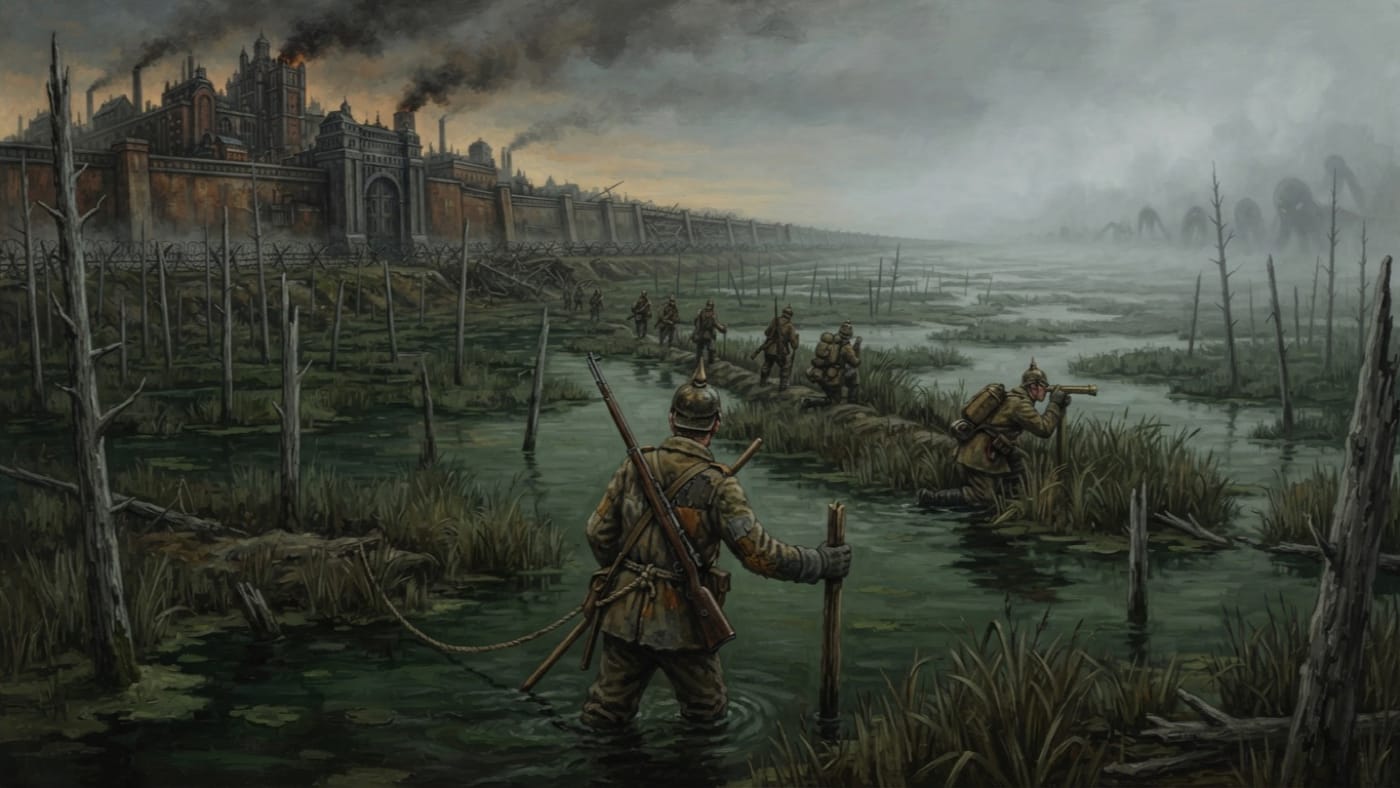
#On the Name and the Northern Approaches
"The lakes defend us. The lakes also confine us. The Bureau sees no contradiction." — Attributed to Colonel-Warden Bruhns, Northern Garrison Command, A.S. 189
The Bureau of Engineering calls it the Primary Hydrological Defensive Zone. The soldiers call it the Drowning Garden. I have consulted both parties. The soldiers have the better ear and the Bureau has the better filing system, which is the customary division of labour in the Church's service.
Both names describe the same ground. Running east and southeast from Bastion-Königsberg, where the Sagittal Line comes to the end of its two thousand miles of wall and wire from the Bosphorus and stops at the Baltic, the Masurian Lake District of East Prussia covers the approaches with thousands of linked lakes, marshes, reed-beds, channels and drowned forest. Nobody built it. The Bureau of Engineering annexed it in the way a clerk annexes a pen left on someone else's desk, then entered it on the northern anchor's defence ledger as if it had been poured to specification.
Its military use needs no explaining. An army that comes from the east in good order must first cross the Garden, and the Garden does not allow good order. Columns break into files. Files break into single men wading at the pace of the slowest. Single men, if they guess wrong about the water, become business for the chaplains.
#On the Water and the Charts
In the warm months the Garden is mostly shallows. It is green-black water over silt, and the reeds grow tall and close enough to hide a section of riflemen from a man twenty paces off. Drowned timber stands in the channels, the grey trunks of a forest whose drowning no ledger records, and every one of them looks like a sentry until it fails to challenge you.
The bottom does not hold to one depth. Submerged ridges run under the surface where a soldier can stand chest-deep, keep his carbine dry above the waterline and fire from what amounts to a firing-step the Creator neglected to wall. A pace beyond such a ridge, the water can drop to thirty feet with no warning at all. There is no slope and no change in the colour of the water to tell you. The reeds give no sign either. A man is standing, and then the ledger has one fewer man in it.
The Bureau of Records holds seven maps of this ground. They contradict one another, channel against channel and island against island. All seven have been accepted as canonical. A clerk in the Ordensburg showed me two of them laid side by side, with an expression usually reserved for viewing relics of disputed provenance. One showed a stretch of open water where the other showed a reed-island large enough to camp a company on.
#On the Two Seasons
The Garden has a summer face and a winter face, and the garrison has to answer both.
In summer, the water fights for the defender. An eastern force wading in has to find the ridges, avoid the drops, haul its guns through silt that takes boots off feet, and do all of it within sight of men who were born there. Boats are little help. Across much of the maze a laden hull runs aground in water a man would drown in a hundred yards further on.
Then the ice comes and the arrangement turns over. A frozen lake is a road. It may be a bad road, cracked or rotten where springs rise under it or where the reeds keep the cold off, and nobody who has served in the Garden calls the ice uniformly sound. Still, it is a road, and a road leads toward the bastion as readily as away from it. Ground that broke formations in August will carry them in winter, if the ice holds and the commander is willing to bet on it.
The garrison therefore keeps two separate doctrines of engagement, one for liquid water and one for solid. The Bureau of War calls this a stimulating tactical exercise. I record the Bureau's view, together with the fact that it is held in Strasbourg, where the holy water in the fonts is kept at room temperature.
#On the Masurian Watchers
The Watchers are light infantry, and they are recruited from one source only: the lake-district villages taken into the bastion's service at the original requisition, about A.S. 67 (1777 CE). That was in the war years after the Sundering, when the Church's emergency administration was seizing what it needed and the formal Synod was still twenty-three years from its settlement at Strasbourg. The villages became part of the bastion's establishment and their sons became its patrols. Nobody had to explain the water to them.
They find their way by reed-pattern, by bird-call, and by notched stakes driven into the lake-beds at places and intervals they do not publish. The Bureau of Records has tried to catalogue the stakes five times. It abandoned four of the attempts. The fifth has not been abandoned and has not been finished, and Records will not say which of those two conditions it is closer to. I have seen a Watcher stop in water to his waist, run his thumb down a stake's notches as a cantor runs a finger down the psalter, and turn left without looking up. I could not tell you what he read. He could, and did not.
They are commanded by Lake-Captain Kaspar Dreyse, a third-generation native of the lake district. He knows the channels the way a sacristan knows his vestry in the dark. He is the bastion's most effective field officer. He is also the Bureau of Purity's most frequent subject of inquiry in Königsberg, because his men's methods fit neither of the two drawers Purity keeps. They are not plainly natural skill. They are not plainly heterodox practice. Purity cannot rest with a thing unfiled, so it opens the file again.
The Watchers go out through the Lake Gate, the eastern district facing the Masurian approaches. Its walls are the thickest on the bastion: twelve metres of stone, iron and fill. Here the Bureau of Engineering spent its best masonry against the threat that made strategic sense. No recorded attack on Königsberg has ever come from that direction. The Bureau counts this as proof that the Gate works. The garrison counts it as proof that nobody has tried the Gate, and I am not convinced the two readings can be told apart from inside the wall.
#On the Flank the Garden Does Not Cover
All this water and masonry faces east. The thing Königsberg actually watches does not come from the east.
The garrison calls it the Grey. The Bureau of War's Northern Theater assessment calls it Unknown Forces, Extradoctrinal Classification Pending, and the classification has been pending since A.S. 190. Every report places it on the Baltic and the northeastern approaches, along the coast or out of the sea fog, where the Garden gives no cover and the Lake Gate's twelve metres look the wrong way. Its nature is unknown. So is its intention. So is whether it is one thing or many. I set this down as a list of absences because that is what the file contains.
No one has observed the Grey crossing the lakes, in summer or in winter. The Bureau of Engineering takes this as a compliment to the Garden. I take it as a statement about the observers. Something that has never been seen in transit has only never been seen. That falls a long way short of something that cannot pass. The garrison knows the difference and does not discuss it near the Lake Gate.
It should not be confused with the time-fog of the southern highlands, which belongs to another theatre and another file, or with the accumulating pressure at Brest that the Bureau calls the Nameless Tide. Those two have their own suppressions. The Grey has its own as well.
An earlier compilation of the Church's lore described the Sagittal Line as running from the Carpathians to the Aegean.
This was incorrect and is struck. A Line drawn that way has no Baltic terminus and no northern anchor, and so it leaves the Drowning Garden defending nothing at all. The Line runs north to south, about two thousand miles from the Baltic at Königsberg to the Bosphorus, and the Masurian Lakes are its first natural obstacle in the north. The Bureau of Records regrets the omission of several hundred miles and an entire lake district, and has been asked to regret it in writing.
#On the Present Condition
The patrols go out. The bastion holds. In the warm months the Watchers wade their stakes and listen to the birds. In winter they walk the ice where they judge it will bear them and stay off it where they judge it will not. They have not yet been asked to explain the difference to anyone's satisfaction.
Records keeps seven maps and one open catalogue. Purity keeps a file on Lake-Captain Dreyse that grows by roughly the thickness of one clearance at a time. The Bureau of Engineering keeps its twelve metres of wall facing a direction from which nothing has come. Two doctrines of engagement sit in two binders, and both depend in practice on a few hundred villagers' sons whose methods the Church cannot classify and cannot spare.
The Garden does its work. Its work lies to the east.