
Sources checked; writing the dossier now.
#On the Surviving Record
This dossier records a survey made in A.S. 201 of one patrol report and the map entry it is filed beside. The incident it concerns has no recoverable year. No supporting ledger supplies one, the released text of the report fixes none, and any reader who wants a date may take the complaint to Strasbourg, where it will be received, filed and left unanswered.
Drift-S 9 is an identifier on Bastion-Shipka's internal maps. The numeral marks the entry and has no connection to the calendar. A clerk who reads it as a year will place a marsh incursion in an age before the bastion's first pile was driven. I have seen this error in two draft indices. Both drafts are now in the stove.
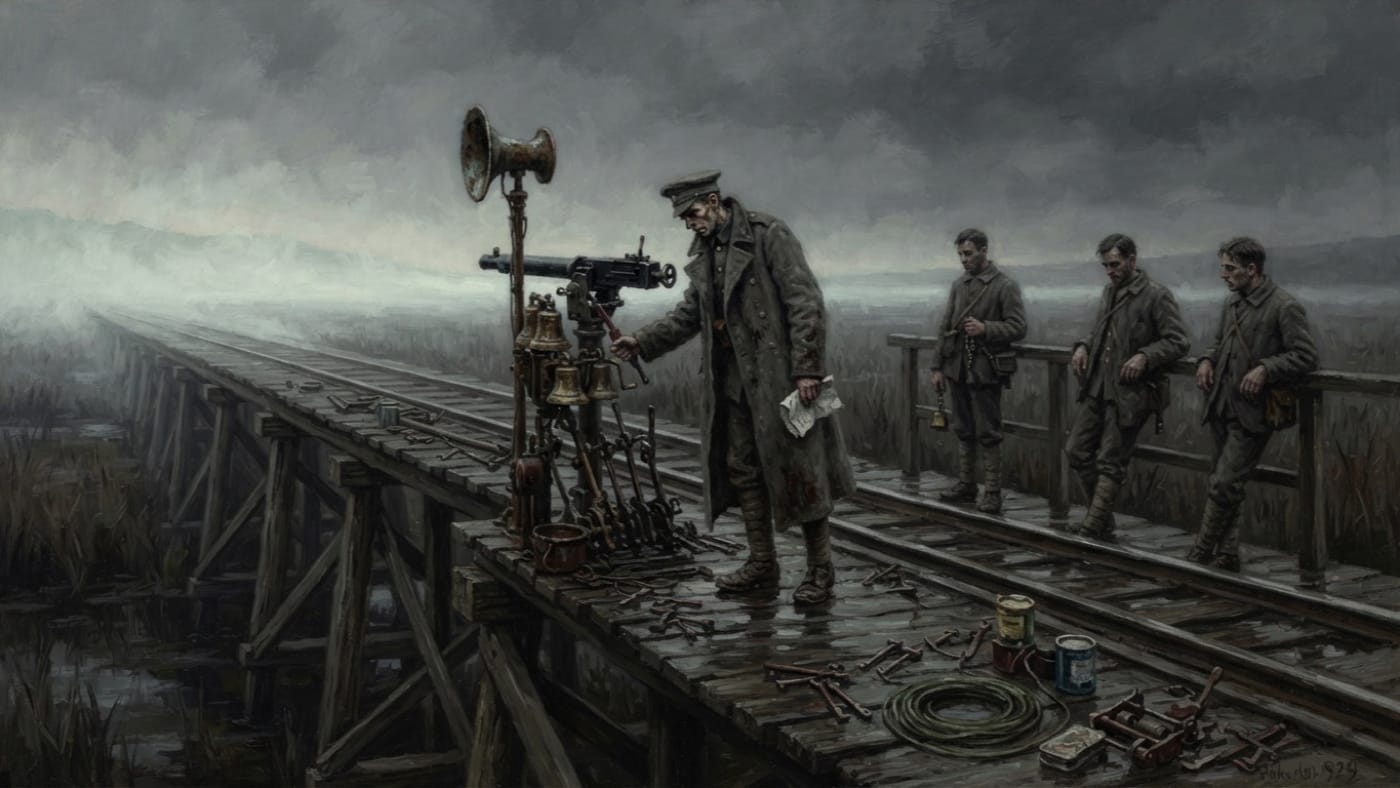
The ground is the Reed Road, the raised rail embankment and inspection causeway that leaves Shipka's western guns and runs east across the Phocis Marsh toward the Vales of Stagnance. It carries the marsh spur of the Sagittal rail, the patrols that walk it and the signals the Hourglass times along it. Two documents concern Drift-S 9 on this road. The first is a patrol report from Ladder-Platform Seven that names a corporal. The second is the bastion's account of two pale-haze incursions, entered together on the maps as Drift-S 4 and Drift-S 9. Each document has its own witness, and they must be read with their seams showing.
#On Ladder-Platform Seven
Ladder-Platform Seven is a timber tower on stilt legs. It overlooks the most unstable stretch of the Reed Road, where the embankment has a habit of sinking under the inspection crews. From its rail, on a clear day, a watcher can see the Vales of Stagnance. The garrison does not count this as one of the post's amenities.
Corporal Ivenn Rusk made his report here. In the order it records, he understood that the patrol needed to fire. He heard himself give the order and saw the men waiting on it. He then reported that he "could not be bothered to finish wanting it."
The sentence has been misread so often that the Records copy-room keeps a spare blotter for it. The order was spoken. Rusk does not say his tongue failed him, or that someone else's voice came out of his mouth. He says that he understood the need, that the words left him, that his men stood ready, and that the wanting behind the words stopped short of completion. The report does not record whether the shot was fired. It names no target and no enemy. It gives no wound, punishment or diagnosis, and nothing about Rusk's later service. Anyone who supplies these things is writing fiction, and should apply to the Bureau of Propaganda, which pays better than I do.
He was recovered alive. That is the outcome the record confirms. It does not say who recovered him, how long it took, or in what state he came back beyond the fact of breathing. The report holds all of this back, and the survey holds it back as well.
#On the Mapped Haze
The bastion's account of the paired incursions says that ladder crews on the Reed Road twice saw low drifts of pale haze come in from the east and fail to move properly with the wind. Inside the haze, sound fell away. Boots stopped ringing on the sleepers. Horns were muffled. Even the main bells of the bastion came through as little more than a tremor. Men who went through it later reported elongated echoes, minutes that seemed to stretch while they were inside them, and a deep reluctance to complete any action they had begun. The haze dissipated at the edge of the marsh.
The account reads well. Its arithmetic is poor. It describes two incursions under one heading and does not divide its observations between Drift-S 4 and Drift-S 9. The muffled horn might belong to either. So might the stretched minute. The survey therefore treats these effects as reported for the pair. Shipka's Hourglass staff have pressed the account into service as a description of Drift-S 9 alone more than once, and each time they have had to go back to the map and fetch Drift-S 4 again.
The stretched minutes also need a caution. They are what the men experienced. No drag-gauge reading, telegraph beat or clock comparison is attached to either entry in the surviving copy. The Hourglass has a register for measured duration and another for reported duration, and it does not mix them. The account belongs in the second.
The paired account also quotes a sergeant. He is unnamed, and his words are withheld from the public annals. The surviving record does not make him Rusk under another rank, and neither will this survey. The two documents differ in witness, rank and wording, and clerks who merge them to save ink have caused more confusion at Shipka than the fog has. The corporal's report is the public anchor for Drift-S 9. The sergeant remains an attributed figure in a paired entry, and the survey quotes nothing he said.
#On Bells and Rations
The map entry for the pair carries a stamped injunction: Increase bell density and caffeine rations. That is the entire recorded response. It says what a responsible office ordered and nothing about whether the order worked.
The injunction matches what Shipka already does. The Bureau of Bells answers fog on the Reed Road with staggered horns, wake-peals, ladder chimes and signal masts. The Hourglass compares beat-counters with bastion clocks. Line gangs carry stimulant tins as routinely as spike keys. All of this is established sector practice. None of it is shown to have been used on Rusk's patrol, by any named hand, at any recorded hour, and the recovery of a living corporal is not evidence that it did any good. Recovery happened, and so did the injunction. The surviving papers make no causal link between them, and this survey will not invent one.
Shipka's records link the haze to Syrion, the Languid Dreamer, and to Sloth. The Hourglass puts his glyph in the margins of incidents like this one. The Bureau of Doctrine classifies the corridor as a persistent low-grade stillness field under Syrionic seepage. I report both classifications as theirs. On the essential point, Doctrine is correct and nobody in the copy-room is permitted to doubt it. No demon takes a man's will. The Dreamer, like his brothers and the Great Deceiver behind them, can tempt, delude and make the wrong choice feel as natural as lying down. He cannot make the choice.
So Rusk's testimony does not prove that something seized him. It records fatigue, reluctance and a slowed will, set down honestly by the man who felt them. It is equally no proof of cult service or of idleness worth a penance, and the Purity inspector who once called it "a confession of Sloth" was told to read it again, slowly. The road teaches that a will can be delayed before it is broken. Delay is a condition. A verdict needs more than that.
#On Mercy Custody
After the sentence quoted above, the report goes on. Its next three sentences are sealed in the custody of the Bureau of Mercy.
Three sentences of Corporal Ivenn Rusk's report, following "could not be bothered to finish wanting it," are held under Mercy seal. Their contents are not available to this survey.
The survey did not see them. It makes no guess at their length, tone or subject, and it does not suggest that they hold a confession, a vision or a joke. Mercy keeps the testimony of men brought back from the fog-margin for its own reasons, and nothing in the surviving record states those reasons. Speculation about the seal has already produced three corridor rumours at Shipka. Each contradicts the other two, and each is held most firmly by soldiers who never stood watch on Platform Seven.
What remains for the reader is short. There is a map identifier, a timber tower and a corporal who understood his duty, gave his order and found that his wanting stopped short of the shot. He came back alive. There is a haze recorded together with its twin, and a stamped instruction to ring more bells and brew stronger coffee. Three sentences sit under Mercy seal, and the year is unknown.