
#On the Name
Where the bread went, and what came back in its place.
The Drava Lowlands have no charter. No governor has administered them, no assessor has drawn their perimeter, and no census of their living has reached the Ledger since the Sundering turned census work in southern Pannonia into counting the absent. The name is a regional courtesy. It means the low ground along the Drava, which was once ploughed and taxed, and was so dependable that nobody in the western offices bothered to remember it.
The name stays in the Codex because of one file. In A.S. 174 a community in these lowlands built a chapel inside an Abundance Field, and a clerk recorded what was found there. The rest of this entry describes the country in which a parish comes to put up such a building.
#On the Low Ground
The Drava country fed people. That was its whole historical distinction, and it was enough. It had a river and flat soil. Grain went downstream in barges and the tithe went upstream in ledgers. The arrangement was so dull that it would never have earned a Codex number had it lasted.
It did not last. Kargath's spread through the Drava and Sava valleys came as water before it came as armies. Floods swollen with bile drowned villages and rotted the stores. Whole districts of provision became a column of losses, which the tithe-books carried for some years under "deferred" until the word grew indecent. The plains that once fed empires now lie under the grey mud of the Blightmarsh. Their soil was consumed rather than exhausted. The Marsh keeps taking farmland at its edges with the patience of a creditor who has already been paid twice.
The river remains. It runs yellow-grey now, an artery of the Marsh, and its barge traffic serves the Cauldron Citadel and nobody the Church would care to receive. Patrols treat its banks as a hazard. The Drava has its own file and its own grievances, and I leave them there.
The documents decline to say where the Lowlands end. Cartography has offered three boundaries during my tenure. Each was drawn in good faith, and each was overtaken by mud before the ink had been sanded. The honest description is regional: low, wet and formerly fertile ground, now disputed between the grey of the Marsh and something greener and worse.
#On the Return of Plenty
The worse thing is green.
Inside ruined provision country and around it, the Harvest leave Abundance Fields. Wheat stands where no seed was sown. Fruit hangs from branches that should be dead. Beans climb the fence posts the flood left behind. The Fields are exceptions, and the Marsh around them stays barren. A strip of fertile ground in barren country tells you nothing about reclamation. It tells you that something has been planting.
The produce is real, and nobody honest calls it illusion. The Bureau of Medicine has weighed it, dried it and reduced it to tables of nutritional content that would satisfy any agronomist in the Synod. It feeds the body. Then the body grows hungrier, and the hunger widens with every meal that answers it. In the end the eater wastes away among full bowls and goes on eating.
The fortified posts see such a field through glasses and report it as the order requires. The refugee sees it from the road. The smallholder who stayed on a drowned plot sees it from the doorway, after years of watered soup, deferred tithe and children counted against the stores. To a soldier the Field is a hazard. To a parish of farmers who watched their soil die, it looks like the restoration they were told to pray for.
I do not know how this community came to its Field. The file does not say how long they ate, who crossed first, or whether any voice objected. I will not supply a conversion story from my own imagination. The Bureau already keeps enough fiction under seal.
#On the Chapel in the Field
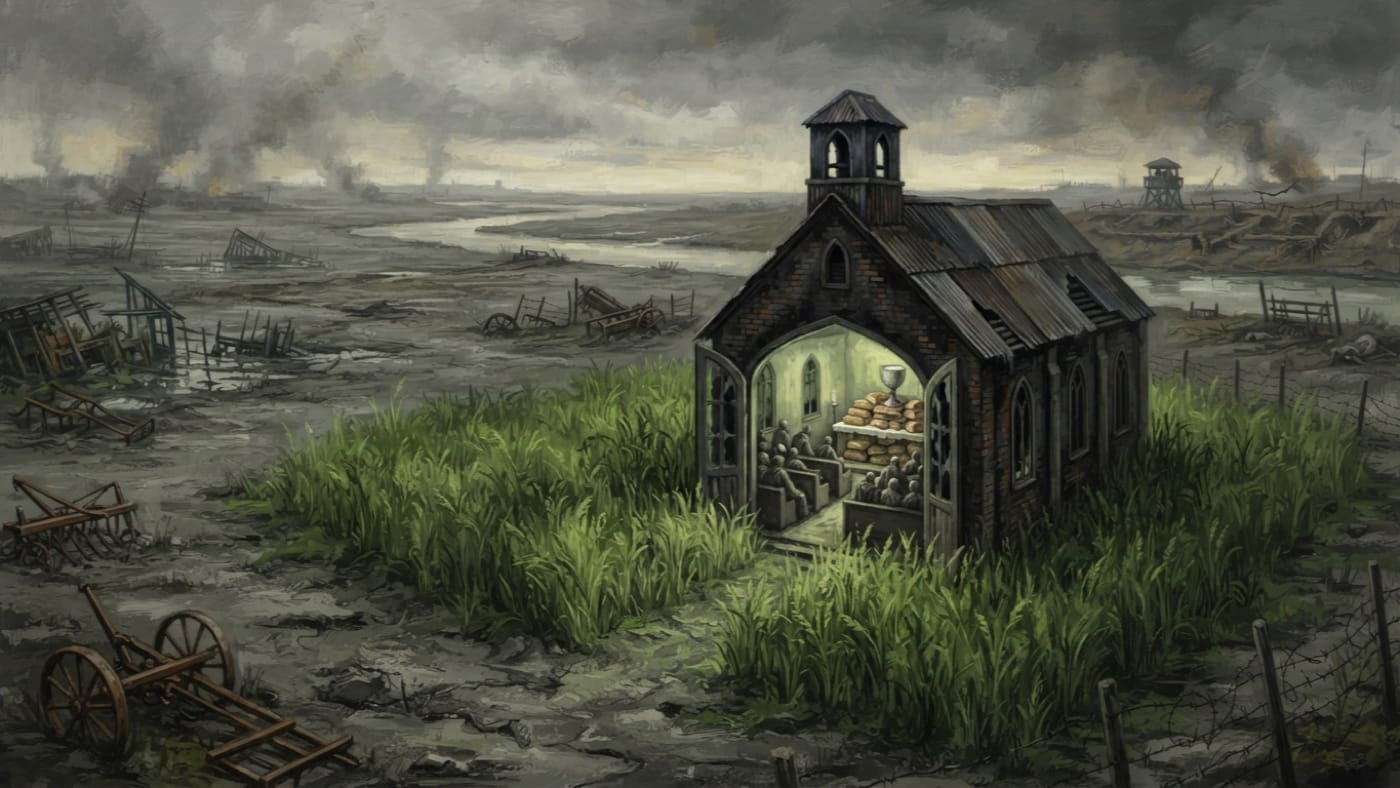
The community had built a chapel inside the Field.
The record does not describe its walls, its dedication or its builders. It records the interior. The altar was made of stacked loaves. The chalice held milk. Every pew was occupied, and every worshipper was dead.
The presiding clerk wrote that the congregation appeared attentive.
I have read that line more often than the Creed. I still cannot decide whether it is the worst sentence in the Kargath files or the most accurate one. The clerk was no poet. The office trained its clerks to record posture, condition, number and disposition, and this one recorded posture. The dead were seated. They faced the altar. Their attention was intact, so far as a clerk can certify such a thing. Whatever else Kargath took from them, he left the form of worship standing, correctly turned toward the bread.
The altar states the doctrine of the place in flour. A Church altar lifts the offering toward the Creator. Here the offering had become the altar, and the bread pointed to nothing beyond itself. The milk in the chalice is plainer still. Milk is the first food, given before a child knows how to ask for it. A parish that filled its chalice with milk had reached a liturgy in which the Field was mother, table and god together, and the congregation came to be fed.
I am permitted to condemn this, and I do. I am not permitted to know how it happened, and I will not pretend to. The file contains no sermon and no witness to the last service. It does not say who stopped eating first, and it gives no tally of the dead that I am authorised to reproduce. The public copy does not record who found them, what was done with the remains, or what has become of the building. No one with a pen has gone back, and Standing Order 119-F would forbid it to anyone who tried.
The reviewing analysts of the Bureau of Doctrine filed the incident under heresy, because heresy has forms and fees. I find a less comfortable word for it. These people invented no rival god. They took the worship we had taught them and pointed it at the thing that fed them, and we had told them that was what worship was for.
#On the Four Returns
The chapel was the third of four confirmed communities. In A.S. 147, near Pécs, a remote village of about eighty souls died among full root-cellars. In A.S. 159, near Kaposvár, households died seated at their own tables. The Lowlands chapel followed in A.S. 174. In A.S. 191, near the northern edge of the Marsh, the dead were found in an orchard, reaching up toward the fruit, and the Bureau of War burned the orchard for nine days.
Read in order, the sites move outward from the house: cellar, table, chapel, orchard. Each time the parish carried its hunger into a more public room. I note the progression and take no doctrine from it. Four points make a line only for someone who needs one.
Public copies withhold the name of the Lowlands community. The official reason is the protection of surviving kin. No surviving kin have been identified. I hold that the real reason is commerce. A named village becomes a pilgrimage. A pilgrimage collects stalls, and stalls beside an Abundance Field sell exactly one product to customers who do not come home. A chapel full of attentive dead would draw devotees from three dioceses within a season, and some of them would want to kneel.
#On Refusal and the Present Rule
Standing Order 119-F was issued from Bastion-Constantinople in A.S. 163. That was after Pécs and Kaposvár, and eleven years before the chapel. The Lowlands deaths did not prompt the Order. They happened under it, in country too far from any patrol for anyone to be withdrawn. The Order requires withdrawal from unregistered cultivation within ten miles of the Blightmarsh boundary and forbids harvesting and sampling. Its revision in A.S. 199 classed smell as contact. In my experience it is the only amendment ever drafted by the nose.
Blessing does not cleanse the produce. Consecrated Field grain is still Field grain. The holiness passes over the husk and leaves the hunger underneath untouched. This has always been the position of the Church.
A Bureau of Relics circular asserted that triple-blessed grain from suspected Abundance sites may be rendered safe for emergency distribution.
Withdrawn, as the Harvest file records. The circular stays in the archive under "inconclusive." The Bureau now maintains that any cleric who blessed Field produce in reliance on it acted on personal authority. The Bureau has no record of being consulted, and has taken care to keep it that way.
The remedy is refusal, quarantine, burning, and hunger honestly endured. Chaplains begin the Litany of Sufficiency at the first sight of unregistered wheat. Its whole merit is that it keeps a man on the safe side of the rope until the officers can count him. Issued rations protect for the same reason: they are known, counted, dull and disappointing, and they promise nothing. A Lowlands smallholder in A.S. 174 had no ration hatch, no rope and no Order within reach. The smallholder had a field, a memory of bread, and a Church that had spent generations teaching that plenty is a sign.
The Lowlands lie where the Marsh and the Fields left them. Cartography still lists them as pending. The chapel's present condition is unrecorded, and so it will stay.