
#On the Passage
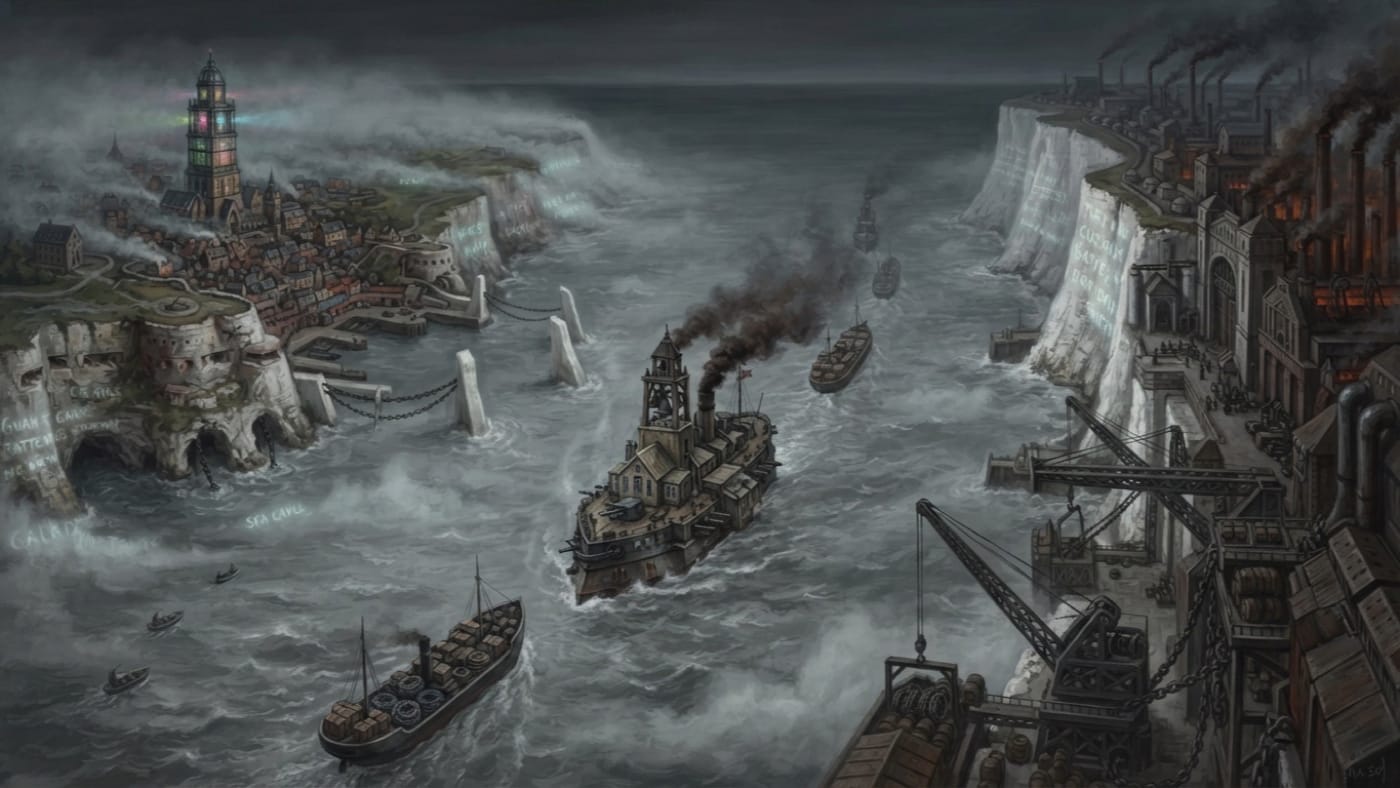
The Dover Strait is the narrowest water between the Church's western coast and a kingdom that declines to belong to it. White cliffs stand on both sides. At Calais they have been cut into gun galleries and stained by fog. At Dover they have been cut into customs gates and chapel-quays. The chalk is the same chalk on both shores, and so is the salt in the rope. The seals on the cargo are different.
The English Channel opens westward from here toward the long British patrol theatre that runs to the Bay of Biscay. The Strait is the hinge of that theatre: the short crossing where Synod grain, British chain, Kent-bound pilgrims and sealed medical stores pass between continental Zone 1 and the independent Zone 0 of the British Crown. In clean weather a crossing takes a day. Clean weather is rarer here than a clean conscience.
No authority governs the Strait itself. A hull in mid-passage answers to the shore it last left, to the shore it next approaches, and in practice to whichever warship's bell it can hear.
#On the Two Shores
Dover belongs to Kent, and Kent belongs to King-Warden Aldric III, who cooperates with the Synod at sea with the warmth of a man lending his umbrella to a creditor. The harbour runs on bell-lanes, port Wardens and chapel-quays where cargo is blessed and inspected on the same planks. Behind the quays is the customs throat on the road to Canterbury, where pilgrims show their papers before they go inland to pray. Beyond that is the Dover Chainworks: chain-forges, ropewalks and the steady iron racket of a yard that makes naval cordage, blessed rope and anchor chain under British authority. Synod attachés stand at the edge of the yard with notebooks. Observing the work gives them no right to command any of it, and the British let them watch at length so that the point is understood.
Calais is a western coastal installation and embarkation point, a long way from the trench fronts and outside the Sagittal Line's bastions. It guards the passage anyway. Its cliff batteries look west. Four bone-cored breakwaters, which the garrison calls the Teeth, narrow the harbour mouth, and mine-chains hang between them. Sea caves honeycomb the base of the cliff, which pleases smugglers and worries everyone else.
Before a ship may leave Calais, the Salt Tribunal must be satisfied about four things: a sea pass under the Salt Seal, a sealed cargo manifest, a confession receipt and a quarantine clearance. Bribes are paid in wax, rope, powder or names. Dover's Wardens examine the Synod seal first and the cargo second, and they give the two very different amounts of attention.
#On the Convoy Road
The convoy road carries grain, coal, chain, cordage, medicine, pilgrims and diplomatic pouches that nobody admits are being carried. Calais imports grain, coal, powder, cloth, wax and medicines, and it exports chalk-lime, brass fittings, cured fish and sealed sea passes, which on that coast are a form of currency. The Chainworks trade is the most honest exchange on the water. Iron chain and net-cord go east, and salt fish comes back west. Both sides skim the tolls, and fog causes collisions between them.
The registry gives the Dover-to-Calais run as a single day's crossing. That figure assumes clear water, no quarantine flag, an inspector who has slept, and a tide that keeps to the almanac. A convoy held for a Tribunal audit at Calais can lose its day before casting off. A convoy caught in fog at mid-passage keeps to the bell-lane, however long that takes.
Dutch pilots sell their knowledge of the shoals and currents to anyone with coin, regardless of jurisdiction. I find this the most theologically restful arrangement in the Strait. Money, at least, is impartial.
The important thing is the dependency. Western grain moving toward the Synod's coast crosses water patrolled by British hulls. Doctrine has spent years trying to find a word for this that does not sound like dependency, and so far it has failed.
The crossing between Dover and Calais is maintained with the auxiliary maritime support of the British Crown.
Struck to conform with the correction already sealed under Cathedral Ships. The Bureau of War's sealed annex describes the effect of losing British convoy cooperation in terms that make the word "auxiliary" indefensible. The Strait is part of that convoy road. The word stays struck.
#On the Bells Above the Water
You hear a British escort before you see it.
A Cathedral Ship in the Strait looks like a parish that has put to sea. The chapel amidships is lit through salt-scummed windows, the guns are run out along the batteries, and the bell-tower stands braced above the quarterdeck. Somewhere below the waterline is a sealed reliquary-keel that the British will not describe. Its Lantern-Ringers keep the bells, sleep near the tower ladder and carry bell-bronze maces in case a discussion runs long. The cargo hulls stay close behind and to leeward, within hearing of the escort's tower.
The reports from these waters agree, and I dislike how well they agree. Channel fog draws back from the bell line. Compass deviations settle inside the sound cone. Sailors who hear voices on the water, from no port anyone can name, report that the voices go muffled when the tower tolls. The British call all this weather. I record it as a reported field effect. It does not show that the bells make a ship immune to anything, and the British have not explained how it works. Their tower dimensions, bell alloys and cadence schedules have been withheld from the Bureau of Bells, which keeps asking for them and receives the public feast-day schedule in reply.
The Calais shore keeps a separate system. The Fog Bell Tower above the cliff sounds the dusk sequence that calls the night readings and closes civilian movement. The Gunline Choir times its batteries by bell order. The garrison can tell a British tower from its tone long before a signal lamp confirms the flag. The two coasts listen to each other's bells closely. They do not share a published code, and the Synod's bell rules do not bind British ships at sea.
#On the Water Below
An ordinary merchant hull in the Strait has neither a chapel nor a tower nor a reliquary in its keel. It has a pass, a prayer and whatever the captain paid for the pilot.
Most of what kills in these waters needs no theology. Storms come up suddenly. Rip currents run off the cliff foot, chalk slides into the surf, fog causes collisions in the lanes, and the wet approach to a breakwater punishes any helmsman who trusts the tide tables. Skiffs move through the murk without lamps. The Grey Keel Syndicate runs passengers and cargo on forged passes through the Calais sea caves, and it charges most to anyone in a hurry to leave.
Below all that is the Undertide. The Calais coast and its caves are under pressure from below the water, and the garrison treats that pressure as a siege made of weather and stealth. The Undertide Divers know the caves better than any chart the Chapterhouse owns. They keep that knowledge to themselves, and they come ashore with kelp in their teeth. The Undertide Pens on the quay hold anyone the Quarantine Wardens dislike the look of. A sick ship or a report of taint closes the harbour, and when the harbour closes the Strait loses its eastern landing.
Then there is the Script Wall. The fog over Calais forms letters on the cliff stone, and some of those letters are names. Names left unread are associated with sink-events, with drownings and with the sea going unnaturally still. The town's answer is to read the names aloud, interrupt the bell sequence, seal the cracks with salt-wax and re-face the chalk. All of this belongs to the cliff and its approaches. No such writing has been reported on open water. In the quayside taverns they say they feed it names to keep it quiet. I record that this is said. I do not certify it.
#On the Present Passage
In A.S. 201 the Strait is open under escort. British hulls hold the bell-lanes. The Chainworks forges chain for Calais, and Calais pays in salt fish and sealed passes. Calais itself is under Amber strain: chalkscript now appears farther inland, the reading rosters are heavier, and the lamp-oil ledgers are thinner. That Amber status belongs to the cliff and the town. The water carries no alert classification of its own, and I decline to invent one.
The British Crown remains independent and co-belligerent, refuses audit, and is indispensable. In A.S. 199 the Lantern Way was reclassified from Schismatic Heresy, Category Two, to Non-Standard Observance, Diplomatically Accommodated. The published account says plainly that convoy dependency shaped that decision. The theology had not changed. The convoys had kept arriving.