
#On the Oak That Carries Doctrine
A doctrine tablet is a board. Provincials hear the phrase and imagine stone, a mountaintop, a voice in cloud. I correct them. The doctrine tablet of the Order of Saint Ephrath is a working instrument of dense, dark oak, seasoned seven years and engraved on both faces with Articles of the Creed. It works no miracles and holds no saint's bones. It has carpenters, a shelf number and a sanding schedule.
Each face is cut deep enough to receive the head of a square iron nail. The obverse bears the Triune Knot. The reverse bears the seal of the Bureau of Purity, whose design I am not authorised to describe and the reader is not authorised to need. Ephrath's own emblem, the tongue transfixed above an open book, appears on its robes, banners and correspondence. It does not appear on the oak. The Order wears its own mark. The board carries only the marks of what it serves.
This distinction matters more than the novices suppose. The condemned man is used once. The oak is issued again. Every tablet in Prague has outlived someone, and most have outlived several, and the brothers handle the oldest boards with the deference a sacristan gives a chalice that has seen three bishops buried.
#On Its Authority
The tablet belongs to the second of Ephrath's three grades of humiliation. Exposure makes the condemned visible in his error. Reflection, perfected in the Pillars of Glass, shows the crowd its own face in the punished. Attachment binds the body to doctrine. The tablet is Attachment made portable: the body carries what the mind rejected, and it carries it in public, where the lesson is collected by everyone within sight of the street.
The theology of the tongue is credited to Grand Inquisitor Severian, whose writings on faithful severity Purity still cites when a magistrate grows squeamish. The choreography is Ephrath's. Severian explained why the mouth that served error should be bound to the Creed. Ephrath worked out how many paces a bound man can manage before he falls, and where the children should stand.
The Order's Prague chapterhouse enters the Ledger in A.S. 92 as a disciplinary theatre annex in the Bohemian severity district. By A.S. 94 the brothers had their licence, and the first Procession of Tongues crossed the Vltava with two hundred condemned, by the Seventh Revision of the Bureau of Records: captured Republican officers, Rationalist academics and the Prefectural clerks who had once administered the Republic's own processions. That account is the first in which the oak appears in use. Whoever planed the first board, and in what year, the Ledger does not say, and I decline to invent a joiner for the convenience of a reader who wants a founder.
The Procession of Tongues was adopted two years after the Bureaus were constituted.
Corrected. The Bureaus were never constituted in a single season. Offices and organs existed long before the Concordat. Records was transformed in A.S. 78, Purity's Index work developed from A.S. 80, and the formal Synod was settled at Strasbourg only in A.S. 90. The Ephrath annex of A.S. 92 and the licence of A.S. 94 belong to the consolidation that followed. The earlier sentence was tidy, which is how I knew to distrust it.
#On the Board in Procession
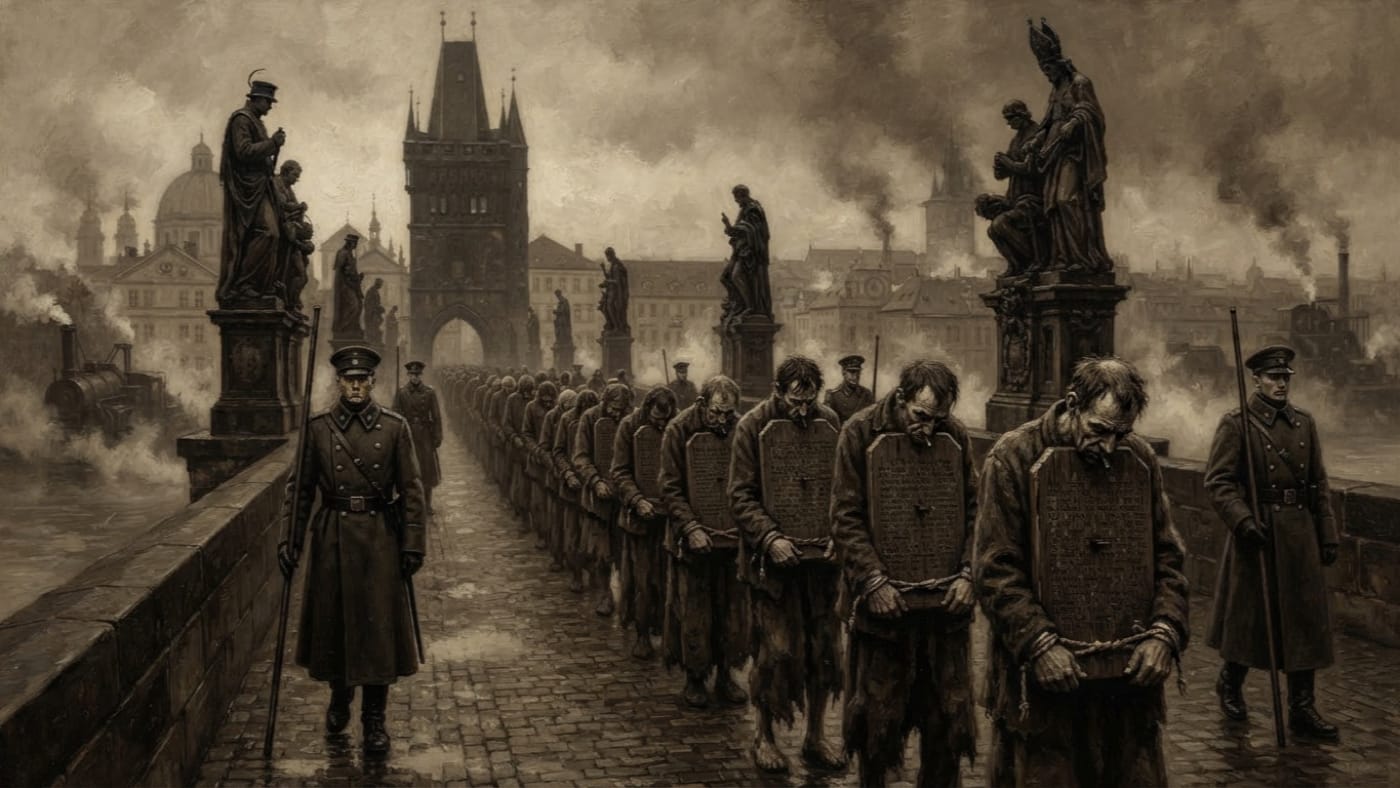
The tablet's public day begins in private. At dawn the condemned stand in the chapterhouse courtyard above the Vltava, and the boards are brought out from the stores already sanded and inspected. The tongs come forward, then the nail at dull-red heat. The brothers are quick about it. The Order's manuals call the moment the commencement of ambulatory confession. I will leave the anatomy to the manuals and keep to the woodwork.
The condemned then holds the tablet before him, with his hands tied to its edges. The cord fixes his grip and the grip fixes the board, so his posture is decided by carpentry. He cannot lower the Creed without lowering his own face to follow it. He cannot turn from the Articles, because they are fastened to him at the mouth. The Order considers this the finest arrangement of a human body yet devised for catechesis, and I have not heard a better one proposed.
The route was fixed by charter in A.S. 96, a regulation of streets and not of timber. The procession descends from the chapterhouse, crosses Charles Bridge beneath the stone saints, and passes through the university quarter, where the Rationalists once taught that a good argument could stand in for obedience. Bells time each step. The Bureau of Orison and Song lets fog out of the vents across the cobbles. Witnesses are arranged along the route, children among them. The children count the tablets. Ephrath counts the children.
What the crowd sees is speech made into posture. A man who wrote treatises walks with his tongue fixed to an engraved text he once mocked. He cannot recite it or refute it. He can only carry it. The board does the instructing. He is, for the length of the route, its bracket.
#On the Warehouse and the Next Tongue
Beneath the Prague chapterhouse lie the tablet stores, which I have called among the most appalling archives in the Synod and will call so again, because I do not waste a good phrase on one article. The shelves climb higher than confession screens. The boards stand on edge in ranks, sorted by year, route, offence, nail diameter and what the Order's registers call final silence weight.
The older tablets interest me most. Their nail-holes have been worn smooth by long use, the grain polished around the opening like a stair-tread in an old abbey. The newer boards still splinter. Between uses the brothers sand each tablet with care, taking off the raggedness but leaving the hole, since the hole is the board's record of service and the next condemned is entitled to a clean one. The Order's reasoning is economical and theological in equal parts. Ragged wood draws the crowd's eye to the injury. A clean opening keeps it on the Creed.
Consider what the shelves mean. Every condemned man believes his sentence is personal. The warehouse corrects him. His board was cut before his arrest, it has held other tongues, and it will be sanded and shelved after he has finished with it, filed under a year and an offence beside a hundred others. The Order does not replace the tablet for each man. It hands each man the tablet that is ready.
Novices learn this before they learn anything else. In their first year they carry the tablets empty, up and down the training yard, until arms, shoulders and stride adjust to oak. In the second year the tablets are weighted with wet sand. In the third they learn handling and timing: tongs, nail, cord, lift, brace and the pause. A brother who has carried the board for two years knows how it pulls on a body at the four hundredth pace, and he puts it in a condemned man's hands knowing exactly what it will do.
#On the Articles and Their Custody
The engraving is Creed. Junior clerks are forever confusing it with the Catechism of Obedience, and junior clerks are forever wrong. The Catechism is taught, recited and examined in its own form. The tablets carry Articles of the Creed. Which Articles, how many to a face, and in what order the cutters set them, I leave to the copies held by the Bureau of Doctrine. A codex is a poor place to publish a carving template, and a worse place to get one wrong.
Custody follows the chain of command. The boards are Purity's instruments, kept by Ephrath under Purity's seal. The Order maintains them, sorts them and sands them, and when it travels it packs them into collapsible tablet racks alongside its portable platforms and oilcloth banners. Records counts them as it counts everything. No citizen owns a tablet, and the condemned owns his for less time than anyone, holding it from courtyard to final bell, after which it returns to the shelf it came from.
#On Present Application
In A.S. 201 the tablets are in service, and Prague remains their principal seat. The stores are stocked. The novices are carrying sand. Bells are cast, vents primed and the route charter in force, and when Purity sends down a fresh list of the condemned, the brothers go to the shelves before they go to the courtyard.
Ephrath holds licences elsewhere, and provincial correspondents too often assume the oak travels with the brothers unchanged. That does not follow. Lyon keeps its own festival under a similar name, in which citizens recite until their voices give out and are then gagged. It is a separate custom with its own logic and its own cloth, and it does not use nailed oak. A licensed order adapts to the city it serves. The Prague rite, with its seasoned boards, square iron and bridge, belongs to Prague, and I will thank provincial correspondents to stop crediting the chapterhouse with every humiliation performed in grey-white sleeves.
The boards will outlast this article. Several have outlasted the clerks who first catalogued them, and one or two, judging by the smoothness of their holes, have outlasted the shelves they were first stored on. When the next condemned walks onto Charles Bridge, a brother will hand him a board that is clean, sanded and correctly filed. Whatever he once argued, the Creed will reach the university quarter ahead of him.