
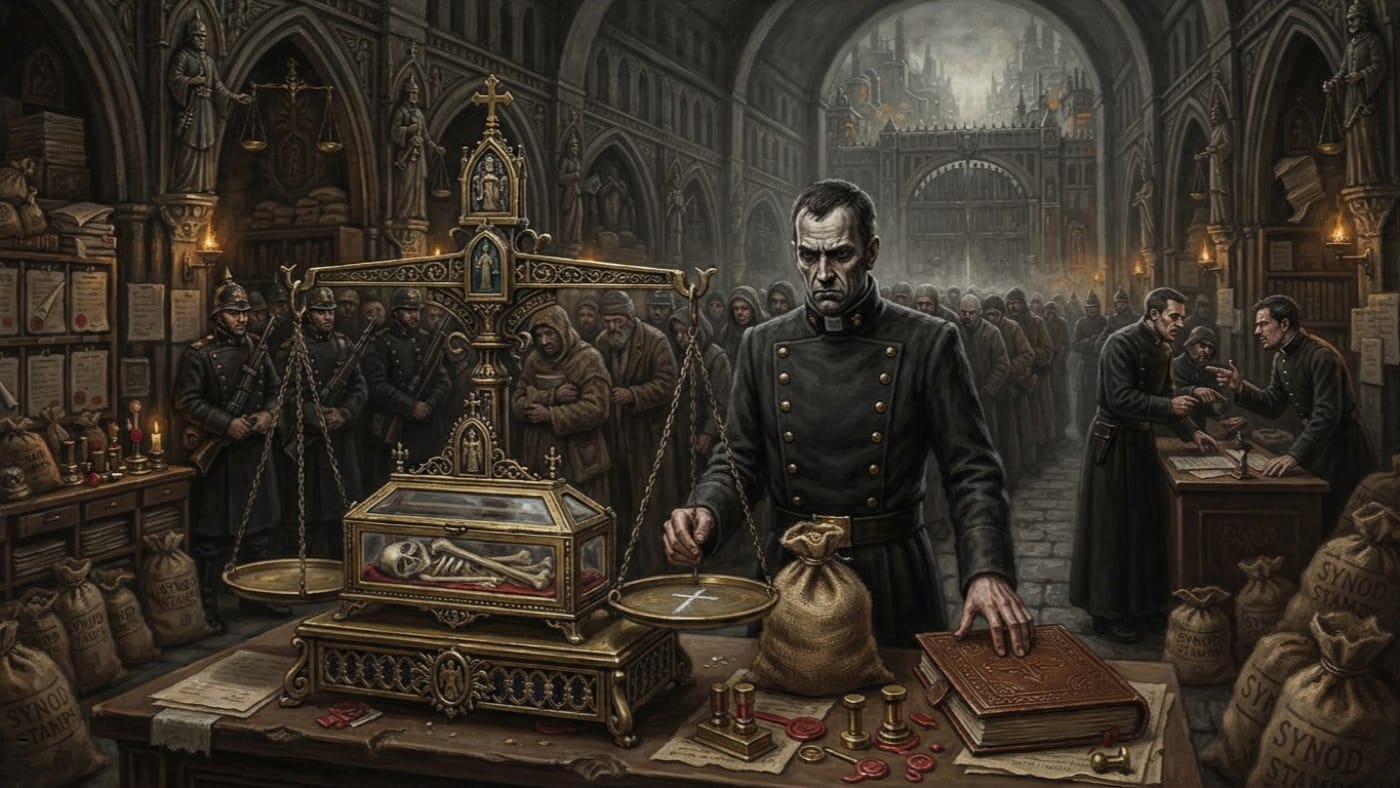
#On Sacred Measure
The Doctrine of Measure is the Church's teaching that weighing on a Synod scale is a sacramental act, that the scale belongs to the Synod as state-holy property, and that a deliberately false weight is heresy and not merely theft. It governs every tariff chapel on the Line: port gates, market wards, pilgrim-road chokepoints and trench supply depots. Wherever a sack crosses a threshold under law, the doctrine stands behind the clerk with its arms folded.
Readers looking for the founding instrument can stop looking. No bull is headed Doctrine of Measure. No council voted it into numbered clauses, and no author's portrait hangs in the Bureau of Doctrine beside the ink-cupboard. The teaching lives in the practice: in the casket, the chalk, the seal and the ledger, and in the clerk who is punished when any of them goes astray. A doctrine written in procedure is harder to repeal than one written in Latin, because you would have to burn every chapel to find all its clauses.
The institution explains it in one breath: the saints knew true measure, and demons thrive in ambiguity. That is the approved reading, and I set it down under seal. The practical reading is shorter. The regions had broken standards, forged weights, a dozen competing currencies, and a front that ate grain faster than farmers grew it. Someone had to say what a pound was, in a voice no guild could buy.
A scale that tells the truth is the first requirement of justice. It is a long way from being the last.
#On the Seizure of the Scales
In A.S. 97 a grain guild poured lead into the weighing pans at the southern gate of a bastion I decline to name, because the bastion has suffered enough and its archivists sue. Every sack weighed heavy and every tariff came in fat. The queue paid for flour it never received until it could pay nothing at all, and the city starved one ounce at a time. Then the city burned: the gate, the guild hall, and a good deal besides. This was the Bread-Scale Uprising.
The Synod's answer was unsentimental. It seized the scales and outlawed private measurement. It declared weighing a sacramental act, which made a leaded pan a sin against the altar and a guild weigher a heretic with an abacus. Within the year it adopted reliquary calibration. Bone slivers, saint-ash and splintered hymn-metal were locked in caskets and set against the scale-arm as the anchor from which all honest weight proceeds. Relics were chosen because they are rare, hard to counterfeit well, and impossible to argue with in a market square. A brass weight can be filed. Try filing a saint in front of a crowd.
That seizure produced the Commerce Clerk, the chapel, the stamped weight and the witnessed zero. The founders had been dead for nearly a decade and had no hand in any of it. Anyone who tells you otherwise is selling a commemorative plate.
#On the Witnessed Zero
Every shift begins in the same order, and the order is the doctrine.
The clerk opens the calibration casket before a witness, touches the fragment to the scale-arm, recites the calibration line in full and chalks a small cross on the pan. The empty scale settles and its zero is recorded. The profession forbids calibrating alone. An unwitnessed scale, it says, will choose a side, and so will the auditors.
What the rite establishes is narrow and precious. At a written hour, before a second pair of eyes, the instrument agrees with the Church's standard. It establishes nothing yet about the cargo, the price, the cleanliness of the grain or the honesty of the man carrying it.
The queue then passes through the sequence. The clerk checks identity and manifest, and verifies calibration again in front of witnesses. He weighs the sack gross, then net. The street version is two-pass or riot. He computes the tariff from the rate sheet, applies the purity mark or condemns the load, issues seal and ticket, reconciles the ledger, and files a copy in the archive for the auditors.
Each act answers a different question, and each answers to a different master. Weight belongs to the scale. The tariff belongs to Tithes and its rate sheets, which shift with war, season and "sector discipline." The purity mark is enforced by Purity. Ticket and archive copy go to Records. Sanctioned trade as a whole sits under the Bureau of Commerce, and every one of these offices believes the chapel is chiefly its own. Confuse the questions and one day you will find yourself at an inquiry, defending a correct weight as though it were a correct tariff.
The fragment in the casket raises a separate question again. Its sanctity is the business of the Bureau of Relics: provenance, examination, authorised narrative and notarisation. The clerk does not authenticate. He trusts a paper that says someone else did. After the Relic Counterfeit Scandal stocked port caskets with bone of a distinctly porcine character, relic assay became mandatory, and the zero has carried a faint smell of the sty ever since.
#On Mercy and Exactitude
Every clerk recites Measure is mercy and False weight is heresy. They agree on the words and have never agreed on the arithmetic.
The True Measure Zealots hold the doctrine at its sharpest edge. They zero once as the rite requires, then a second time, and in some chapels a third. They clean the pans between sacks, refuse cracked wax, and record every bribe by amount, donor and witness. Their private maxims are their own: the pan decides, drift is confession by metal, the zero remembers. The Bureau has not adopted them, and the faction would do well to stop quoting them as if it had. Repeated zeroing is their discipline. It is not required of the ordinary clerk, and the ordinary clerk who skips it is no heretic. He is merely faster.
The Mercy Weighers read the same slogan from the other end. A widow with half a sack and three children has her tariff shaved by a hair. The difference is recovered later in the week from a fat guild caravan, and the book balances. They call this mercy. The Zealots call it false weight in a charitable hat.
Both claim Saint Calibrus, the Level Hand. His icon holds a suspended balance over a kneeling crowd and keeps its mouth shut, which is the wisest thing anyone in this dispute has done. Neither faction is a separate Church, and neither has been crowned the whole of orthodoxy.
The Zealot's virtue is plain. Fraud dies at his gate, and a guild with leaded pans cannot work within sight of him. His fault is just as plain. The hungry customer meets exactly the lawful tariff on exactly the lawful weight, and if she cannot pay it, the doctrine has nothing further to say. The Mercy Weigher feeds her by cooking a ledger. A cooked ledger is precisely what killed the Bread-Scale dead.
Training summaries circulating in tariff chapels hold that a weight correctly taken and correctly sealed is, by that fact, a just weight.
Withdrawn. The Bureau of Doctrine affirms that false weight is heresy. It has never approved the inference that every lawful weight is just. Clerks who cite that inference in a dispute will be corrected in writing, and the correction will be weighed.
#On Balanced Ledgers and Empty Sacks
The doctrine has two great embarrassments, and both were perfectly measured.
In A.S. 129 a grain fleet came into Varna harbour sound and dry, under calibrated scales, with no weight in dispute. The offices quarrelled over which tariff jurisdiction applied, and the quarrel ran until the grain rotted in the holds. The city rioted and Purity intervened. Records then declared the deprivation a holy fast, and Tithes declared every calculation correct. Every calculation was correct. The Ledgers of Varna are taught to clerks as a failure of velocity. Nobody at Varna weighed anything wrongly. The food simply never moved.
In A.S. 147 two inspectors at Novi Sad stamped one cargo with conflicting seals, and each office declared its own seal valid. The cargo was allocated twice on paper, and ration lists were drawn against grain that existed only once. People queued for their allocation of administrative fiction and died of it, while Records filed the ledgers as balanced. The scales at Novi Sad were sound and the grain did not multiply. The seals did the lying, and every one of them was lawful. This was the Stamp War of Novi Sad.
The Doctrine of Measure stops theft at the pan. It has no jurisdiction over a fleet held at anchor while offices argue, or over a single sack promised to two hungry halls. A True Measure clerk at Varna could have certified the rot to the half-ounce.
#On Present Application
As of A.S. 201 the doctrine is at work in every licensed weighhouse along the Sagittal Line. It runs in harbour chapels that smell of tar and incense, in market alcoves where children are told to stand still and stop breathing on the pan, and in depot chapels where ammunition convoys idle while a clerk chalks his cross. The Synod asks two incompatible things of it. It wants honest weight, because nothing breaks a bastion faster than the belief that the scales are lying. It also wants speed, because Tithes counts revenue by the hour and quartermasters count it by the convoy.
Sanctions remain proportionate and permanent. A clerk caught at false measure loses his seal, then his posting, and then, for a sufficiently instructive case, the use of his walls through immurement. Systemic distortion across a whole chapel is punished by erasure, which the profession regards as a promotion out of the queue. The single True Measure clerk kept at each major gate is there as a deterrent, and no one there is fond of him.