
#On the Charge
“One heretic is a sinner. Two is a congregation.” — court-annex proverb, origin unrecorded
Doctrinal Contamination is the Synod’s name for error that travels. A heretic alone in his cell is a regrettable man. A heretic who teaches, sings, annotates, falters over the Creed in company, or refuses to answer a street catechist in front of children is an epidemic with an address. The Bureau of Doctrine treats him accordingly.
The charge is wide on purpose. It covers heresy, contagious doubt, unlawful teaching, repeated catechetical failure, forbidden speech, hostile silence and shrine tampering. It also covers certain acoustic events, the kind after which everyone in the room suddenly starts following procedure. The commentary on Standing Order 14-M calls it the wide gate. I drafted part of that commentary. Had anyone asked, I would have made the gate wider. Nobody asked, because nobody wanted the answer.
Its premise is that belief can be caught. A wrong word in one ear can ripen in the next. A pause in the Creed becomes curriculum once a child sees it. The Church does not wait for the sickness to show. It records the exposure and acts on that.
#On Declaration and Transmission
Three Bureaus share this charge and resent the sharing. Doctrine declares what may be believed and said. The Bureau of Purity investigates, seizes and enforces. The Bureau of Records keeps the classification, the evidence, the identity and the sentence, and keeps them longer than anyone else. When Doctrine and Purity rule differently on a file, Records binds both rulings into one folio and waits to see which survives. In my experience Records has never backed the wrong one.
Two instruments handle the words. The Index Claritatis lists the words a loyal mouth may use. The Index Damnatus lists the texts, names, songs and relics nobody may touch. A clerk who confuses them once is retrained. A clerk who confuses them twice ends up listed in neither.
Detection is the work of many small offices. The Doctrine Street-Vicar stops citizens at corners. He tests the Creed, checks tokens, writes correction slips and marks the doorways worth watching. The Codex “Doubt” Auditor compares confession abstracts against attendance rolls. He sorts each variance into benign hesitation, contagious doubt, organized heresy or infiltration. The White-Mantled Inquisitor traces suspect language back through print, song, chant, graffiti and rumour, and seizes the source when he finds it. Denunciations arrive at every stage, unrequested and in quantity.
Article 9 lays the legal floor. Heresy is whatever Doctrine declares it to be, and the declaration reaches back to the moment the thought first formed. A phrase a grandmother spoke innocently in her youth may be declared contaminating in her grandson’s time, and it will have been contaminating all along. Article 19 of the Catechism of Obedience keeps the cases coming. Every subject must report deviation, or “spiritual unease of a character suggesting contamination,” within twenty-four hours. Keeping quiet about what one heard is itself an offence. By Purity’s own count, Article 19 produces more prosecutions than every other Article combined.
#On the Degree That Reaches the Wall
Standing Order 14-M, issued by Doctrine in A.S. 104, permits immurement for Doctrinal Contamination of the Second Degree or above. The depot histories say “sufficient degree.” That is the shorthand. The law says Second Degree.
Doctrine decides, file by file, what separates the First Degree from the Second. I will not publish a table for men who would use it as a map. The degree measures the contamination. It is a different count from the number of offences under Article 9, whose schedule runs from supervised recantation to public penance to the wall. A first offender may carry a grave degree, and a third offender a slight one. The Judge reads both columns, and either one may be enough.
The precedent came from another crime. In A.S. 97 the Ration Plunder Winter produced the first formal writ of immurement. A Rhineland depot clerk had diverted three barrels of flour. He was walled into the depot’s east wall, and theft there fell to zero within the week. That case was Resource Betrayal, and every honest file still says so. Seven years later, 14-M took the depot’s lesson and extended it to Doctrine. Flour supplied the method, and heresy inherited it.
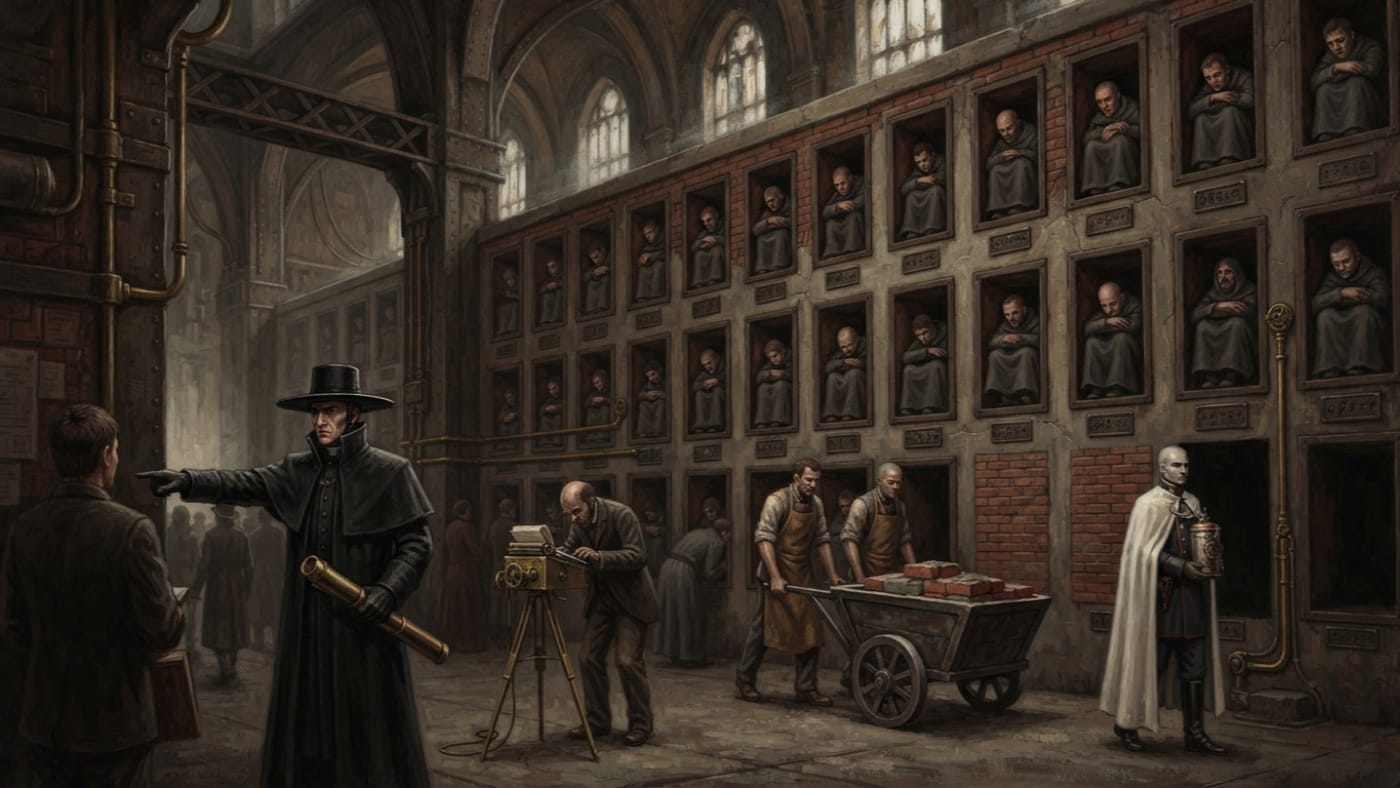
The letter of the Order is exact. A lawful sentence needs a writ and verified custody. The name and charge must match. The binding mix must be approved. The plaque must carry name, charge, hymn-line and seal imprint. The mason sets his stamp and a completion record is filed. Certain aggravated contaminations receive the seated penitential box. Others fold or stand as the Judge directs, and most referrals never reach a wall at all. Plaques for this charge face court annexes, inward walls and restricted instruction routes, where the right readers pass and the wrong ones do not. Air provisions are at the discretion of the presiding Judge. The Bureau recommends none.
The Sentence Masons argue over that line the way they argue over everything. Pure Sealers take the recommendation as a command and lay a seam with no breath in it. Breath-Givers read the discretion as room to work. They argue that a contaminated man teaches longer if he lives longer. Sometimes they win an authorised slit from the Judge. Sometimes they sell an unauthorised reed to the family. Neither faction judges anyone. Both get judged eventually.
#On Potential
The finest example of the charge involves no wall at all.
In A.S. 112, mothers in Vienna’s pilgrim quarters sang their children a lullaby about rain and barley. The Bureau of Orison and Song classified it as “an unsanctioned cadence exhibiting potential for doctrinal contamination.” Within the month, five thousand mothers had their tongues branded with hymn-fire. Their children were reassigned to Mercy orphanages. The Vienna Incident is still a training case in Orison schools and Purity manuals.
Read the classification the way a lawyer reads a contract. “Potential” freed the file from any need for proof. “Doctrinal” moved the matter out of the nursery and into theology. “Contamination” turned a tune that worked into an illness that spread. Each word did a clerk’s day of labour, and none of them required the song to have harmed anyone.
The surviving record shows no breach, no corruption and no demon at any cradle. It shows children who slept and mothers who taught one another the verses. It shows households that refused to name the first singer, and an approved Mercy sleep phrase that failed in every room where the old tune worked. Orison judged these symptoms adequate.
Public copies of the Vienna digest stated that the lullaby caused “measurable spiritual degradation among affected households.”
Withdrawn from internal editions. No such measurement survives. The households slept.
Vienna is useful because the case is so clean. A heretical pamphlet comes with a printer, a press and a buyer. A lullaby comes from exhaustion, and every household has plenty of that. The charge was built for exactly this problem. If nobody can trace how the error spread, exposure is presumed. If nobody can measure harm, potential is recorded. If the only evidence is a sleeping infant, the iron is heated anyway.
This does not mean the Inquisitors chase phantoms. Some words do open what ought to stay shut. Vienna proves only that the charge never asks which kind of word it has caught.
#On Present Application
By A.S. 201 the charge reaches inward. The Twelfth Amendment of A.S. 196 brought private devotional sentiment under jurisdiction. What Purity had called the internal loophole shut like a ledger. Unauthorised hope, unlicensed grief, and doubt kept entirely behind the teeth can all now be referred. In practice they are referred when a face slips during the wrong sermon, or when a neighbour needs a favour from Purity.
Doctrine and Purity still contradict each other every week. Doctrine permits a phrase in Strasbourg, and Purity seizes it on the Queue Road. Records keeps both rulings. The accused learns which one governs on the morning it is applied. Schoolmasters drill recitation harder after every circular. Printers burn their own proofs. Mothers hum less, and only indoors. Masons in the court-annex yards cut seated boxes to code. They wash lime from hands that have learned, without anyone teaching them, which plaques face inward.
Households pay first: a branded tongue, a reassigned child, a seized hymnal, a name in an Auditor’s black-book that will outlast the house. Officials pay next. Every Auditor knows a quiet quarter looks like negligence. Every Vicar knows that a pause he saw and did not report is an Article 19 matter of his own.