
#On the Cessation of Pity
Shared obligation is shared grace. — Bureau of Tithes route card, first clause
The Bureau of Tithes issued Directive 91-B in A.S. 139 under the title "On the Cessation of Pity Exemptions." With it the Synod stopped forgiving widows and began invoicing them gently. Careless readers trip on the number. Ninety-one is a filing designation, and a filing designation records no birth year. The instrument belongs to A.S. 139, a full generation after the founders were laid in their vaults, and no founder's hand touched it.
Its operative change fits on a receipt stub. Before 91-B, a bereaved household might stand on an exemption roll, outside the count, owing nothing for as long as a clerk's discretion held. After 91-B the roll was closed, every name on it was carried across to an assessable account, and each account was charged the Widow's Pennies at reduced rate. Grief kept its discount and lost its absence.
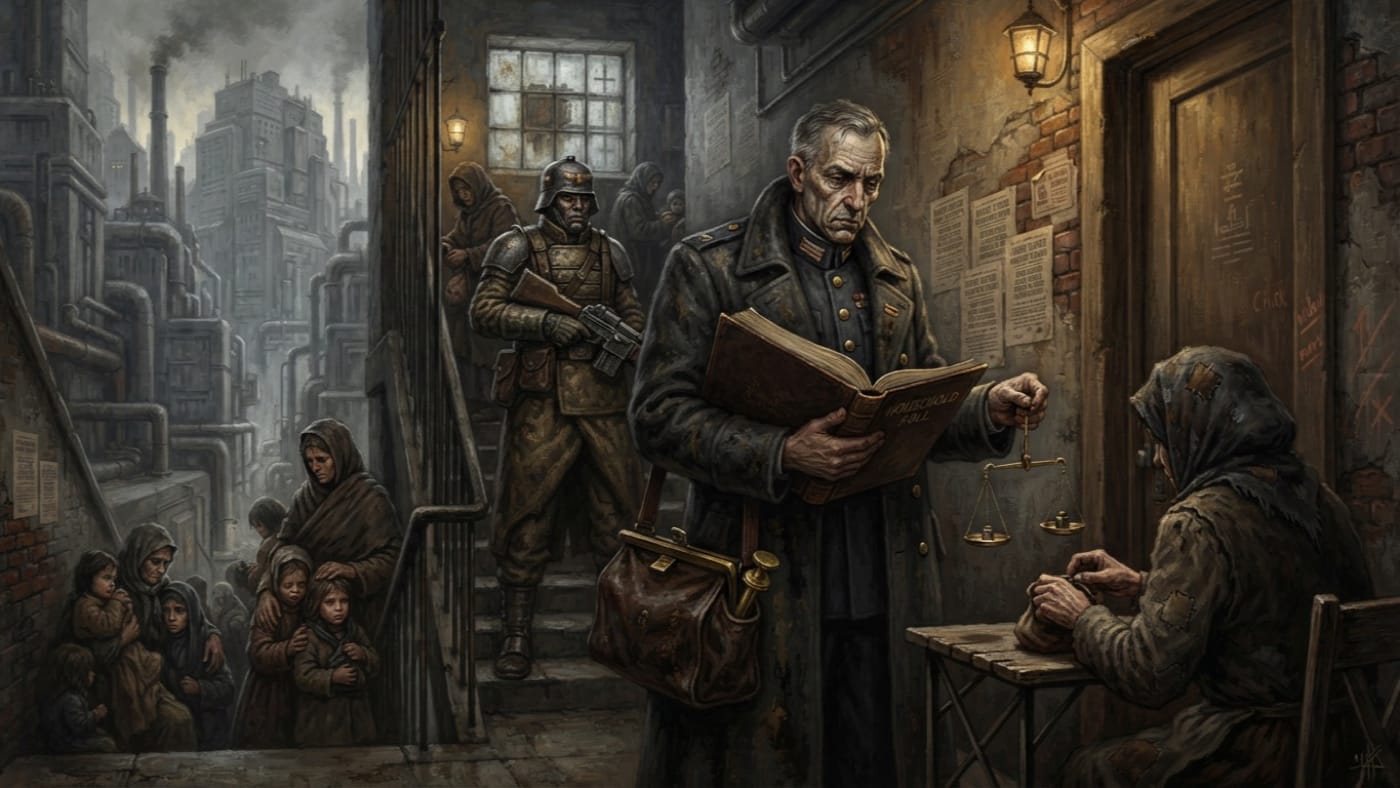
The Palatine Counting House at Strasbourg received the arithmetic and the Bureau of Doctrine supplied the grace. The Tithe Assessor carried both up the stairwell in a satchel.
#On the Exemption Rolls
The Widow's Pennies were older than 91-B. A famine levy under that name was taken in A.S. 65, when the offices that would later constitute the formal Synod were still learning to spell their own titles. The grief-toll customs later associated with Griefgate kept their own books on the pilgrim roads. The charge existed. Nobody had yet ruled that everyone owed it.
What existed instead was the pity exemption, which meant a district's mercy in the keeping of whichever clerk held the roll. In one parish a widow needed a confirmed death notice, a clean confession and a stair solvent enough to be worth recording. In the next she needed a neighbour willing to swear and a clerk willing to be fed. Rolls differed from parish to parish like local saints' days, and they were about as auditable.
War did the rest. The Sagittal Line consumes husbands in forms the Ledger cannot always itemise. The widow category swelled from wives of confirmed dead soldiers to wives of the missing, the conscripted, the imprisoned, the excommunicated and the erased. Last came the merely untraceable: men absent from every current file, whose households claimed exemption on the strength of a silence. On certain northern corridor routes feeding Bastion-Königsberg and Bastion-Brest, the Brenn dossier counts as many as a quarter of households paying nothing. Tithes began to speak of pity the way engineers speak of a cracked buttress.
#On the Brenn Memorandum
Assessor-General Kaethus Brenn wrote the precursor in A.S. 138. A memorandum proposes and a directive commands. The year between them is where the Bureau chose which of his sentences to keep.
Brenn proposed a reduced universal bereavement due. Where payment could not be substantial, he argued, it must be instructional. A small surrender keeps a household inside obedience, and a child who watches the coin leave the table learns the price of the wall before the catechist arrives. The revenue was almost beside the point, and that is the most honest thing any Assessor-General has ever put in ink.
He also drew gradations: symbolic reductions for widows of confirmed soldiers, heavier assessment for widows of heretics, and independent-household treatment for women whose husbands existed in no current file. These are recommendations in his hand. No authenticated text of 91-B survives to show which of them reached the operative clauses. I decline to forge a tariff to make the archive look tidy. Forgery is a Records sin, and I have enough of my own.
Beside his calculation Brenn squeezed a small prayer, in a hand smaller than his body text, asking the Creator's pardon for the arithmetic. Doctrine struck the plea and wrote in its place that the Creator requires it. Later copies of the memorandum are bound with minutes of the Second Fiscal Synod. That proves only that some clerk owned string.
A Bureau schoolroom primer called Brenn "Father of the Widow's Pennies."
Withdrawn. The charge already had older forms, including the A.S. 65 famine levy. Brenn universalised it, disciplined it, and gave the Bureau a reason to stop blushing about it. Its paternity belongs to famine. Brenn may keep the lesser title of tutor.
#On the Obligation
The enacted rule needs two lines. Pity exemptions ceased. Widow's Pennies became compulsory at a reduced universal rate.
Universal means liable. It does not mean identical. Every bereaved household that had stood outside the count now held an account, and each account was weighed, entered and assessed by the Assessor who climbed to its door. The levy is called Pennies for the same reason the Feast of Balanced Scales is called a feast: the Bureau names things by their intended mood. The sum on the receipt is whatever the household roll and the scale agree it must be.
Doctrine furnished the justification, and every route card still carries it whole: shared obligation is shared grace; exemption from obligation is exemption from grace; the graceless are the Enemy's harvest. Under this logic the old roll was a quarantine ward, and 91-B a charitable discharge. A widow who paid was readmitted to the common body. A widow who did not pay had taken herself out of it, and the Bureau would note the fact with regret, in triplicate.
Practice is quieter than doctrine and smells worse. The Assessor arrives in wet wool, his hands brine-washed against impurity. He carries the struck-through exemption roll, the new household roll, a folding scale and the receipt folio whose blanks are counted at dawn and again at dusk. He hears the widow out. The good ones listen a long time, because listening costs nothing and is never audited. Then the coin goes onto the pan and the pan clacks level. The receipt is torn from its blank, wax is pressed under the seal, and the counterfoil goes into the satchel. A receipt marks the line between grace and arrears. A household without one has crossed into the arrears ledger, and every later visit escalates from that entry.
#On the Enforcement After the Fire
Assessors posted the notices in the Lower District of Bastion-Königsberg, a city of bells and ice. They were answered with cooking pots. For three days in A.S. 139 the tenements struck metal against metal, blocked the stairs to collection, raised barricades of carts and benches, and on the second night saw the Lower District Tithe Office burn. The Records loss note reports four centuries of collection records gone. Whether the fire was a fallen lamp, an unbolted grate, a bought key or a deliberate hand remains disputed. The witnesses contradict one another so thoroughly that the file has grown fat on them. The full account belongs to the Widow Riot, and it can keep it.
For a short while the ash did what the widows had wanted. Arrears that had not reached district vaults vanished. Classifications became uncertain and old debts went up as smoke. Nothing was repealed. The directive stood on the scorched wall while Records rebuilt from parish duplicates and witness audit.
Then came the addendum. The original instrument closed the rolls and set the charge. The riot supplied the rest. Households lacking prior records were assessed by punitive estimate until documentation was restored, which in a burned district meant until the Creator chose to restore it. Arrears were marked on doors in rust-brown chalk. Escorts became mandatory on every Widow Route. Public pot-striking during collection windows was classed as obstruction of sacred accountancy, so that a kitchen implement struck at the wrong hour now amounted to a doctrinal offence.
#On the Present Application
As of A.S. 201, sixty-two years on, Directive 91-B has outlived its author, its rioters and the office it provoked into burning. The Widow Route is a recognised assignment and a recognised punishment, and Assessors with good patrons still go to some length to avoid it. Arrears pass from mother to child with the household account, because the account belongs to the house, and the Bureau has never once inherited a grief. The rust-brown chalk is renewed each season. In the rebuilt Lower District office, kettles carry permit tags.
The public vocabulary has been disciplined to match. Doctrine retired pity from notice walls after it proved flammable. The approved terms are reduced rate, bereavement class and shared burden. On the Feast of Balanced Scales, Saint Ysolt permits each Assessor one structured mercy, a single forgiven entry under the saint's patronage. That custom belongs to the Feast and nowhere in the text of 91-B, and any Assessor who cites it as a statutory exception will learn the difference from an inspector.
The broader history of the levy, its tolls and its exchanges belongs to its own entry. This entry concerns one instrument. The instrument holds.
The roll is closed. The account is open. The widow pays.