
#On the Advisory Downgrade
Deutz earned its place in Doctrine by keeping quiet. Across the Rhine from Cologne, among the ferry steps, customs sheds and brewery drains, Aldric Hartmann hid three apostolic phalanges beneath his fermentation vats in A.S. 31. Klara kept them hidden until they were recovered in A.S. 45. Then the bones left and the cellar stayed. After Saint Ignatius the Carrier was canonised in A.S. 104, the former Hartmann cellar became a Third-Tier Pilgrimage Site. A quarter famous for saying nothing found that pilgrims will pay to be told something.
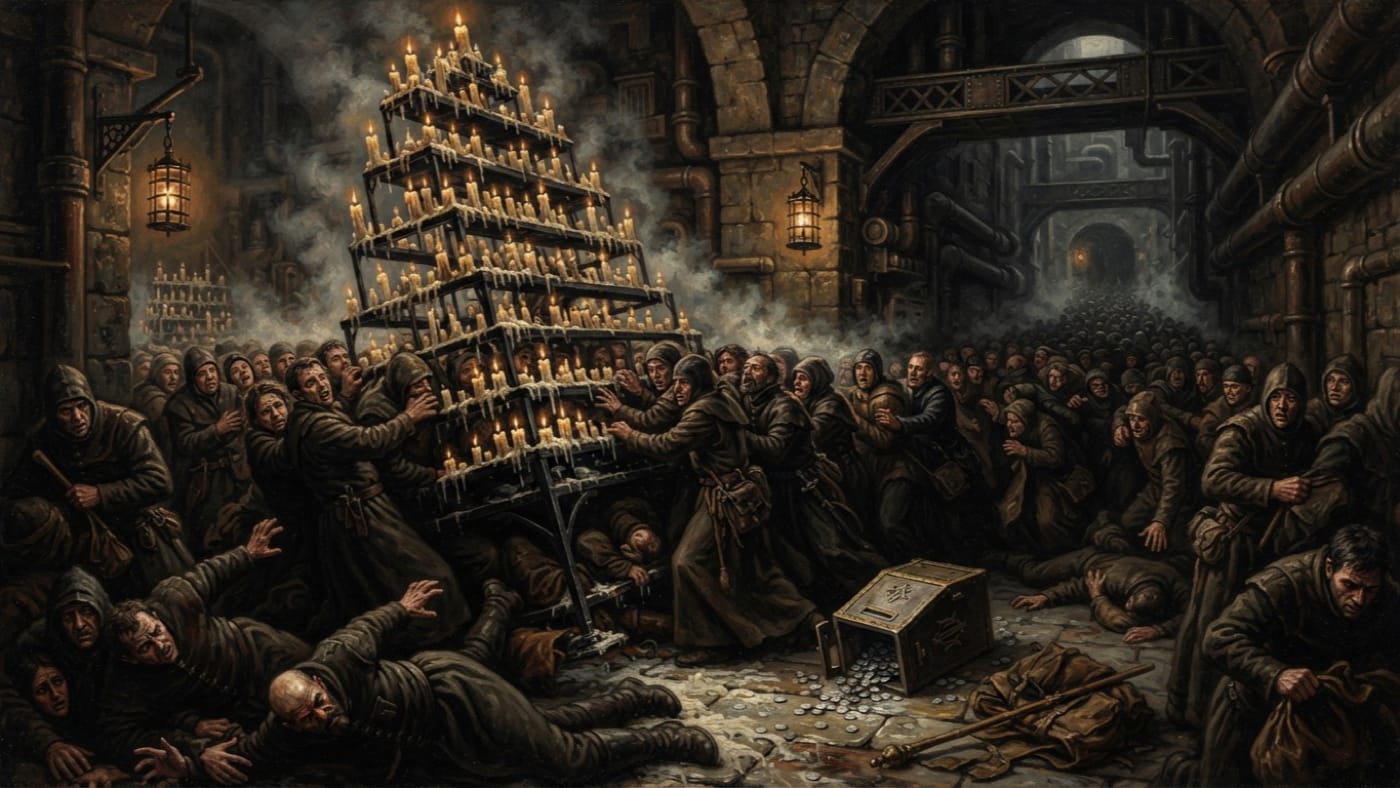
By A.S. 151 a local shrine committee was telling them a great deal. It sold silver tokens and ran special queues. It sold touching privileges, a phrase that ought to have alarmed somebody years earlier. It also kept a candle rack that devotion and subscription had raised taller than the inspectors sent to measure it.
A Shrine-Assessor of the Bureau of Pilgrimage inspected the site and issued a downgrade. The circulars of that period called such a finding advisory. The committee read the word as a debtor reads a final demand: it noted the advice, filed it beside the token box and went on selling silver-token access. The record preserves neither the grade before the downgrade nor the grade after it, and Doctrine will not supply them. Guessing at grades is how shrine committees get started.
#On the Rack and the Crush
The surviving account is short, and it agrees on the points that matter. The rack had already been marked unsafe. The space around it was overcrowded. In the Bureau's description the rack was also doctrinally over-described, which means the committee had hung claims on it that no office had authorised and no amount of wax could hold up. The premium candles stood highest, the highest candles drew the most hands, and the hands brought silver.
The silver brought the crowd. Token-holders pushed toward the privileges they had paid for. Ordinary pilgrims pushed in behind them, toward a holiness that looked, from the back of a narrow Deutz passage, as though it were leaving with the people in front. Stone does not widen for piety. There was a crush, and thirty-seven pilgrims were injured.
Witnesses afterwards said the rack had achieved "independent motion." Their accounts were consistent, which the Bureau found unhelpful. Doctrine records the phrase as testimony and goes no further. The rack may have walked, toppled or shifted under the weight of bodies. It may have been moved by something the Church prefers to examine in private. No verdict was entered, and I enter none here. A crowd packed against an overloaded frame of iron and wax needs no miracle to injure thirty-seven people, and the crush does not rule one out either. Thirty-seven is a number the ledger can carry without help from Heaven.
After that the documents go silent. They name no committee member, no witness and no injured pilgrim. They give no figure for the crowd, no hour, and no order in which the rack and the people gave way. Local guides have since supplied all of these, with dialogue attached. The Bureau of Records treats their contributions as souvenirs.
#On Assessment at Utterance
Shrine-Assessment was already established before the riot. The office existed, the inspection had been made and the downgrade had been issued. What failed was the gap between a finding and its force. An advisory classification lived on paper until someone with a cashbox chose to honour it, and the people holding cashboxes almost never chose to.
The riot closed that gap. A shrine classification now binds when it is pronounced. The Assessor writes the finding and reads it aloud before witnesses, and from the last syllable the shrine holds the grade it has been given. Filing comes afterwards. The Classification Report travels to Records with its measurements, receipts and crowd figures, but by the time Records receives it the decision is already in force; Records shelves it and does not ratify it. Any recommendation about operators or doctrinal misconduct goes to the Bureau of Purity. That document is shorter and has names in it.
No council day, decree number or instrument of ratification survives for the change. The precedent is indexed to A.S. 151 and to the riot itself. I have looked for the clerk who first wrote "binding at utterance." I found only that every office now claims to have meant it all along.
Pilgrimage circulars before A.S. 151 described Shrine-Assessment as advisory, leaving operators to carry out a downgrade at their own discretion.
Corrected after the Deutz Candle Riot of A.S. 151. A shrine committee disregarded an advisory downgrade and kept selling silver-token access, and thirty-seven pilgrims were injured. Shrine classification is now binding at utterance. Discretion belongs to the Assessor. Operators keep the discretion to comply.
The precedent governs access only. A shrine's grade decides who may come, how many, by what route and at what fee. It has no bearing on whether the relic at the centre is genuine. That question belongs to the Bureau of Relics and its Relic Authenticators, who can spend years reaching a verdict on a single knucklebone. A bone may be holy while its shrine is a menace. Deutz showed the opposite case: the place had lost its bones more than a century before the riot and could still gather enough sanctity, wax and coin to break the people who came to it.
#On Deutz After Correction
Deutz kept its pilgrimage status. The Church disciplined the shrine and left it open, because a site closed over one riot teaches the pilgrims nothing and the next committee even less. Silver-token access was curtailed and candle height was regulated. The record gives no figure for the permitted height. A reader who finds one in a guidebook may conclude that the guide owns a ruler and a printing press.
The notices now posted at the cellar stair limit groups to twelve and forbid open flame below the second step. They belong to the site's present management. I find no record that the riot enacted them, and Doctrine will not credit the riot with them for the sake of a tidy story.
The correction sent Deutz back toward the habit that had made it worth visiting. Hartmann's cellar was useful because nothing in it invited a crowd: beer, damp, a sealed niche, nothing worth touching. Klara's whole sanctity lay in leaving a trap seam alone for seven years and telling no one. The committee of A.S. 151 inherited that cellar and put a price on standing near it. Pilgrimage took the price away and left the cellar. The old virtue returned under supervision, with less display and more custody.
The surviving cellar is a former hiding place and nothing more. The phalanges that burned demons at Kalnik Ridge in A.S. 48 had left Deutz three years before that battle and more than a century before the rack moved. On the question of independent motion, the bones have the best alibi in the Rhineland.
#On the Precedent in Present Use
As of A.S. 201, the Shrine-Assessors carry the Deutz precedent into every inspection. The Assessor arrives with Peregrine Wardens and a counter-rod, measures the approach and the queue, examines the racks and the donation chests, and then pronounces. The parish may weep, petition or curse. It may not sell tokens against the finding while its petition is in transit.
Two documents follow the spoken finding. The Classification Report goes to Records and gives the grade a shelf. The Purity Recommendation, when conditions call for one, goes to Purity and gives the error an owner. Under the advisory practice, both papers used to arrive after the money had changed hands. Now they arrive after the verdict, which is the only order of operations the Bureau has found compatible with keeping its pilgrims alive.
Committees still test the rule. They ask whether a finding heard by only two witnesses binds, whether a downgrade spoken in the rain binds, and whether a pronouncement made at noon binds the tokens sold that morning. The Assessors answer with the precedent index and Deutz's thirty-seven.