
#On the Office
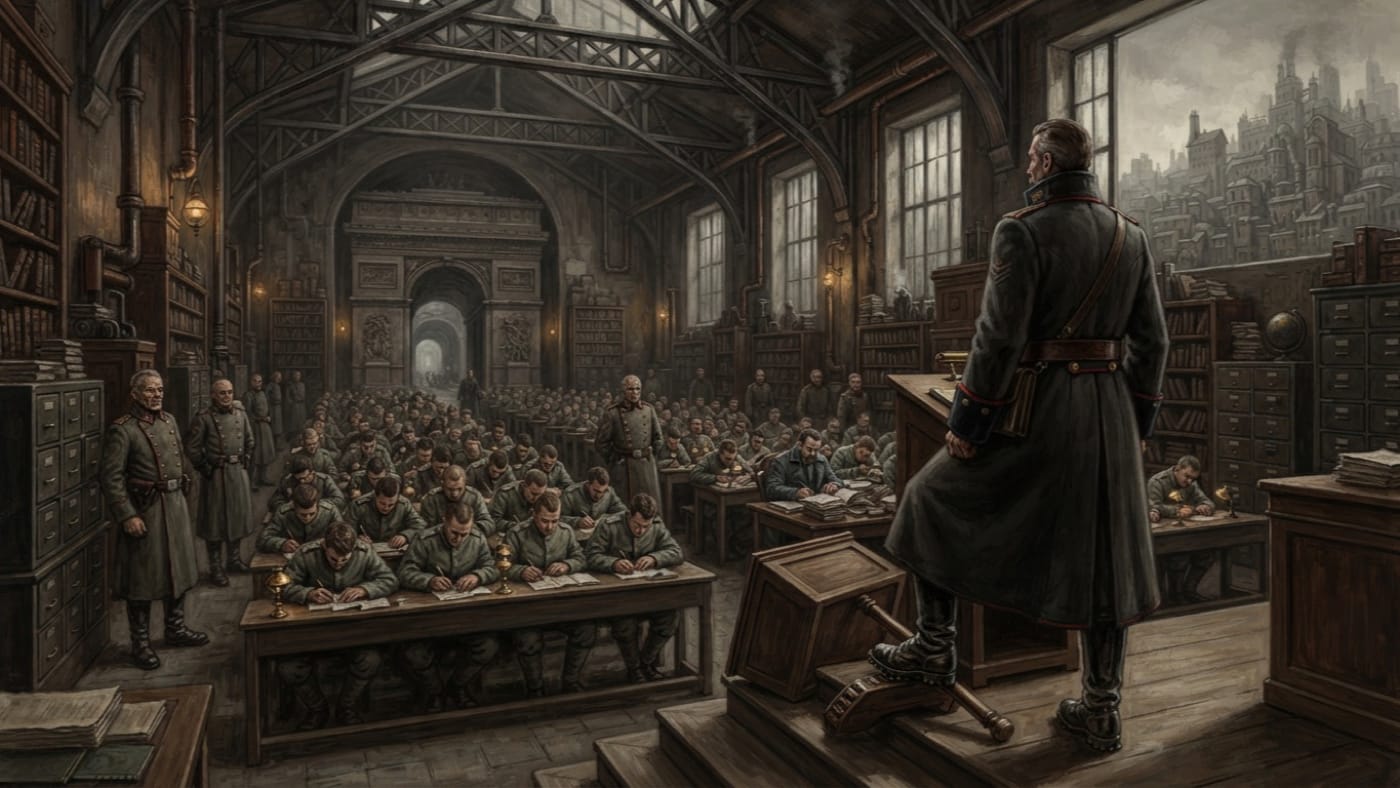
One boot in the lecture hall. The other on the lecturer.
The Dean-Marshal governs the War College. That is the whole of what a public file may certify about the office without an argument, and I have argued with files for longer than most cadets have been alive. The office holds its seal in the custody of the Bureau of War and governs under the supervision of Doctrine and Records. Its desk sits at the College's principal seat in the military quarter of Strasbourg, beside the Arch of Campaigns, and a tunnel under the drill yard joins the two. Cadets use the tunnel when it rains. Dispatches use it in every weather.
The rank requires field command, doctrinal certification and a War seal. I once added a fourth requirement: the ability to sit through a Records audit without confessing to murder just to end the meeting. No statute contains it. It is an observation, and I have not since mistaken it for procedure, whatever compliments the Records auditors may have paid it.
The present holder is unnamed in every file I am permitted to quote. I find no conspiracy in this. The documents never bothered to record his name, which is the Synod's usual courtesy to administrators who have given no trouble. I have written that he is less stupid than his stationery. I repeat the judgment here so that nobody files it as a slip of the pen.
#On the Faculties Under His Seal
The Charter of Crimson Ink gave War a permanent Bureau in A.S. 105, and the College's formal curriculum was put together in the years that followed. Records does not say when the words Dean-Marshal first appeared on a seal, and I will not invent a year to fill an empty line. A blank in the Ledger is still honest, which is more than its neighbours can claim.
Whatever its age, the office inherited a mixed faculty. Instructors come from War, Doctrine, Records, Orison, Engineering and Medicine, and with them come veteran officers whose wounds make them unpleasant company in polite rooms. Each Bureau sends its lecturers the way a poor diocese sends its tithe: late, short-weighted, and with a covering letter explaining why the shortfall is a mark of virtue.
These people do not agree, and they are not supposed to. Engineering wants a correct answer. Doctrine wants a final one. Records wants a citation, a countersignature and a second copy for the vault. Medicine wants the cadets to stop fainting. The veterans want the rest of the faculty to see one ditch at Novi Sad before saying anything further. It falls to the Dean-Marshal to make all of this into a timetable.
People underestimate timetables. If Engineering teaches the trajectory before Doctrine blesses the gun, the cadet learns that the gun works without a blessing. If Doctrine comes first, the cadet learns that a blessing aims the gun. The College can afford neither lesson. So the hours are interleaved, and each lecture is scheduled to correct the vanity of the one before it. The office's real work is the order of the bells.
The branch schools at Metz, Stuttgart, Kanzleiburg, the Vienna yards and certain forward bastions widen the College's reach without widening its governor. I have no itinerary showing the Dean-Marshal inspecting them in person. I have the branch syllabi, which carry the main house's seal, and I have the forward instructors' marginal comments on those syllabi, which do not belong in a public codex.
#On the Footnote Refused
What follows is my own recollection, and I mark it as such because the Ledger has nothing to say about it.
At a sitting whose date I did not write down, about a War College edition whose number I did not keep, I proposed footnoting Koeler. The proposal was modest: one line of small type naming the Vienna Prefectural Analyst whose A.S. 38 survey supplies the bones of Appendix 12-C. I have written elsewhere that the room went so cold I looked under the table for Syrion. That was a joke. The temperature was the usual temperature of a committee deciding not to like me.
"We do not cite Rationalists," said the Dean-Marshal.
Above us the roof stood on trusses copied out of a Rationalist engineering manual. I looked up. The trusses had no opinion. Those trusses have kept Doctrine dry through more winters than Doctrine likes to count.
My notes record the office and the sentence. They do not describe the man beneath the trusses, and I will not paint him in afterwards to tidy the anecdote. Whether the speaker that day is the officer who holds the seal in A.S. 201 is a question my notes leave open, and my vanity will not be allowed to close it.
The sentence also tells less than the truth. The College does write Koeler's surname into its hostile-source indices, its named tables and its annex labels. What it withholds is honour. His title is struck out, his given name is left out pending a harmonisation that will never come, and his work is put to use without thanks. The policy is appropriation with the courtesy removed. I have no objection to the method. I object to its being called principle.
The table itself is taught in the second logistics cycle. Ten thousand unarmoured advancing bodies, four thousand standard-calibre rounds and nine minutes, across open ground under favourable conditions. Koeler's arithmetic was right. Appendix 12-C then corrects for every unfavourable condition the instructors can name and for the waves that come after the first, because Ash-Fodder is never the whole of an attack. It is the price the enemy pays to empty your magazines. A cadet who gets the first wave right and calls the battle prepared fails the cycle, and he deserves to.
Koeler never taught at the College, and no Dean-Marshal stood in Vienna while he counted. The two met only on paper. The Dean-Marshal took the arithmetic and sent the author's name to the annex.
#On Initiative Within Obedience
The College has to turn out officers who can think on a ridge after the runner has been killed, and who will not take that thinking for a licence. The Dean-Marshal's office keeps the balance between those two demands. One withdrawn sentence in the files shows how narrow it is.
An A.S. 158 primer described the College's task as "forming independent commanders."
Withdrawn after frontier captains read independent as permission. The approved formulation is "forming commanders capable of initiative within obedience." The copy before me does not show which hand withdrew the text or on what day. Do not attribute the withdrawal to the present Dean-Marshal, who has enough to answer for already.
None of the College's devices carries his name, and I find no source crediting him with inventing any of them. He inherits them as he inherits the trusses. His office keeps them in working order.
In the third week, each cadet copies by hand the final order of Colonel Kreszner under a brass lamp, so that obedience is learned alongside its cost. In examination the cadet drafts a retreat order, works the ammunition against a first wave without mistaking it for the battle, picks out the relic token that has become bait, and recites the patrol report in its fixed order, with distance first and courage nowhere in it. The oral trial is held under three bells. The first marks tactical error and the second doctrinal error. The third has never been named, and I will not name it in a public file.
Ordinary cadets are allowed restricted extracts from the Sealed Testimonies and nothing more. The full volumes stay in the Vault of Silences, where the air is kept for documents. Purity inspects the dormitories for thought that has wandered away from the timetable. That is Purity's charge and Purity's procedure. The Dean-Marshal does not carry a lantern down the corridor at midnight, and I have no evidence that he would enjoy it.
#On the Present Charge
As of A.S. 201 the College is active, overfilled and doctrinally supervised. All three conditions belong to the Dean-Marshal now.
It is overfilled because the Sagittal Line uses up officers faster than noble houses and garrison schools can send them. Benches built for twelve now hold eighteen. The Koeler Annex, warm by design, is warmer still. The Records lecturers have had to give up their habit of reading casualty classifications aloud at full length, and they are visibly grieving about it. The Dean-Marshal has to send a full graduating class to the Line without sending it unfinished. War measures him on the first count, Doctrine on the second, and Records keeps the paperwork on both.
It is doctrinally supervised because the College handles dangerous material. It holds condemned methods, restricted testimony and the arithmetic of a man the Church would burn again if Records could find enough of him. Each item is useful and each is taught under a countersign. The Dean-Marshal governs how much the cadets may know and in what order. Knowing too little kills officers in the field. Knowing too much, too early, makes them interesting, and an interesting officer is a liability on any front.
Down the tunnel, the Arch houses the Warden-General. I cannot quote any file on what passes between that office and this one, and I will not guess at precedence with an assassin's reading list to think of.
He keeps a school that runs on stolen arithmetic and condemns the people it stole from. He does it without visible distress and without letting a single footnote through. Doctrine counts that as a success. War counts it as a success. I count it as competent administration, and I have the trusses for corroboration.