
#On the Corridor Review
Dead sound. — Section Foreman Grosz, A.S. 186, his entire commentary on the matter
In A.S. 186 the Bureau of Doctrine sent me to walk part of the Strasbourg–Przemyśl corridor. It was three days on foot in the cold. The Bureau has since called the assignment voluntary. My knees still call it a sentence. The corridor is the iron throat through which Strasbourg feeds Bastion-Przemyśl and, by branch and spur, the onward appetite of Bastion-Sibiu. The Bureau of War sends the loads. The Guild of Rails certifies the ground they roll on. That season Doctrine sent me, and the ground was obliged to carry me too.
My guide was Section Foreman Grosz, Track Walker of the harsher middle stretch. It lies close enough to the Line that military schedules weigh on every sleeper, and far enough from glory that nobody writes hymns when the track holds. He carried a hammer, a gauge rod, a lantern and chalk. He took no interest in my rank beyond measuring how much it slowed him. The measurement was unflattering, and I am told it was accurate.
I cannot give the section number, the nearest station or the distance from either terminus. Those particulars live in Guild ledgers that never asked my opinion and will not get it.
#On the Second Night
The first day taught me the vocabulary. "Step." "Wait." "Bad tie." Grosz spoke the way a seal is pressed: once, with no negotiation, and with no concern for whether the wax enjoyed it.
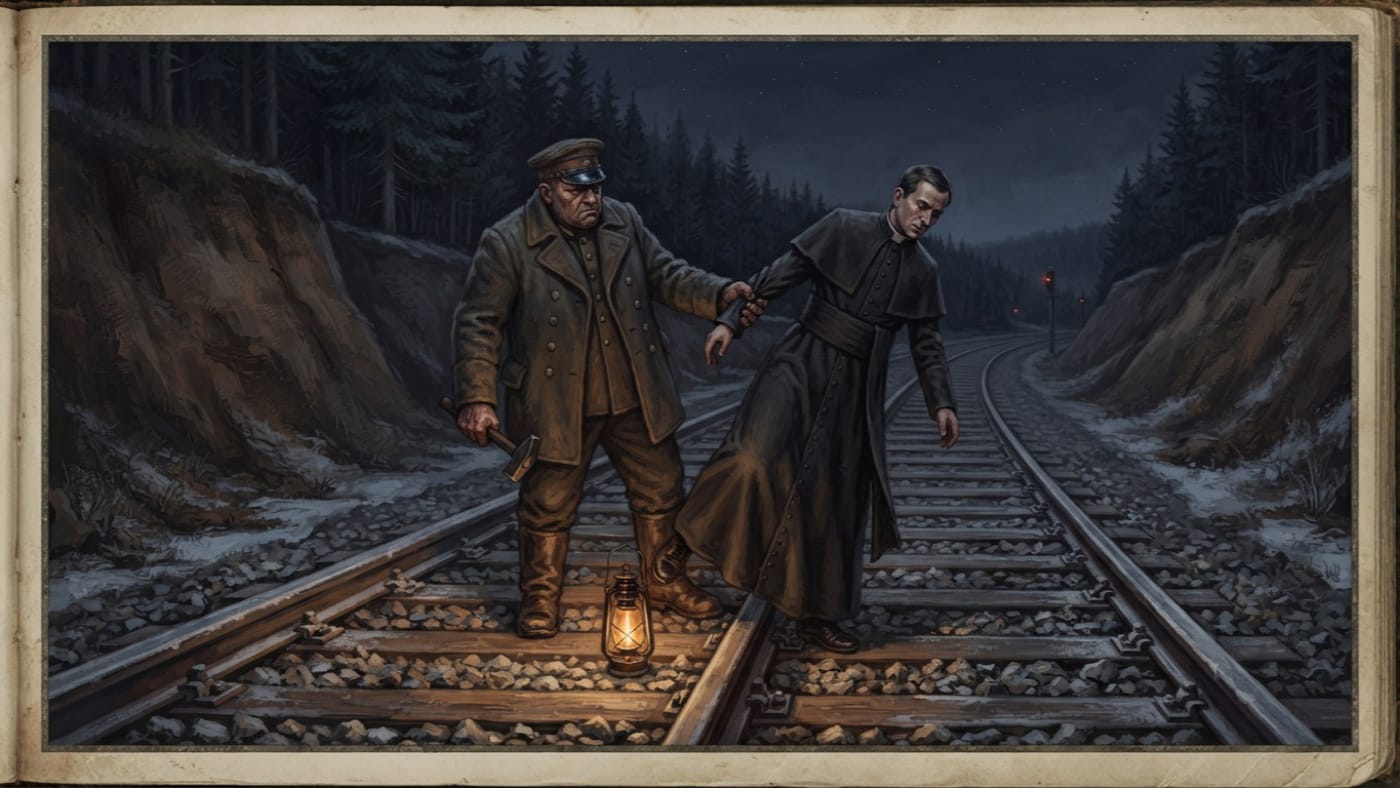
On the second night we came to a length of rail that showed, to an eye trained on manuscripts and heresy, every outward mark of soundness. Moon frost lay along the sleeper edges in tidy lines, like ruled vellum. The rail head was clean. I saw no crack and smelled no hot metal. The ballast lay where ballast belongs, in a dull grey obedience the Bureau of Purity would give its teeth to find in any parish.
I had committed my foot. I choose the word with care: my weight was moving and the decision was already signed. Then Grosz's hand closed on my sleeve and pulled me back hard enough to revise my shoulder's opinion of itself. My knees had been protesting since the first morning. They now filed an amended complaint.
He set the lantern down and struck the rail with his hammer.
Whole steel answers a hammer brightly. Over two days I had heard that answer some hundreds of times and had begun to find it tedious. This answer came back flat and hollow, with no ring in it at all. It was the note a reliquary gives once the bones have been stolen and the lid put back.
"Dead sound," he said.
We went around. I record it plainly. A Track Walker, a theologian and a lantern stepped off the rail, picked their way past the suspect length through frost and loose stone, and rejoined the iron beyond it. No train was halted and no convoy was turned back. A Hieromnemon of the Sacred Ledger left the straight way for a short and undignified distance. Grosz walked it as he walked everything. I walked it as a man walks who has just learned that the ground keeps its own ledger and does not publish it.
#On the Hammer's Answer
The Guild teaches its Track Walkers a test older than most of our liturgy and more reliable than all of it. Strike the rail and listen. A clear, bright tone means solid steel. A dull one means something has gone wrong inside the metal or beneath it, and the Walker's eye will not show him which.
The eye can certify a surface and nothing more. It examines a rail the way a lazy confessor examines a penitent: the face, the posture, the clean cuffs. Frost settles as prettily on fractured steel as on whole. A rail head can shine over a ruin. The Gauge War taught this corridor that a wrong measure kills before the enemy arrives, and the Guild has trusted the eye less ever since. It trusts the hammer, and the man holding it, and the ledger in which the man writes what the hammer said.
I copy that third term, presence, because the Guild teaches it. The events of that night gave me no license to apply it. The Guild includes the word in its warning because the words beside it were not enough for every case that its old men remember. Doctrine copies warnings faithfully. It does not hand out certificates for them.
#On the Opened Bed
The next morning a maintenance crew opened the track bed beneath that rail. I report their findings. I did not hold the shovel, and the Bureau does not pay me to pretend I did.
They found voiding beneath the ballast, where the ground had withdrawn its support and left the bed resting on its own habit. Along the inner foot of the rail they found a stress fracture, hidden on the side no walking eye examines and no lantern reaches at a decent angle. And they found a pocket of black water, liquid in a cold that should have locked every drop in that ground into ice.
Three offices gave three verdicts. Engineering called it subsidence. The Guild called it found in time. Grosz called it nothing. By the time the crew lifted the first stone he had already walked ahead to the next length of his section, where the rail was presumably awaiting his opinion.
Engineering's word is respectable. Subsidence accounts for the void, and a rail left unsupported over a void has every reason to crack along the foot. The word leaves the water outside its jurisdiction, and Engineering did not trouble to extend it. The Guild's phrase claims less and is therefore harder to fault. Grosz's silence claims nothing at all. I have reviewed it at length and found no error in it.
#On the Words Entered in the File
Some months later a travel summary of my corridor review crossed my desk for countersignature. It had been prepared by a clerk who has never walked farther than the refectory. It compressed the second night into one line.
A later travel summary described the A.S. 186 incident as "a routine maintenance diversion made during doctrinal corridor review."
Corrected. Maintenance arrived the following morning with shovels. On the night itself there was a hammer, a sleeve and a Section Foreman who refused to let a Hieromnemon put his weight on a hollow. The incident is to be filed under its own name, the A.S. 186 dead-sound diversion, and the clerk's adjective is withdrawn.
That is the official record. The unofficial one is shorter and less comfortable.
Two years earlier, in the winter of A.S. 184, Grosz lost his junior worker Fehr to a crush incident in the Carpathian tunnel section. The filing gives no fuller mechanism, and I will not invent one to please the reader. Grosz then walked his section alone for nine months. When I asked him about Fehr on that same inspection, he told me the rail remembers Fehr, that he walks where Fehr walked, and that this is enough. I recorded the sentence. I have never found a theology to put beside it.
I do not claim that this loss trained Grosz's ear. I do not claim the reverse. I note only that the man who stopped me had spent two winters listening to steel for something besides its soundness.
His hands are grey, the blue-grey of old rail at the knuckles. The Guild calls this iron-blood and holds that long service alters a Walker's body until it registers the condition of the track before his tools do. That is Guild testimony and I enter it as such. The Bureau of Purity has investigated iron-blood six times, found no supernatural contamination and recommended continued observation. No Purity file I have seen concerns this diversion, and I will not manufacture one. The hand that closed on my sleeve was grey and certain. That much I can swear to.
#On the Limits of the Record
Doctrine holds a private memorandum on the moments between my committed foot and Grosz's hammer. It recommends against any public description of that interval, and I comply. The reader receives the sleeve, the hammer, the hollow answer and the detour. What Grosz perceived before he struck, if he perceived anything, stays in a sealed folio with my handwriting in its margin.
No cause has been certified. Subsidence accounts for part of what the crew found. The water is still unexplained. The Guild is satisfied, Engineering has closed its file, and Grosz was never consulted, because nobody has yet found the nerve to ask him.