
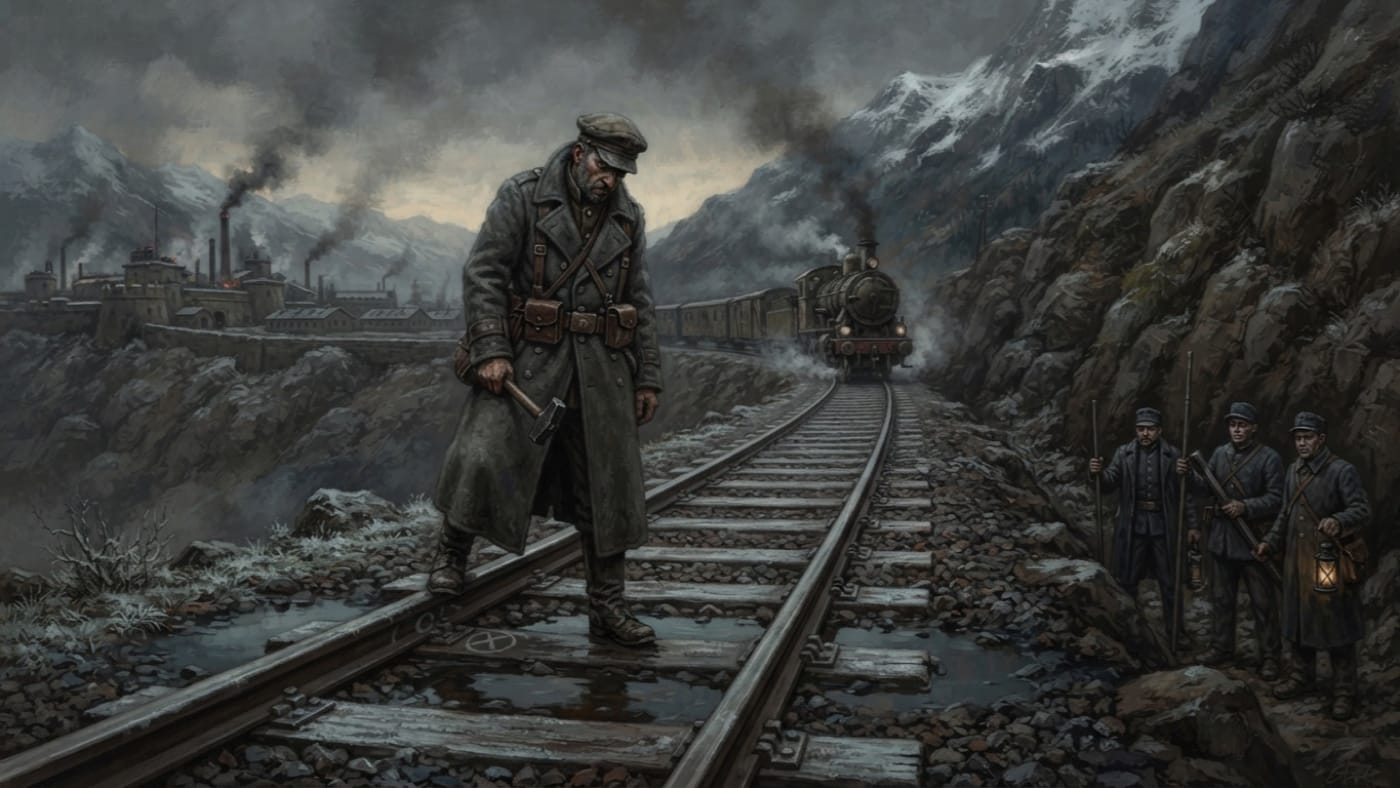
#On the Answer of Steel
Dead sound. — Section Foreman Grosz, A.S. 186
Dead sound is the Track Walker's name for a rail that answers the hammer wrongly. The word misleads strangers, who imagine the steel falling mute. A struck rail always replies. The Track Walker of the Guild of Rails stands over it with his head canted, judging the reply the way a confessor judges a voice through the screen.
Sound steel rings. The tone comes back clear and bright, and the hammer lifts off with a little spring in it, as if the metal were glad to be asked. Suspect steel thuds. The blow goes in and stays there. Guild men call that answer dead, and they were calling it dead long before any clerk wrote the word down, so I will not pretend the Bureau of Doctrine coined it. We filed it.
#On the Hammer and the Hidden Fault
The sound check belongs to the ordinary morning, somewhere between the gauge rod and the ledger. A Walker works his assigned section on foot with a crew of four to six. They measure the gauge, inspect the joints, sight the alignment through the glass, kick and judge the sleepers, and fork back ballast that weather and traffic have scattered. At intervals the hammer comes down on the rail head and the whole crew goes quiet. It is the only liturgy I have ever seen observed without a single complaint.
The eye is a poor inspector of steel. It sees the head, the polished running surface, the frost and the bolts. It does not see the inner foot, where the rail sits on its plate and carries load that nobody watches. It cannot look under ballast. A fracture may run some distance inside the metal before it troubles the surface, and a bed may hollow out beneath a perfectly respectable sleeper the way a parish hollows out beneath a perfectly respectable bishop.
The hammer goes where the eye cannot. The profession's own teaching, recited to apprentices and written in no Synodal canon, holds that a dead sound means internal fracture. Older hands widen the list to fracture, void or presence. All three arrive in the same thud. From the note alone the Walker cannot tell you which one he has struck, and the good ones do not try. They chalk the place, enter it in the maintenance ledger and keep every boot off it until the bed is opened.
I have heard young men in Strasbourg describe dead sound as a kind of demon-detector. It is nothing so obliging. It tells you the rail is wrong somewhere you cannot see, and it is delivered by men who would rather be mocked for caution than buried for good manners.
#On the Foreman's Refusal
A dead rail costs time, and the Bureau of War counts time more jealously than it counts men. The corridor from Strasbourg to Bastion-Przemyśl carries fuel, food, troops and ammunition to the Carpathian passes, and further demands run on toward Bastion-Sibiu. Every hour a section stands closed is an hour some quartermaster further east spends composing excuses.
So the Walker who hears the thud has bought himself trouble. He must chalk the place, enter it in the ledger and send word so that dispatch can clear the track before anyone opens the bed. Then he must defend that entry before officers who have never held a hammer and who regard a ringing rail and a thudding rail as two moods of the same inconvenient metal. The Guild learned its contempt for wishful measurement in the Gauge War and has not unlearned it since. As a body it may refuse certification, and bastions have gone short for it. The individual foreman has no such corporate armour. He has his ear and his ledger, and his name sits at the bottom of the page.
#On the A.S. 186 Examination
In A.S. 186 I walked three days of the Strasbourg–Przemyśl corridor under the guidance of Section Foreman Grosz. He carried hammer, gauge rod, lantern and chalk, and he regarded me as a slow and badly balanced item of rolling stock.
On the second night we came to a length of rail that I examined, as is my habit, with the full attention of a trained theological eye. Frost lay along the sleeper edges. The head was clean. I saw no crack, and the ballast sat where ballast ought to sit. I had found nothing, which in my profession is very nearly the same as finding innocence. I was in the act of stepping onto it when a grey hand closed on my sleeve and removed me backwards with all the delicacy of a crane.
Grosz tapped the rail once.
The answer came back flat. It went into the steel and did not return.
"Dead sound," he said, and led the party round.
I spent the rest of that night's walk composing a complaint. It concerned the sleeve, the shoulder and the indignity of being steered like a mule before witnesses, who had the decency to look at their boots. I had the opening paragraph polished before we reached the section house.
The next morning a maintenance crew opened the bed. By their report they found voiding beneath the ballast, a stress fracture hidden along the inner foot of the rail and a pocket of black water lying there despite the cold. I did not climb down to look. I record what the crew reported. I had seen the surface the night before, and the surface had lied to me with a perfectly straight face.
I withdrew the complaint.
A later travel summary described the A.S. 186 incident as "a routine maintenance diversion made during doctrinal corridor review."
Corrected again, for anyone who read only the first correction. The maintenance came the next morning. The diversion came the night before, from one tap of a hammer on a rail I had already passed as sound.
#On Subsidence and Other Explanations
Engineering classified the condition as subsidence. Subsidence is an honourable word. It accounts for the void, after a fashion. It also accounts for the fracture, if one grants that a rail left hanging over a hollow will crack along the foot where it bears. It does not account for the black water, and Engineering did not try. The report names the water and moves briskly on, a piece of bureaucratic technique I can only admire.
The Guild called it found in time. Grosz called it nothing at all.
Those who insist that dead sound is something more than an ear like to point at Grosz's hands, which are grey, and at his iron-blood, which is advanced. The Bureau of Purity has investigated that iron-blood six times. It found no supernatural contamination and recommended continued observation. Those inquiries concerned the man's body, and none of them concerned dead sound. I will not let a grey hand stand as the explanation for a skill that Walkers with ordinary pink knuckles practise every working morning of their lives. The Guild speaks of rail memory, and of old hands who feel a fault in their teeth before they strike. I enter this as Guild testimony. I neither adopt it nor dismiss it. I was the man stepping onto the rail.
Rail-demons are no rumour in this world, and Guild crews have sealed junctions against them before now. Nothing in the record of A.S. 186 names one beneath that rail. The thud said fracture, void or presence. The opened bed showed fracture and void. Whether the third word applied, the bed did not say, and nobody has put the black water under oath.
#On Continued Inspection
Tomorrow morning the hammer comes down again on every section of the corridor, and on most of them it rings. Grosz still walks with his head canted toward the steel. His crews still carry chalk in their breast pockets and still enter bright notes in the ledger with the same care as dull ones, since the man who stops listening after a hundred clean rings is the one the Guild later has to dig out. The Guild has buried such men. It writes their names in the same ledger as the rails.