
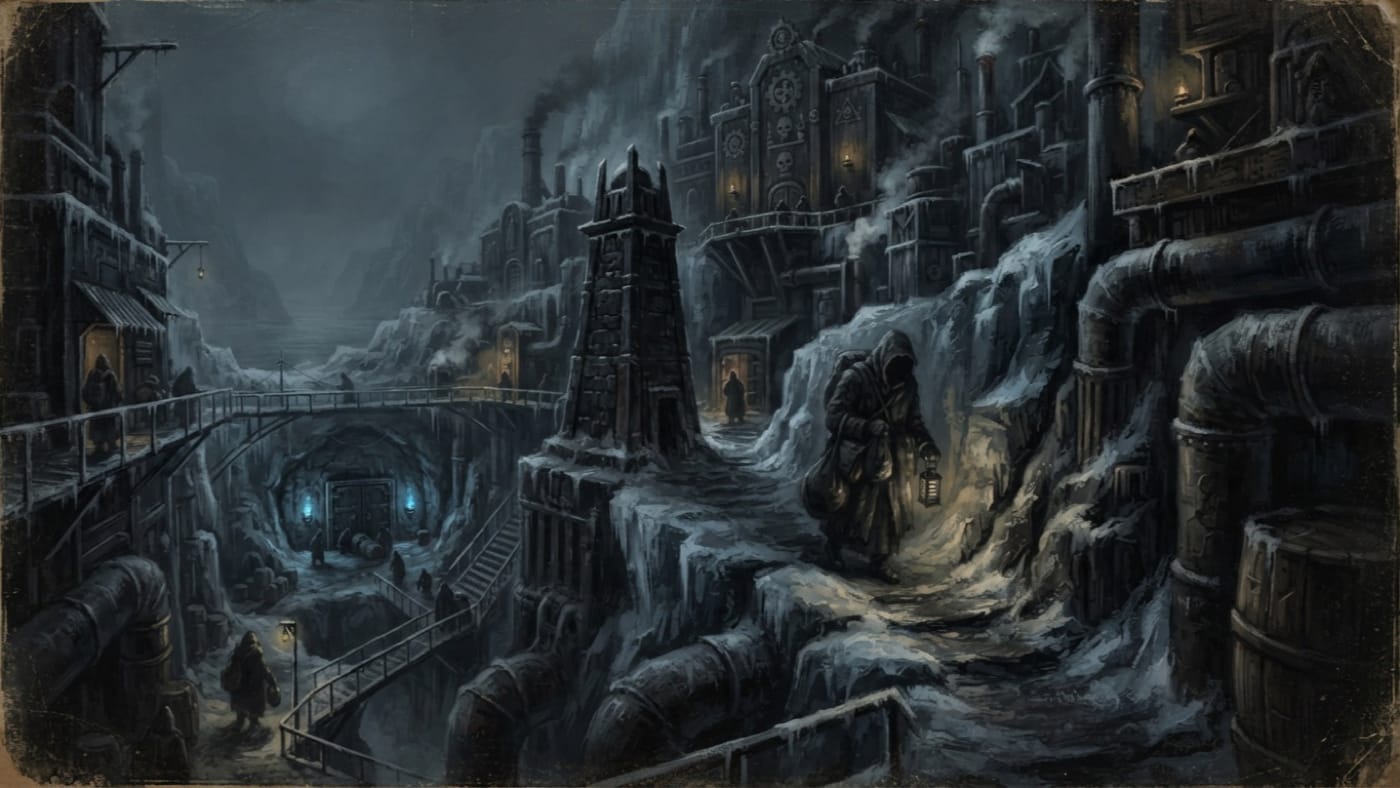
#On the Dark-House Sentence
It costs the Chapter one stroke of ink to strike a name. It costs the household its winter.
The Dark-House Circle exists because Hrafnvik has perfected a punishment that needs no executioner. A household falls behind on its oil-tithe. Its render quota comes in short, and someone at the barrel count decides the shortfall was theft rather than a thin season. A fast is broken in its eleventh week because a child cried for fat. A confession goes into the Shrine Chapter's ledger in a form the Prior judges incomplete. Any one of these will serve. The household is designated a dark-house, and the communal lamp-aid that carries ordinary families through the twenty-hour nights stops coming to its door.
The Bureau of Doctrine would call this an administrative sanction, and the Bureau would be right. Nobody is struck or chained. In Hrafnvik, lamp-time measures wealth and grace together, so a household in lamp-debt owes the Moot and the Creator on the same page. A fast-breaker becomes uncounted. The name comes off the tally, and with it go the small mercies the tally carries, including a place in the queue south when the ice opens. Debt that cannot be paid in oil is paid in watch duty. After that, the cold sets the pace, governed only by whatever the household has hidden under the floor.
Some dark-houses have a private barrel, a cousin with a full lamp, a purse of bone tokens. Many have nothing. The Circle is what the second kind found when they went looking.
I cannot tell you when it began. The clans date the dark-house sanction to a seal die-off winter that nobody has written down. The Circle dates itself to nothing at all.
#On the Hidden Supply
The Synod counts barrels. The Circle keeps what the barrels leave out.
The Circle steals wicks from shrine lamps. Hrafnvik forbids burning unblessed wicks, and a wick taken from the Shrine Ring has at least been blessed. I leave the casuistry to the Chapter, which has never asked to hear it. Shrine oil is a harder matter. Stealing it is one of the settlement's red lines, alongside putting out a lamp in spite. The Circle gets its fuel elsewhere: from unlogged barrels that leave the Render Yard by night, from oil-chits that are short by a spoonful at every exchange, and from households one bad season away from needing the Circle themselves.
The oil goes into the Frost Pits, the storage chambers cut into the cliff face, where the cold keeps fat from turning and keeps clerks from staying long. The barrels there carry tags, and the tags lie. A barrel of good oil may be tagged as tainted render, as tithe already delivered, or as the stores of a household that died two winters ago. Every barrel in Hrafnvik is notched with a code, because paper rots in the damp. A notch is quick to cut and quicker to cut again. In nine days I could not learn which notch-cutters were careless and which were careful in a particular way.
From the pits the oil travels by routes that appear on no Watch roster: through the Frost Pits, along the unlit coves, across ground that carries no lamp because a lamp on a cliff path at night is a report to every Watch Cairn on the ridge. The routes are walked by touch. The carriers come back with wet wool to the knee, greasy gourds under their coats, and hands too numb to hold a cup. Oil arrives at a dark-house in small amounts, enough for a wick cut short, a pot kept just off the freeze, a newborn kept warm. The longhouses speak of a dark-house midwife who carries oil to infants under her coat. I took her for a type of person and not one particular woman. If someone hoped I would write down her name, they were disappointed.
The Longhouse of Shared Heat is the settlement's public refuge, a place of wet wool, stew, and the coughs that spread in close quarters. Beneath its hearth, I was told, the dark-houses meet. I did not go down. My knees are Strasbourg knees, and anything I saw I would have been bound to describe.
The Bureau cannot identify the Circle's leadership. The Moot acknowledges no hierarchy. The Chapter has found no theology it could prosecute. I record those three statements as limits on what is known. They do not prove the Circle has no organisers or no beliefs. It has, at least, one principle, and the parent register records it: no child freezes because a clerk drew a line. I found no oath, charter, rite, or emblem behind it. It did not appear to need any.
#On the Three Authorities
Three powers govern Hrafnvik. The Circle lives where each assumes another is looking.
The sanction belongs to all three legs of the settlement's government, and to none of them alone.
Elder Sigrun Half-Wick sets the render schedules for the Clan Moot and enforces them in the simplest way available: a household that misses its quota loses communal lamp-aid. She lost two fingers keeping her own longhouse alive through the Seal-Death Winter of A.S. 188, which tells you she knows exactly what she is withdrawing.
Prior Malthus keeps the Shrine Chapter's papers, which include the fast calendar, the exemptions, and the confession ledger. He signs the dark-house forms himself, with warm hands, under imported wax. He has held the post since A.S. 192, five years when I inspected him and nine now. The dossier on him records that the Circle treats him as weather. He is dangerous, and in parts he is predictable. A tightened fast calendar can be seen coming. So can an exemption that slows down before a fast, and a confession entered in pale ink. The Circle stores oil against him the way the Watch stacks cairn-wood against a storm.
Watch Captain Rauk One-Eye commands the escorts, the ice closures, and the decision about who is fetched back when a whiteout comes down. A dark-house that sends someone out onto the ice for fuel is asking the Watch for a rescue it has no right to.
There is no single procedure. The Moot cuts the oil, the Chapter writes the debt into its ledgers, and the Watch decides how far its patrols go. Each office can say that one of the others made the decision. I have seen the same arrangement in Königsberg and in Strasbourg. They have better stationery.
The Warm Paper Brokers are a separate matter and must be kept separate in the file. They sell forged exemptions and passage writs for oil, so their customers are people who still have oil. A dark-house usually has none, and its business goes elsewhere. Both the brokers and the Circle operate outside the law, which does not make them allies. When the brokers accept a child's lamp-pin as payment, they cross the one line in Hrafnvik that starts a blood feud. The Circle exists to keep that pin on the child.
#On Silence and Exposure
On certain paths in Hrafnvik, speaking aloud is a form of testimony.
The Circle has a mundane list of enemies. Lamp audits reconcile what the ledgers say against what the barrels hold. Quota seizures arrive in thin seasons. Paper sweeps follow every rumour carried by trade. Whiteouts take a carrier who has stepped six feet off a route walked by touch.
The fog is a less mundane enemy. On windless nights it repeats what it hears from the fjord, and repeats it wrong. Prayers come back with the wrong saint in them. Names come back in the cadence of the dead. Confessions come back with sins nobody confessed. The Bureau of Rites lists this as Category Two Localized Acoustic Distortion, Responsive, which is a bureau's way of writing a noise down. For a Circle carrier, the classification does not matter. A name spoken on a cliff path may come back out of the fog within earshot of a shrine-clerk, and it may come back attached to a theft.
The local countermeasures are triple-wick lanterns, salt circles, and silence rules on certain paths. Nobody has certified that any of them work. Triple-wick lantern cores are contraband in their own right, and a lit lantern is still a lit lantern. The Circle's routes, as far as I could tell, run unlit and silent.
#On the Unreported Count
An inspector's first duty is to count. His second is to decide what the count is for.
I knew of the Dark-House Circle during my nine days at Hrafnvik in A.S. 197. I did not put it in my report to the Northern Office. When I later acknowledged it in the published register, I described what the Circle does and left out who does it and where. That is still my practice, and this entry continues it. I am not a member. I am not innocent either. I am an officer of the Bureau who decided that a functioning underground supply of oil to the condemned was not information the Bureau could be trusted to handle gently. I do not assume I am the only officer who has noticed it. I am the only one who has signed his name to noticing it.
The census carries the evidence in plain figures.
Hrafnvik population, Bureau of Records census, A.S. 195: 6,200.
Corrected, A.S. 197 count: 7,400. Correction entered by the Bureau of Records, Northern Desk, A.S. 199. The 1,200 persons added are not a membership roll of the Dark-House Circle, and the figure is not a tally of dark-house residents. It proves only that the earlier census-taker did not count everyone. He has been reassigned.
The Chapter's ledger and the Moot's ledger have never agreed on Hrafnvik's population. The gap moves by several hundred with the season, the seal harvest, and the Prior's temper. Some of those people are dead, some went south on papers, and some are kept alive in the Frost Pits with oil under a false name. My report does not say which. Neither does anyone else's.
Hrafnvik's compliance was renewed in A.S. 201. It is still conditional and still under review. Its lamps still burn longer than rendered fat has any physical right to, and the Bureau has not yet classified why. Malthus still signs the forms. The Moot still cuts the oil. Somewhere under a hearth, someone is cutting a shrine wick down to the length of one more night.