
#On the Approaches
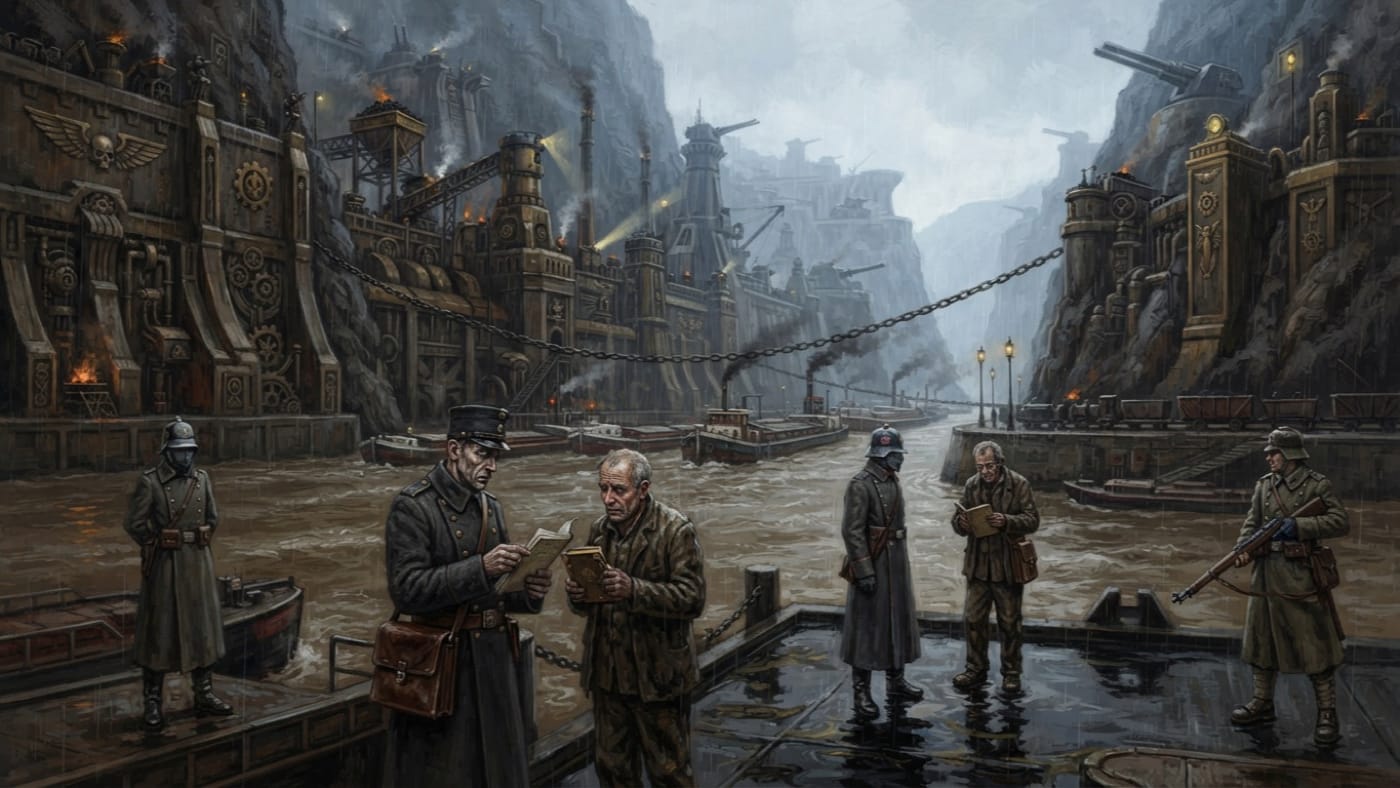
The Danube enters the Iron Gates as a broad, brown, reasonable river and comes out as an argument. Between the two stands Bastion-Irongate, the Gasket Choir, cut into the gorge where the water runs barely wide enough for two hulls abreast. It has cannon batteries on both cliffs and chain-booms laid across the current like a signature across a page. It is the middle-southern chokepoint of the Sagittal Line. Sibiu lies behind its Transylvanian wall to the north, and Shipka and then Constantinople lie to the south. Hold the gorge and the river answers to Strasbourg. Lose it and the mid-continent falls open like a ledger with its clasp cut.
The fortress is one thing and the approaches are another. Clerks who confuse the two tend to be transferred to the second. By "Danube approaches" the Bureau means the river-facing ground around the Irongate pressure front. This takes in the reaches above and below the gorge, the banks, the lesser posts and landings that watch the water, and, on the far side, the country that Morwen presses from the Western Balkans. No charter draws its boundary, and no survey has measured it well enough for me to sign. Like most frontiers, it is defined by the places where paperwork begins to be checked twice.
#On Passage and Provision
Nothing moves through the gorge by right. The chain-booms rise and fall on order. The cliff batteries cover the reach where a hull must slow to clear them. Every cargo that passes is the Synod's guest and the Synod's suspect for the length of the gorge. River control is the oldest argument the place makes. When the Line became defensible, though still incomplete, around A.S. 65–68, the Iron Gates recommended themselves at once: the Creator, in an uncharacteristically administrative mood, had already narrowed the river for us.
Provision comes down from the rear by the documented corridors. Budapest is the principal staging hub for the Sibiu–Irongate corridor, and it is a city cut in half. The western bank is Synod-held and the eastern districts are abandoned and contested, so anyone who calls Budapest secure should be asked which Budapest. Upstream, Vienna imposes its sacred delay. Bratislava handles Danube passage and quarantine between the two. To the south, Sofia sits fortified and half-ruined between the Irongate and Shipka sectors, and it resents its position with admirable consistency. None of these cities is the front door of a single road. They are offices that feed it.
At the fortress end, freight meets the Transit Spine. There are rail carts and convoy staging, diesel, coal and wet stone, brass valve fittings hissing, and the low licensed drone of chant-workers keeping the pressure doors honest. Convoy tolls are reckoned in air rights, and every manifest carries addenda. Every driver brings a permit, a breath score, and the face he had when the permit was issued. Of the three, the gate cares most about the face.
#On the Enemy Who Arrives Familiar
Morwen, the Weeping Host, embodies Envy. Doctrine holds that she presses on Irongate because she covets its engineered beauty and, unable to possess it, would hollow it out. I report the Bureau's reading of her motive. I have not interviewed her, and I decline the appointment.
Her method makes a held gorge less comforting than it ought to be. The guns can command the water. They cannot command a sergeant's voice once it has been borrowed. Every post on the approaches runs on recognition. The bargeman knows the lock-keeper, the lock-keeper knows the courier, and the courier knows the password and the face that ought to speak it. Face-Thieves take the face. Hollow Ones take the habits beneath it: the phrases, the gait, the way a man pours his ration. The Beloved come up the bank wearing the dead. A man who buried his mother in Budapest may be greeted at a river landing by that same mother, properly dressed and using the pet name.
Then there is the matter of reflection. Purity teaches that the enemy watches through mirrors, windows and still water, and that the creatures called Mirror-Stalkers observe before anything is replaced. A river is not still, but its backwaters are. So are the slack pools under a landing, the rain barrels, the brass of a polished valve, the glass of a signal lamp and the window of a toll hut at dusk. Purity has not certified the Danube itself as an aperture, and I will not do it for them. I note only that the men on the approaches shave by feel.
#On Recognition at the Gates
The policy is exact and should be quoted exactly. As of A.S. 201, the Ledgers of Self are mandatory throughout the Irongate sector and advisory at lesser Morwen-exposed installations along the Danube approaches. "Throughout the sector" means the whole sector: its tunnels, gates and staging yards. "Advisory" means a post commander may keep Ledgers, should keep Ledgers, and will be asked at any inquiry why he did not.
A Ledger begins at Vienna, Budapest or Sofia, where recruits bound for Irongate are measured before they are sent. The Bureau of Records compiles their gait, their scars, their handwriting in several conditions of misery, their voice charts and their bone-lines. Bone-lines are small private particulars chosen because no copy should know them: a dead sister's nickname, or the exact curse at a jammed rifle. The fortress adds the rest.
Custody is triple. The field copy travels with the unit in a brass-bound packet. The sealed copy rests in the Irongate archive vault, and the dead copy is kept in Strasbourg. That is the Irongate model, and it is the only one I can certify. What an advisory post along the river keeps in its strongbox is a matter for its commander, his clerk and the damp.
Earlier Irongate manuals, and every extract copied from them, describe bone-lines as "copy-proof."
Corrected. Bone-lines are copy-resistant. The Sector Nineteen inquiry settled the distinction, and the Ledger revision of A.S. 193 followed it. Any reader still holding the older word is to strike it in their own hand and initial the strike.
When comparison fails, the matter goes up. At Irongate, questioned identity is heard in the Hush Court beneath the Transit Spine. A Records clerk reads, a Purity officer watches the eyes, a chaplain listens for doctrinal fracture and a War officer watches the exits. When two claimants match one Ledger, the Twinning protocol applies, and its standard resolution is the execution of both. The great Twinning proceedings of A.S. 199 belong to that court. The approaches send their doubts to the gorge and wait.
Mirror restrictions help, and Ledger comparison helps. Neither settles the question. The enemy has been known to bring private memory to the reading, and a document can be altered by the very hand it was meant to expose.
#On the Cost of Being Admitted
Every safeguard is paid for by somebody standing in the rain. A convoy halted for a discrepancy is coal, oil and tallow not delivered to a fortress that burns all three. The approaches live on that arithmetic. Each comparison needs a clerk, and each clerk needs a ration. Each hour at the boom is an hour in which the river fills with waiting hulls, and the enemy watches through windows.
Fraud follows scrutiny as gulls follow barges. Forged breath licences, counterfeit Ledger amendments, convoy extortion and identity fraud are the ordinary crimes of the Irongate trade, and the Underchords supply a fair share of the stock. The Counterkey Circle prints pamphlets claiming that the Ledgers prove the Synod does not believe in souls, and the Underchords sell them beside the forgeries. Both groups make the fortress less reliable. Neither governs anything on the river, though each would like to be asked.
The chant-workers pay the deeper cost. Irongate depends on licensed voices to keep its pressure honest, and Morwen's craft depends on voices that can be borrowed. A man who earns his living with his throat learns to fear his own throat. A bargeman who has buried his mother learns to fear her at the landing. The Bureau calls this vigilance. The garrison has other words for it, most of them unprintable even in an erratum.
#On the Present Condition
As of A.S. 201, the gorge holds. The batteries stand on both cliffs, the booms answer their winches, and the Transit Spine stages convoys with the usual amount of shouting. Budapest still stages, and its east bank is still contested. Sofia still resents. The lesser posts along the approaches keep their Ledgers on advice rather than by order. Some keep them faithfully. Others keep them the way a parish keeps its baptismal register, in the same cupboard as the onions.
Morwen is not defeated. The Bureau of Doctrine prefers the word "contained," which is what Doctrine says of a pressure it cannot end and would rather not describe. The guns watch the water and the clerks watch the faces. In its slack places, Purity says, the water watches back.