
#On the Coast and the Forward Heartlands
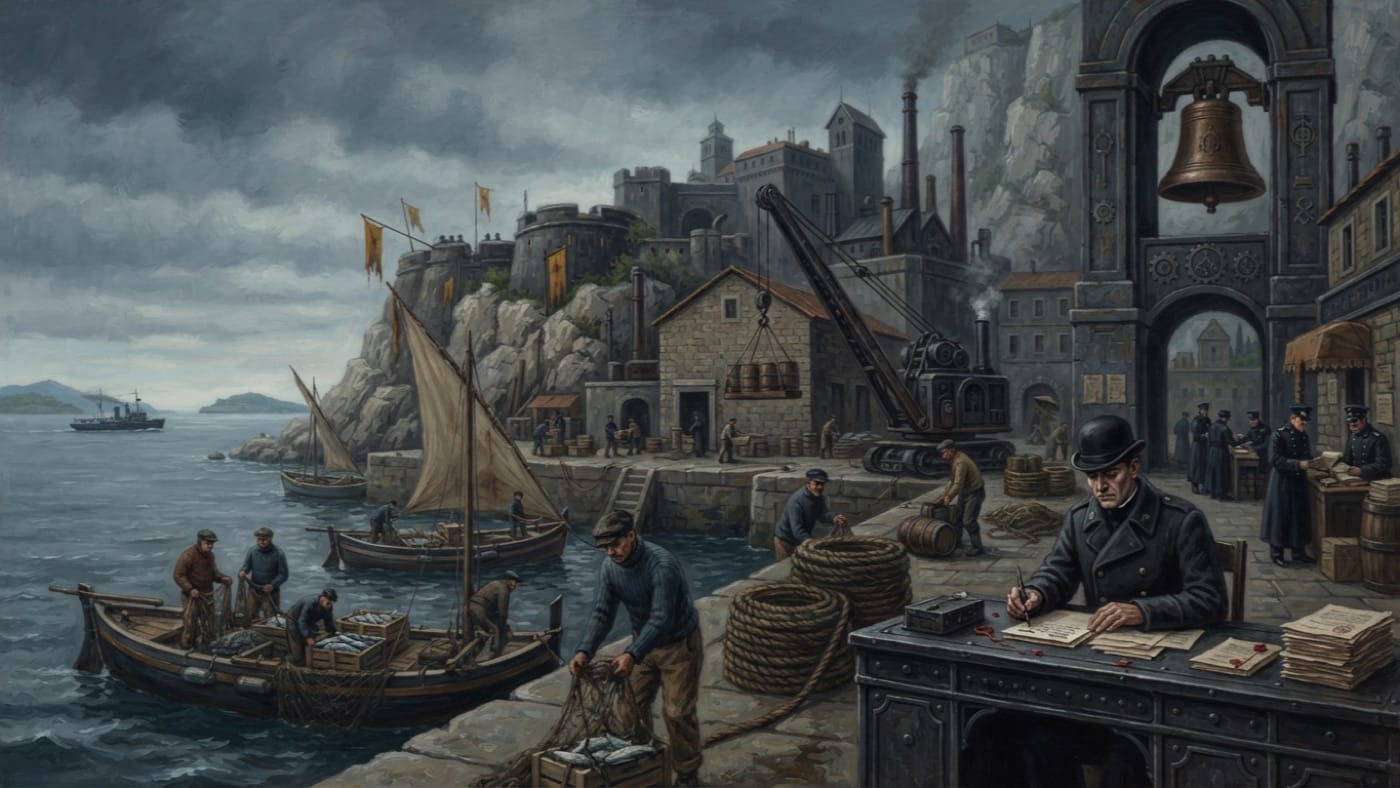
The Dalmatian coast is a long rib of limestone laid against the Adriatic and broken into coves, each just wide enough to beach a boat and dry a net across the rocks. Salt crusts the mooring rings. Most hands here are black with tar from childhood, because on this shore a child learns to caulk a hull before learning the catechism. The fishermen push off before the first bell, row past the headlands, and come home with sardine and mackerel and whatever else the Creator has left in the water. A share is sold, a share is salted, and a share goes to the tithe-clerk on the quay. The clerk is always there first.
The Synod's war-map places this shore in the Forward Heartlands, the third zone, with Bohemia, Moravia and western Hungary. This is staging ground behind the front, where supply is gathered, counted and sent on. The water beyond is entered under a different heading: the southern coast, the seventh zone, which takes in the Adriatic, the Aegean and the Mediterranean, with their convoy lanes and pilgrim routes. A Dalmatian fisherman sleeps in Zone Three and earns his bread in Zone Seven. Neither column of the map was drawn with him in mind.
#On the Harbours That Feed the Line
Venice holds the sea lane between Italy and Dalmatia, and the southern Line eats out of Venetian hands. The southern corridor runs by water and road toward Bastion-Irongate, Bastion-Shipka and finally Bastion-Constantinople on the Bosphorus. The Dalmatian harbours are part of that system. They have pilots who know the channels between the islands, quays where a convoy can take on water and salt fish, and carpenters, rope-makers and porters to hire. I make no claim that every southern convoy calls here. The Bureau of War keeps that ledger, and the Bureau of War does not lend.
No trench runs along this shore. The Sagittal Line lies hundreds of miles east, along mountain and river, and the coast belongs to the geography of supply. War is fought there. Here it is loaded into ships.
The best example of controlled passage on the coast is Saffron Bastion, near Ragusa. It has a deep harbour, batteries along the cliffs, and saffron quarantine flags snapping over grey water. Saffron controls seaborne pilgrimage and a share of southern Line supply. Its quays smell of wet rope, tar and hot sealing-wax. Its trades are salt dues, cargo sealing, ropeworks, munitions handling and pilgrim intake. The Bastion is a coastal installation and is not one of the seven anchors of the Line, whatever its harbour marshals say after the second glass. Most of the coast lives more simply: a village, a quay, a chapel bell and a boat that needs four men.
#On the Sons Taken Inland
The coast had lived under the Church's public authority in the decades after the Sundering of 1 November A.S. 45, and under the formal Synod since the Concordat of A.S. 90. The founders were in their graves by then. Neither of them put a seal to what came next.
Strasbourg's answer to the loss of Brașov and the burning of Thrace was decreed in A.S. 110, which is 1820 by the old reckoning. That was the First Continental Levy. Its seals came from the Bureau of War and the Bureau of Doctrine together. A refusal could therefore be classed as apostasy at once, with no inquiry needed to establish heresy. The demand was one son in ten. Every household with two or more males between fourteen and thirty-five had to present them at the nearest mustering field within sixty days of the decree arriving. The Bureau of Records supplied the lists. The Bureau of Purity supplied the consequences. A name struck into the Index Damnatus removed a household from the ration rolls, and a fishing village has no other larder in winter.
The Synod devoured ten sons per household!
The marginal exclamation entered beside the Lore Book's account of the Levy is wrong, and the hand that wrote it has been reproved. The decree took one son in ten. It did not take ten sons from each house. A household with ten sons would have been unusually fertile and unusually unlucky, and the Bureau of War has never been able to count on both.
The muster accounts record fishermen's sons from the Dalmatian coast standing with farm-hands from Aquitaine, apprentice masons from the Rhine valley whose hands were still white with chalk, and vintners' boys from Burgundy. The Bureau did not care what any of them had been. It measured height and weight, inspected teeth and heard confession. A field chaplain could get through sixty souls an hour. Somewhere between the dental inspection and the wrist-stamp, a young man who could read a squall from the colour of the water off a headland stopped being a fisherman. He became an entry under the Bureau's own taxonomy, with no lord and no parish behind him, and he answered to Strasbourg alone.
The Bureau would call this an improvement. A coastal boy owed nothing to any local magnate and arrived with shoulders already built by the oar. He was also used to obeying bells. War valued all three. It recorded none of them, because its forms had no box for them.
The coast had no Bureau scribes of its own to complain to, so it gave its sons, and the boats went out the next morning with fewer oars.
#On the Work Left Behind
A fishing boat runs on its crew, and on this coast the crew is usually a family. Two pull at the oars, one pays out the net, one bails and swears. Take a single son out of that arrangement and the arithmetic of the whole boat changes. Fathers who had gone ashore to mend gear go back to sea. Younger brothers move up to the oars sooner than their arms are ready. Neighbours lend a hand and expect one back, and a debt like that is kept more faithfully than any Tithes ledger.
The nets still have to be mended on the warm rocks. Rope still has to be tarred and the catch still has to be salted before it spoils. The levy took no account of any of this, because the levy measured boys, and work does not have teeth to inspect. Whoever was left on the quay did the work. The tithe-clerk took his share regardless.
The decree was called temporary and has been renewed each generation since. The coast now has grandfathers who went inland and fathers who went inland, and boys at the oars who know the mustering field will be waiting for them too.
#On Bells, Passes and Quarantine
The Church keeps time on this coast the way it keeps time everywhere: with bells. A harbour bell marks when boats go out and when they come back. It marks when the catch is counted and when prayer is owed. The fisherman lives by the tide, and the Church overrules the tide.
The Lore Book records that Archon Basilius of Ragusa once sentenced an entire fishing fleet to ten years of penance-labour because it failed to ring its harbour bell at the appointed hour. The account gives no year, no tally of boats and no fate for the men. It gives only the bell, the hour and the decade. I call that a model of judicial economy. The fleet would have used another word for it.
At Saffron the discipline is heavier and the paper costs more. Quarantine clerks on the Causeway check tongues and lungs. Harbour wardens check seals and berth chits. The Tide Hymn sets harbour time when the locks open, and dock workers put a pinch of salt on their tongues before starting a shift. The Bastion's provosts report voices under the piers at night and lantern flames leaning toward black water. The approved answer is to stick to licensed lantern patterns and salt the pier boards. I have nothing to add, except that the Great Deceiver appears to have learned the harbour schedule as well. Every quay along the shore now carries some echo of Saffron's lesson. A pass is worth more than a catch. A boat outside its bell is a boat in breach.
#On the Present Register
The coast fishes, salts and pays its dues. Its harbours load the southern corridor whenever the Bureau of War sends a manifest. Every generation the Continental Levy comes round again, the Records lists are copied fresh, and the mustering field fills with boys whose hands smell of tar. The decree stands. The bells are rung on time. No complaint from the Dalmatian coast has reached my desk. The Bureau of Records says this proves the coast is content. I suspect it proves that complaints written on wet paper do not travel well.