
#On the Entry Grade
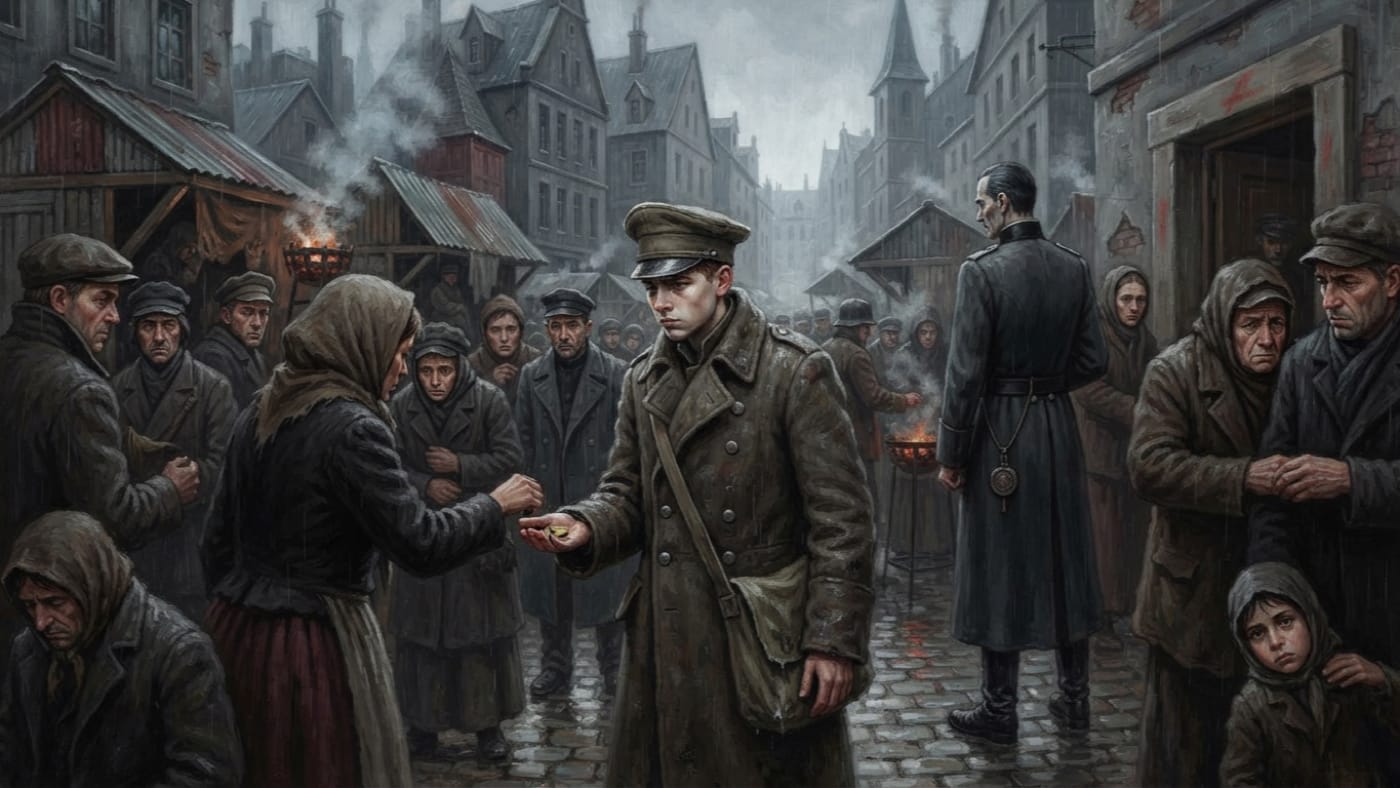
A Street-Vicar is assembled from cheaper parts. The first of them arrives at sixteen with cold hands, a satchel that never quite dries, and no authority worth stealing. This is the Creed Runner, entered on some district rolls as Token Checker. The second name describes the same youth on a drier day. The Runner belongs to the Doctrine Street-Vicar Corps, and so to the Bureau of Doctrine, Third Division, Public Compliance. The Runner checks tokens and carries correction slips between chapel annexes. Those two duties make up the whole office.
The Corps itself was chartered at Strasbourg in A.S. 104 under the Catechism Third Revision, filed as SVP/104-7. It was the Bureau's answer to the Market Drift Years of A.S. 98 to 103, when the Rhineland kept going to chapel and stopped answering in the market. Every Runner is taught the Drift. It is presented as a warning, as the Corps' origin story and as an accusation against the street, and the lesson is recited plainly: chapel compliance is not street obedience.
They learn it at sixteen. Most adults in the Synod have yet to learn it.
#On Tokens and Correction Slips
The purity token is a palm-sized brass disc. It records the citizen's last chapel attendance, last confession and current ration-hall assignment, and every citizen is meant to carry one and present it on request. The confession entry depends on receipts produced at the Confessor-Booth Clerk's window, so a single disc holds the judgments of three offices. A Runner learns to read one by thumb and by eye. They feel the edge for filing and the ligature for wear. They check the stamped dates against the week, then against the face in front of them.
The officer's seal token is a different object. It hangs at the Vicar's cord, is tapped at the brine wash and certifies the person enforcing the law. A Runner who mixes up the citizen's brass and the officer's brass has misunderstood the job.
The slip is paper, and paper is where the Runner does the most harm. When a Vicar hears a stumble on the third article of the Eternal Creed, the Vicar writes a correction slip. The citizen then has forty-eight hours to recite at a chapel annex. The presiding cleric signs, and the slip goes back to the Vicar who issued it, to be filed. If it never comes back, the matter goes up to a Codex Doubt Auditor, and the Auditor's consequences are what the Bureau calls "pastoral."
The Runner moves the paper. Slips go from the square to the annex and from the annex back to the filing desk, through fish-market gutters, cart traffic, Cologne rain and the smoke of chestnut braziers. Each one is a household's two days, folded once and gone limp with damp. Ink runs and signatures blur. A slip that arrives late at the desk looks, to the filing Vicar, much like a slip that was never returned. The Runner does not decide what happens next. The Runner decides only how fast they can walk.
Over these four years the Runner also learns the chalk, though they do not hold it. White means clean. Yellow means watched. Red means uncertain, and a red doorframe tells the ration-hall clerk, the tithe office and the family next door what to think before anyone speaks. The Runner walks past these lintels every day while carrying the slips that put marks on them. That is the course of study. There is no other.
#On What the Street Teaches
At a square-stop the Vicar lifts a hand and the square goes quiet. The quiet is the loudest thing in a market. Carts stop. The fishmonger stops calling his prices halfway through. The Vicar calls the lines, and the Runner works along the halted crowd with an open palm, taking discs and handing them back, checking dates while the crowd recites.
The crowd watches the Runner. Looking at the Vicar is dangerous. The Runner is sixteen, has no chalk and stands within arm's reach, so the resentment goes to them. It is a shoulder in the crush, spit that misses the boot by a deliberate inch, or a baker's widow who knew the Runner's mother and says so. Runners come home with brine-raw corners to their mouths and bruises they cannot remember getting.
Then the offers start. The street pays in lamp oil, salt, ration chits, wash fees and, worst of all, names. A token checker who misses a filed edge has done the bribe-payer a small favour. One who carries a slip a day slower has done a bigger one. The Bureau's own registers list token checkers among the people who take bribes, so the Runner learns early that corruption begins at the first rung.
The street teaches one more thing, and this lesson can kill. In Echo Season a crowd can recite every word correctly and still be wrong. A Runner may feel the cold before hearing anything, a sense that thirty voices are being led from somewhere other than the front. The Runner's duty is to notice it and tell the Vicar. Measuring the cadence belongs to the Cadence Examiners, and what comes after belongs to the Bureau of Purity. A Runner who reaches a diagnosis on their own has stepped out of their grade. A fumbled article from a frightened grocer is a fumbled article and nothing more. Fear is not evidence, and a Runner who confuses the two harms households that only needed a slip.
#On Personnel Renewal
In A.S. 112 the Quiet Purges removed four hundred and eleven people from Rhineland postings without public trial: teachers, choirmasters and Street-Vicars counted in a single total. No public trial took place and no charge was posted. Over the season, experienced Vicars vanished from their corners.
There was no grand reserve to fill the gaps. There were Runners, so the Corps promoted them before their chalk had dried. Doctrine's files call this "personnel renewal." The street muttered and closed its shutters. Youths still learning what a yellow lintel cost a family were given the chalk that made one, and they replaced men who had been removed for marking too gently, or too rarely, or in some other way the night packets never described.
The lists that drove the removals were compiled by an apparatus with no settled name in A.S. 112. It had liaison clerks, variance assessors and provisional examiners. The Bureau of Purity constituted it formally as the Codex Auditor branch only in A.S. 114. The Runners promoted in 112 therefore took up their chalk under an office that existed in practice and not yet in law. They kept working the corners its unnamed hand had emptied.
Rhineland summaries list the A.S. 112 removals as "411 Street-Vicars."
Corrected. The four hundred and eleven were teachers, choirmasters and Street-Vicars in one total. The summary turned a mixed list into a single profession because a single profession is easier to count. The Bureau of Records regrets the convenience.
When pressure rises, the institution protects its senior ranks and spends its junior ones. The Bureau's internal ladder answers the question of who is sacrificed with three items: creed runners, a junior vicar, or a scapegoat from the street. That makes the Runner the first answer. A slip delivered late in a bad quarter, a token passed that should have been stopped, a delay at the wrong annex: someone has to sign for each of these, and the Runner's signature costs the least.
#On Oren and the Two Schools
Before their first square-stop, Runners whisper the name of Saint Oren of the Corner. The Corps invokes him at every shift-start brine wash. It is a tolerated cult, run by people who need one gentler ancestor in the vestibule. The legend puts Oren on a Cologne market corner late in the Drift, singing the Creed alone until the corner joined in. The copies disagree about which corner it was, about where he was buried and about whether he existed. The Bureau of Records keeps six incompatible burial notes and has not chosen between them.
District lecture sheets call Oren "founder of the Street-Vicar Corps."
Amended. Oren founded no corps, signed no charter and issued no chalk code. The Corps was chartered at Strasbourg in A.S. 104 by people who had never heard him sing. It adopted him later, for display.
The Runner also inherits a quarrel. Mercy Vicars correct in private: a word in the ear, a recitation together on the corner, a slip handed over with something close to a handshake. Marking Vicars answer that mercy without consequence reads as permission, and that a yellow lintel has stopped more heresy than a thousand whispers. Both schools serve in the same District Offices, and neither names the other. They argue through quarterly compliance figures.
The Runner carries slips for both schools and learns, from the satchel, whose slips come back signed and whose come back with the household's name already passed up to the Auditor. Neither school has to recruit them. The paper shows them which way each school runs.
#On What Promotion Grants
At about twenty, a Runner who has proved competent and is still alive may be raised to Street-Vicar. Both conditions apply. Twenty is the age at which promotion becomes possible, and many Runners reach it without promotion.
Promotion changes everything the Runner was kept from doing. The new Vicar carries chalk, may call square-stops and may mark doors and issue corrections without oversight. Slips written by this Vicar will now go out in some younger Runner's satchel. Above the Vicar stands the District Doctrine Officer, who oversees eight to twelve Vicars and reports to the Synod Doctrine Registrar, who reports to the Bureau. The Runner spent four years carrying the paper that every one of these ranks produces.