
#On the Bell and Its Uneven Toll
"It rings badly. That is why Mainz loves it." — Codex survey of Mainz, A.S. 201
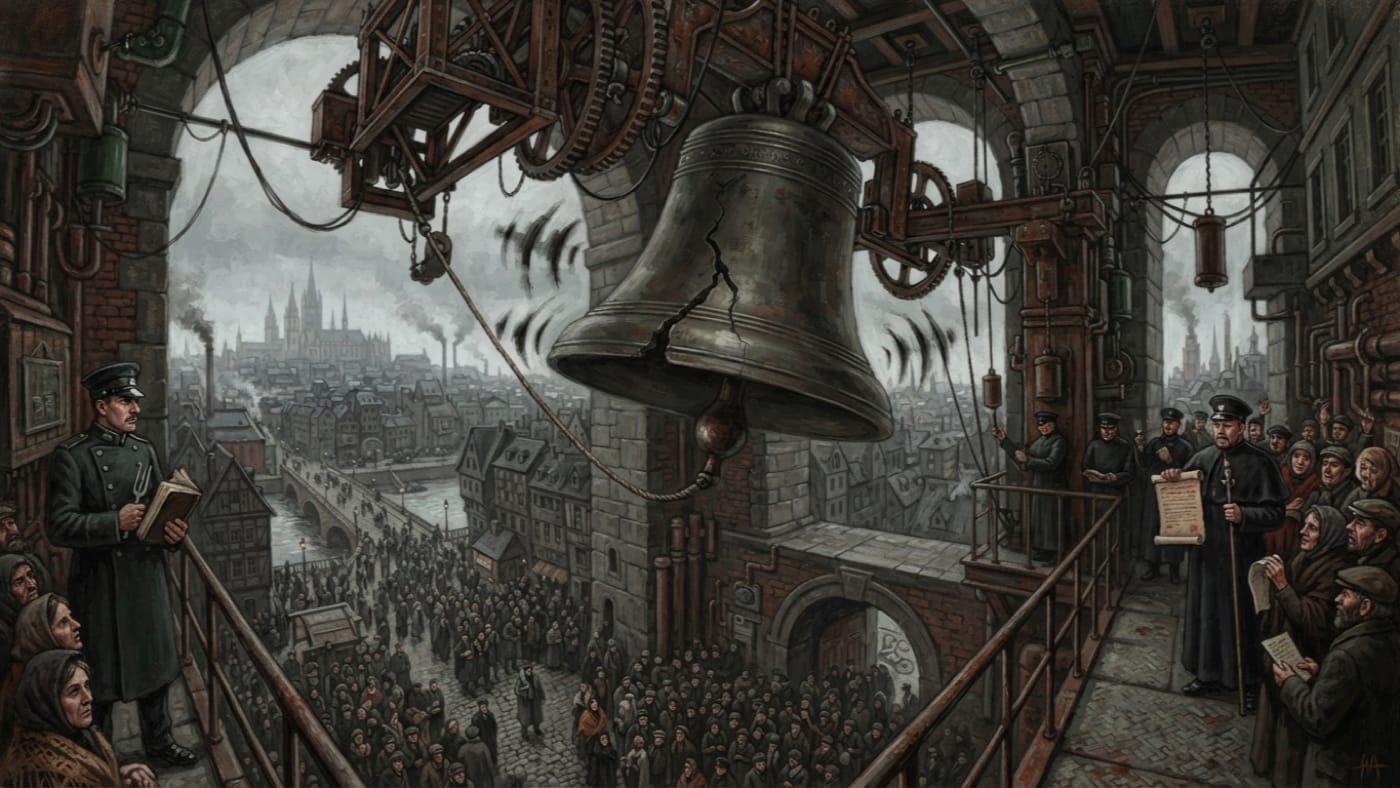
The Cracked Bell of Mainz is a damaged bell kept in the Rhine city of Mainz and rung under the licence of the Feast of the Cracked Bell. The Bureau of Festivals protects it. The Bureau of Bells would like it gone. It is still there.
The Ledger says nothing of how it was made. No casting year has reached this office, and no founder's mark. Nor is there a certified account of whether frost, a fall, a flaw in the metal or a careless hammer opened the crack. Mainz has never pressed the question. This is a city whose bridge clerks can price a barge's cargo while it is still fifty yards from the dock. It keeps toll books older than several Bureaus, and in all that time it has never once asked who broke its favourite bell. I take this as policy.
What is known is the sound. Strike a sound bell and it gives its note, then lets the note die in good order, as a well-catechised parish lets a sermon die. The Mainz bell gives its note and then quarrels with it. The toll comes out uneven. One stroke lands and the next limps after it, and the air over the street fills with a noise that any Bellwarden would write up as an infraction if another bell in the province produced it. The citizens stop to hear it, and they have been stopping for longer than anyone in the Bureau of Bells finds comfortable.
#On Faithful Imperfection
"Hear the flaw, and know thy kind."
The doctrine of the Feast is short enough to fit on a handbill, which is how the Bureau of Festivals prefers its doctrine. Citizens gather to hear the toll of ancient broken bells, and the uneven tones are declared to symbolise "the flawed but faithful spirit of mankind." Mainz's is the one bell the Feast has had to defend.
The catechesis works by an exchange any confessor will recognise. A perfect bell instructs the faithful in perfection. They do not possess it and will not acquire it, and they hear it twice a day as a reproach. A cracked bell that still rings teaches them something they can use. The thing is broken and still in service. It is struck, it answers badly, and it is struck again. The Bureau of Festivals has looked at the population of the Rhine, with its debts, its rations, its tolls and its morning coughs, and has concluded that this is the sermon the population can afford.
That is why the Bureau objects to repair. Mend the crack and the bell rings true. A true bell teaches the wrong lesson, and once it does, the Feast has nothing left to display except a bell. Festivals kept the defect for use rather than sentiment. It preserved an instrument of instruction whose instructive part happens to be the damage.
The licence is narrow, and I record its edges for the benefit of the enterprising. The Feast attaches a sanctioned meaning to certain bells on certain occasions. It does not make every split handbell in Mainz a sacrament. Nor does it shelter the parish ringer who strikes the wrong hour and then pleads faithful imperfection before the Bellwarden. Let him try the plea. The Bellwarden has a tuning fork and no sense of humour, and the Feast has no clause for him.
The Feast has also been unlucky in its company. In A.S. 153 it fell on the occasion chosen for the Laugh Riots of Seville. The Bureau of Festivals found itself administering a solemn observance of human frailty in one city while frailty of a less symbolic kind broke out in another. Mainz was not involved. I mention the matter so that nobody assumes otherwise.
#On the Competing Authorities
"A bell that lies about the hour lies about everything."
The Bureau of Bells deserves a fairer hearing than the Bureau of Festivals has given it, and I give it one here because nobody else will. Bells is not fussy. Bells is responsible. An Office of Bells was constituted in A.S. 52, in the raw years when the Church governed through an interim council and local habit. The present standard was ratified in the Bell Codex of A.S. 115. Between those dates and since, the Bureau has made itself the keeper of the hours. A province rises at the bell, prays at it, works, eats, stops and goes indoors at it. Curfew is a bell, and so is Matins. So is the alarm, and on the Line a misheard alarm is a lost trench.
From that height, a cracked bell is a clock with a stammer. Bellwardens carry tuning forks and lawful schedules. They calibrate, they correct, and they move crowds by tone alone. The whole method assumes that a bell means one thing when it rings. The Mainz bell means at least two, and Bells has never been able to determine which of them the city is listening to.
The Bureau of Festivals answers from a different ledger. Its business is morale, the rationed and audited release by which a frightened population is kept working. To Festivals, a sound a city loves is a stock of morale already paid for. Bells counts the defect, and Festivals counts the crowd.
The three proposed redesigns sat squarely on this fault. By Bells' reckoning, each would have improved the bell. By Festivals' reckoning, each would have abolished it. A corrected bell would ring true and keep the Feast's name while teaching nothing, and Festivals could see that outcome from Strasbourg without a tuning fork.
Inherited catechetical summaries dated the Bell Codex to A.S. 231 and implied that the Bureau of Bells kept no standard before it.
Corrected. The Bell Codex was ratified in A.S. 115. The Office of Bells was constituted in A.S. 52, and bell practice and local bell records are older than either. A.S. 231 lies thirty years beyond the present survey. An office that keeps time for the Church should not have been dated into the future. The correction is entered without further remark.
#On the Attempted Confiscation
"Symbolism, once licensed, is harder to confiscate than contraband."
The record of the dispute consists of a column of figures and one outcome. The Bureau of Bells filed fourteen formal protests and submitted three proposed redesigns. It made one attempt to confiscate the bell, and the attempt failed. The city's Festival Chorus-Master met it with a crowd of three thousand celebrants and a strongly worded petition. The bell stayed where it was.
That is the whole of the certified account, and I decline to improve it. The file names no Chorus-Master and gives no year. It records no warrant, escort, blow, arrest or tribunal, and I will supply none of them. I am aware how much better the article would sell with a bloodied Bellwarden in the third paragraph.
What the figures permit is a reading. Fourteen protests is persistence. Three redesigns is a Bureau trying to win by improvement what it could not win by argument. One confiscation is a Bureau that has run out of paper. The order matters. Bells did not begin with the seizure. It arrived there.
The Chorus-Master answered with the instruments of the office. A Chorus-Master's trade is crowds: assembling them, cueing them, holding them with a baton and a kneel-beat, and dispersing them before anyone thinks of an encore. Three thousand celebrants gathered under festival licence are a sanctioned crowd doing what sanctioned crowds are for. The petition was the other instrument, the written form by which one Bureau's officer addresses another's. Faced with a baton and a petition, the Bureau of Bells found nothing it could lawfully seize except the bell, and the bell had three thousand witnesses.
I note for the Bureau of Purity, which reads everything, that a licensed crowd obstructing another Bureau's officers is a jurisdictional dispute with an audience. On this record it was no uprising. Nobody was asked to stop believing anything. They were asked to stop listening to a particular bell, and they declined.
Bells still had the last word, in the only register left to it. At some later point it examined the petition and confirmed that the ink was "liturgically non-standard." The record attaches no penalty to the finding. It names no substance and accuses no one. The finding is simply true, and filed, and it is the one irregularity in the whole affair that the Bureau of Bells managed to classify. Having failed to correct the bell, Bells corrected the stationery.
#On the Present Application
"The Cracked Bell of Mainz continues to toll. The Bureau of Bells continues to flinch." — Codex survey of the Bureau of Festivals, A.S. 201
As of A.S. 201 the Cracked Bell of Mainz remains in place and continues to toll. The Bureau of Festivals still holds that the symbolism outweighs the acoustics. The Bureau of Bells still holds the bell an abomination, and I can find no record that it has withdrawn any of its fourteen protests.
No document that has reached this office settles the matter. I advise the reader not to assume that a seizure repelled once is forbidden for ever. The bell enjoys a licence and a crowd, but it has never received an immunity. Licences lapse and crowds go home. Bells keeps its files open and its tuning forks oiled.
Mainz takes no instruction from either Bureau. The city has made its bridge into a mouth and its ledgers into teeth, and it counts everything that crosses the river. Yet it keeps one object whose value lies entirely in failing to do its job properly. It rings badly, Mainz loves it for that, and nothing in the Codex suggests the affection is due for correction.
My judgment is entered as follows. The bell is defective, and the defect is licensed. The licence is defended by a Bureau that understands crowds against a Bureau that understands clocks. In this city, on this question, the crowd has kept better time.