
#On the Station
The Bureau of Records holds no charter for any body called the Covenant Garrison. I have asked for one in writing, twice, and received two receipts. The name comes from parish rolls and lecture halls, which needed a noun for the six hundred soldiers of the Covenant who held Rostov against Maldrake's forces for eleven days in A.S. 153 and then lost it in two hours. The clerks' own phrase is "the Rostov establishment, as constituted at the commencement of hostilities." I would like my readers to reach the end of the sentence alive, so I use the parish name.
Rostov was a garrison post. It is not among the seven bastions of the Sagittal Line, and nothing I hold places it against them precisely enough for me to seal. I have no founding year for the post, no commander's name and no order of dissolution. The garrison's recorded duty was to hold. Its stores were calculated for three ordinary combat days. The siege lasted eleven, and the garrison paid for the extra eight with whatever it had besides cartridges.
#On the Work of Holding
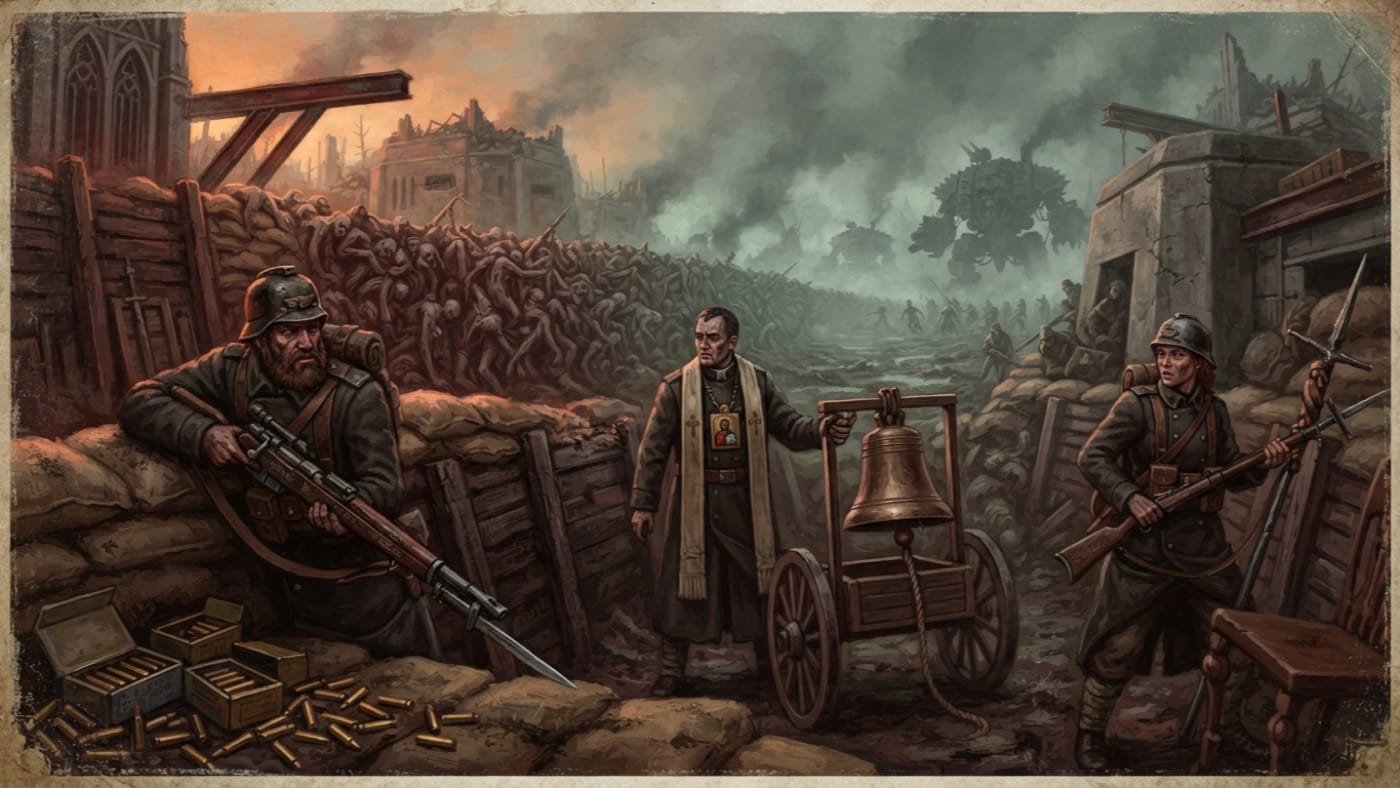
The establishment, as the siege account gives it, was modest. It had rifle companies, a reduced artillery section, two field chaplains, a bell-cart and Quartermaster Adel Truhn. They held the northern approach behind low bastions, a mud glacis and timber revetments. Somebody in an office warmed by a stove looked at that list and judged that the place was unlikely to matter.
A rifle is the last article in a long requisition. Before the trigger come the cartridge and the cartridge box, then the soldier who carries the box along the firestep, then the oil and the rag and the armourer's file. After them come the spare spring, the water to cool the barrel and the quiet hour in which to clean it. Take any one away and the rifle becomes a club with a sight on it. Holding a wall is mostly a matter of keeping that requisition whole while the enemy spends patiently against its cheapest line.
Stores alone do not keep a Covenant line standing. Across its armies the Church administers war and sings it in the same motion. Rifles carry engraved verses and rounds carry stamped prayers. Chaplains walk the issue lines, and bells mark the hours of a fight as they mark the hours of an office. The record does not say whether Rostov's rifles bore verses, and I will not engrave them after the fact. It does record two chaplains and a bell-cart, and I know what those are for. A garrison on its eighth day is not holding because it is rested. It holds because someone is still keeping the hours and saying the names, and still ringing the next watch onto the wall. When the stores are gone, liturgy is the part of discipline that remains.
#On the Exhaustion
The Ash-Fodder were conquered mortals taken from fallen country. They had no enhancement and carried whatever lay to hand, or nothing. Overseers of the Shadow Court drove them forward. The enemy spends them for three purposes: to use up ammunition, to wear out equipment and to exhaust defenders before the real assault comes on. At Rostov they came at dawn, at midday and at dusk, as regular as a monastery bell.
The Bureau's lecturers like to paint Wrath as a bull at a gate. At Rostov, Wrath kept a timetable. The troops worth keeping were held back from the full magazines of the first morning, and the cheap thing did the work.
By the fourth day the rifles had overheated. With three engagements a day and no cool hour between them, a barrel stops being a precise instrument and becomes a hazard to the hand holding it. By the sixth day the defenders were using bayonets. The bayonet is the line's admission that the ammunition column has failed. It brings the enemy to arm's length, which is a distance the Ash-Fodder doctrine is happy to reach. By the ninth day the garrison had made pikes from furniture legs and iron railings. Stairs lost their banisters and rooms lost their tables. The northern approach was defended by the contents of houses.
On the eleventh day the ammunition was entirely spent. The defenders stood behind barricades of enemy dead stacked higher than a man. The Bureau of Engineering has no specification for such a wall. It was built of people who had not chosen to come, and it was the only fortification at Rostov that grew stronger as the siege went on.
#On the Forty Minutes
On the eleventh day the attacks stopped.
For forty minutes nothing came. After that the Wrathforged advanced, rested and fed, and Rostov fell in two hours.
The account records the interval and nothing inside it. I have read the commemorative sermons, which fill those forty minutes with hymns from the parapet, last confessions and a final psalm sung into the smoke. None of it is in the record. I will not add a speech, a charge or an account of who fell where and how. The garrison spent forty minutes waiting with empty cartridge boxes. Then came the troops the waiting had been arranged for.
The enemy took eleven days to empty the garrison and two hours to collect it.
#On the Roll
The six hundred are listed by name, with final dispositions recorded where known. Where known is the clerks' phrase, and it is the most honest phrase in the file. The fall of a position does not establish that every soldier in it died, and the roll does not pretend otherwise. I extend it the same courtesy.
The ninety thousand are not listed.
The Bureau of War's ratio of one hundred and fifty to one measures expenditure. It is what Maldrake spent, divided by the number of defenders he spent it against. It does not say who fired, how often, or whether a given round found anyone. Any instructor who tells cadets that each defender of Rostov killed a hundred and fifty has learned division and nothing else, and I have recommended such instructors for reassignment to the quartermaster's office, where division is at least useful.
I will write the part the report leaves out. The ninety thousand were farmers and prisoners, and some were too old to run. They were driven at those walls by powers that would have burned them for turning back. Had I stood on the northern approach, I would have ordered the volleys and kept ordering them until the boxes were empty, because the other choice was to open the gate to what waited behind them. I would also have recorded their number as people. The Bureau keeps the first half of that sentence and files the second under Doctrine, which has not yet ruled.
#On the Instruction
Five years after the siege, the training revision of A.S. 158 brought Rostov into doctrine. Each office took from it the lesson it had arrived wanting. The Bureau of War took the ratio. The quartermasters took the three days and argued for larger stores, which was the only argument anyone made from Rostov that I would sign without reading twice. The parishes took the names. Endurance went into the sermons, ammunition went into the petitions, and loss went into a column of the Bureau of Records, where it is very well kept.
Nobody took the forty minutes, because they cannot be taught. The defenders spent them with their stores already gone. An enemy who can wait that long for you to run out does not need you to be weak.
The ruins of Rostov lie east of anything the Church presently governs with confidence. No survey of them has crossed my desk. The shrines are nearer and are dusted more often.
Field instruction presented the defence of Rostov as proof of Covenant superiority over massed infantry.
Withdrawn. Rostov proves that six hundred trained and consecrated defenders, supplied for three days, can be outspent by an enemy willing to pay in other people. Instructors who require a lesson in superiority may look for it at some other siege.