
#On the Sovereign Court
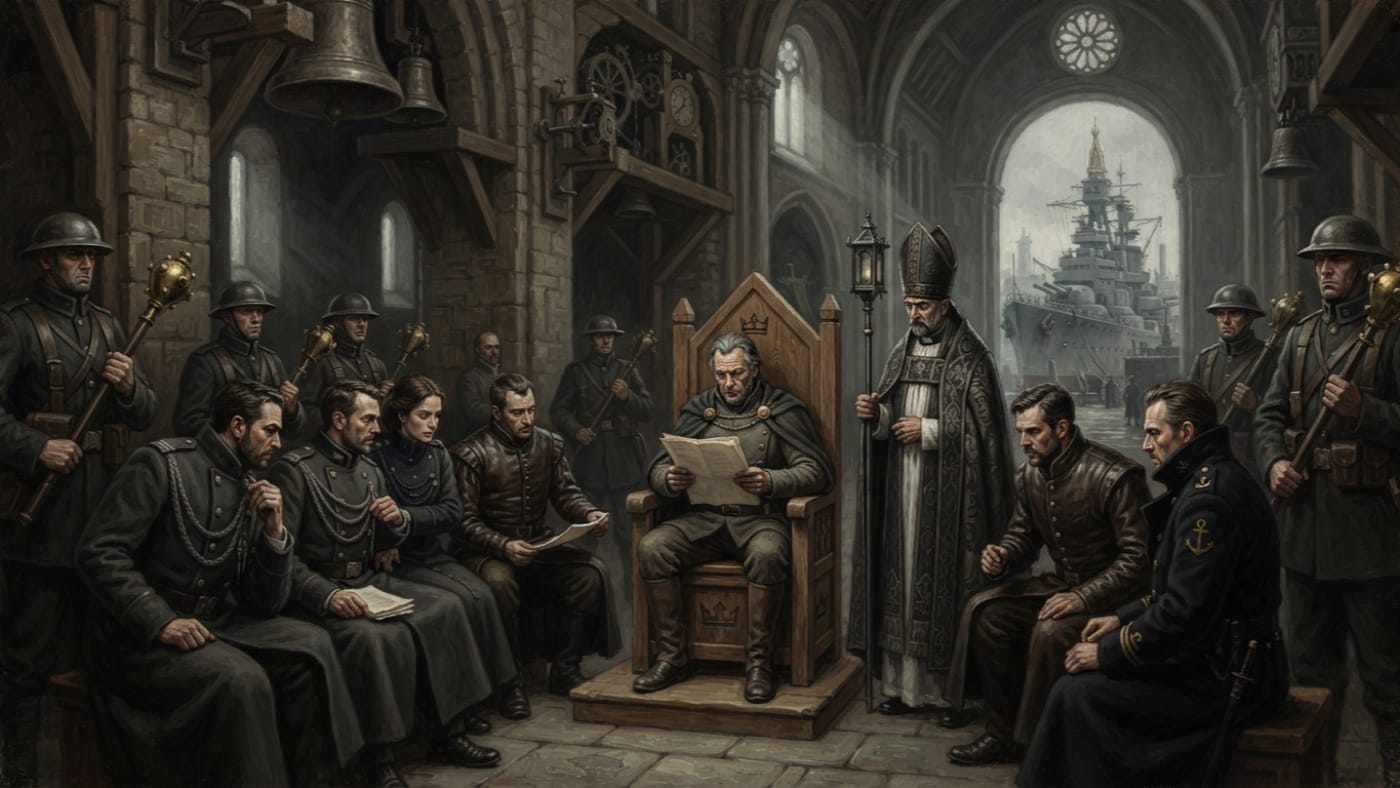
The Court of Canterbury is the name the Synod gives, for want of a better folder, to the governing and diplomatic establishment of the British Crown at its seat in Canterbury. We hold no charter founding it, and no British clerk has ever shown it to me as a body with a seal of its own. It is simply what a foreign envoy finds when he enters the inland cathedral-city of Kent with papers in his satchel: a king who reads, a council that quarrels, a prelate who blesses, and a great many armed men who ring bells.
Canterbury lies in Zone 0, independent British territory, inland behind the Dover shore. The Crown seated there never signed the Concordat of Strasbourg. It is classed Category Zero, an independent allied sovereignty and a co-belligerent at sea. Its court answers to nobody in Strasbourg. It was never subordinate to us, so its refusals cannot be prosecuted as rebellion, which the Bureau would have enjoyed.
Legate-Prior Mertens lists this court in his dossier as his counterpart, beside King-Warden Aldric III. The pairing is correct. No one negotiates with Aldric alone. One negotiates with the arrangement around him, and the arrangement keeps no minutes it is willing to share.
#On the King, the Prelate and the Nine
Aldric III, Rex Custos, governs. He does it through the Table of Nine. He arbitrates between its Wardens, confirms major naval levies, hears coastal petitions and receives foreign legates. Final settlement is his. Everyone at Canterbury knows where the last word sits, which spares the court the continental chore of finding out afterwards.
The Table is his council, and it is a separate thing from the court in the way a hand is separate from the man who owns it. Nine Wardens hold their seats by old Crown charter. Their duties cover shores, ports, interior marches, northern strongholds, and inland obligations of bread, bridges and bells. A Warden holds soldiers, judgment and sacrament in a single commission. I have not seen the full roster, nor has anyone in Strasbourg, and I distrust any abstract that claims otherwise. The British say the charters predate the Sundering, and they say the charters descend from the Arthurian table that Britain still swears by. Both claims supply legitimacy. Neither has been laid on a reading desk where a Synod archivist could test the ink.
The Archbishop of Canterbury keeps the cathedral. His office holds the rite of the Lantern Way, ordination, custody of relics, and the sacred authorisation without which British law would be merely law. It is separate from the throne. The Bureau of Doctrine likes to translate him into three Synod chairs at once, Doctrine, War and Rites. That translation tells you more about our furniture than about him. His personal name has not been released to Synod registers. I refer to the office, as the British do, and leave the man inside it unfiled.
Oath holds the three authorities together. A Warden swears to the Crown under the Archbishop's rite. At the change of watch the King-Warden kneels where the prelate stands. The Wardens bring their quarrels to the King and carry his answers home. The published accounts do not say under which roof or in which room the throne and the Table meet, and I will not draw a floor plan out of envy.
#On Audiences and Dispatches
The reception rooms are stone, oak, iron and wool. Only the throne is gilded, and only lightly, as though gold were a sin allowed so that visitors can find the King. No incense burns at diplomatic audiences unless a relic is present. The first time a Synod envoy notices this, he thinks he has been insulted. The second time he understands that the room smells of candle-fat and wet cloaks because nothing in it is there to perform.
Aldric reads foreign papers himself, and he reads them to the end. He keeps no secretary to summarise them and no layer of undersecretaries, the device by which a continental prince holds unpleasant sentences at a hygienic distance. This one habit has ruined more Synod drafting than any heresy of the past decade.
The best example comes from autumn of A.S. 194, the season I spent eleven days in Britain between Canterbury and Dover. Mertens presented the King-Warden with a six-page objection to British penitential walling. It had been composed in Strasbourg and improved by committee until it weighed about as much as a moth. Aldric read it, folded it once, and said, "No." The witnesses were two Wardens, a chapel clerk, three Lantern-Ringers and Mertens himself. The Legate-Prior bowed, picked up the paper and wrote the scene down exactly as it happened. The Bureau has suspected him ever since, chiefly for being exact.
Canterbury courtesy has limits, and the limits are easy to read. Mertens asserts Synod primacy at every formal audience where protocol calls for it. The court hears him out. Nobody laughs, nobody objects, and nobody acts on what he said. Being received at Canterbury gives a guest no jurisdiction, any more than the chair offered to a guest makes the house his.
The arrangement runs the other way too. Lord-Warden Eccleston represents the Crown in Strasbourg with a Lord-Warden's authority, and our correspondence reaches Canterbury through his hands. He receives everything and passes everything on. His receipt means the paper has arrived. Agreement would need a separate miracle, and Canterbury does not report its miracles to us.
#On the Court's Instruments
A decision made at Canterbury leaves the room on its own feet. The Wardens argue against it loudly, citing drowned abbots and their grandmothers, and once it is settled they carry it out. Ports open or close. The militia musters. The chains rise at the Dover chainworks. Bell-towers change their watches. The Lantern-Ringers are ordained, armed servants whose bells mark the hours, the alarms and the duties of a parish, and whose bell-bronze maces are meant for fighting on stairwells. Nobody carries them in procession for show.
The Royal Fleet answers to Aldric, and the Wardens keep it at sea through port administration, local levies, victualling, repairs and harbour discipline. Its Cathedral Ships sail alongside warships of several other types, and each one carries artillery, a chapel, bells and a reliquary-keel in the same hull. Escort across the Channel is the court's heaviest argument. It is seldom mentioned at an audience, and it is always in the room.
Coin and relic serve the same sovereign. The Iron Crown circulates wherever British law says it circulates. Canterbury's relics are sworn on, carried in procession and sealed into keels, all without a Strasbourg custody number.
This efficiency is paid for by penitents. British penance is harsh and public. Judicial walling is still practised, and it was the target of Mertens's six pages. Our sources do not settle how responsibility for a given sentence divides between the royal court, the local Warden and the cathedral rite. I will not lay the mortar at the prelate's door simply because his see is the easiest door to knock on. The walls exist, and men are put inside them. Canterbury calls this legible justice. I call it cruelty that keeps honest records of itself. That is more than some of our offices can say for themselves, and it is still well short of mercy.
#On the Accommodation
My report reached the Bureau in A.S. 195. The British had returned my confiscated notebooks about six months after I left, marked with green redactions in a hand I have not identified. The report described a court that worked. The Bureau received it as an unwelcome inventory.
Earlier Synod marginalia described Canterbury as "ceremonial centre; practical power dispersed among local Wardens."
Withdrawn after observation in A.S. 194. At Canterbury, power spreads into the shires only after it has been gathered before the throne. The original annotator mistook the noise of the Table for the absence of a king. The note stays in the file with a line drawn through it, so that later annotators can see the shape of the mistake and how hard it had to be corrected.
In A.S. 199 the Lantern Way was reclassified from Schismatic Heresy, Category Two, to Non-Standard Observance, Diplomatically Accommodated. Doctrine signed the wording. War supplied the reason, and the reason was convoys. Strasbourg can denounce a foreign rite at great length, and it can go hungry, but it cannot do both while British hulls guard the grain lanes. The accommodation puts no Briton under Synod government. All it records is that Strasbourg has stopped calling the court's faith a heresy in documents the court's captains might read.
Purity opened its review of Mertens that same year and found no actionable contamination. It was offered a convenient culprit and declined him. The ships remained the cause.
#On the Present Court
As of A.S. 201, Aldric governs at Canterbury. The Table sits when summoned and acts once a matter is settled. The Archbishop keeps the cathedral and the rite. Mertens still lives in the outer precinct and writes short letters under loud bells. Eccleston is still in Strasbourg, receiving our papers. The court's records are kept with its charters, out of reach of our reading desks, and the convoys sail on schedule.
The Bureau asks whether the Court of Canterbury can be made to answer. It answers constantly. It answers in one syllable.