
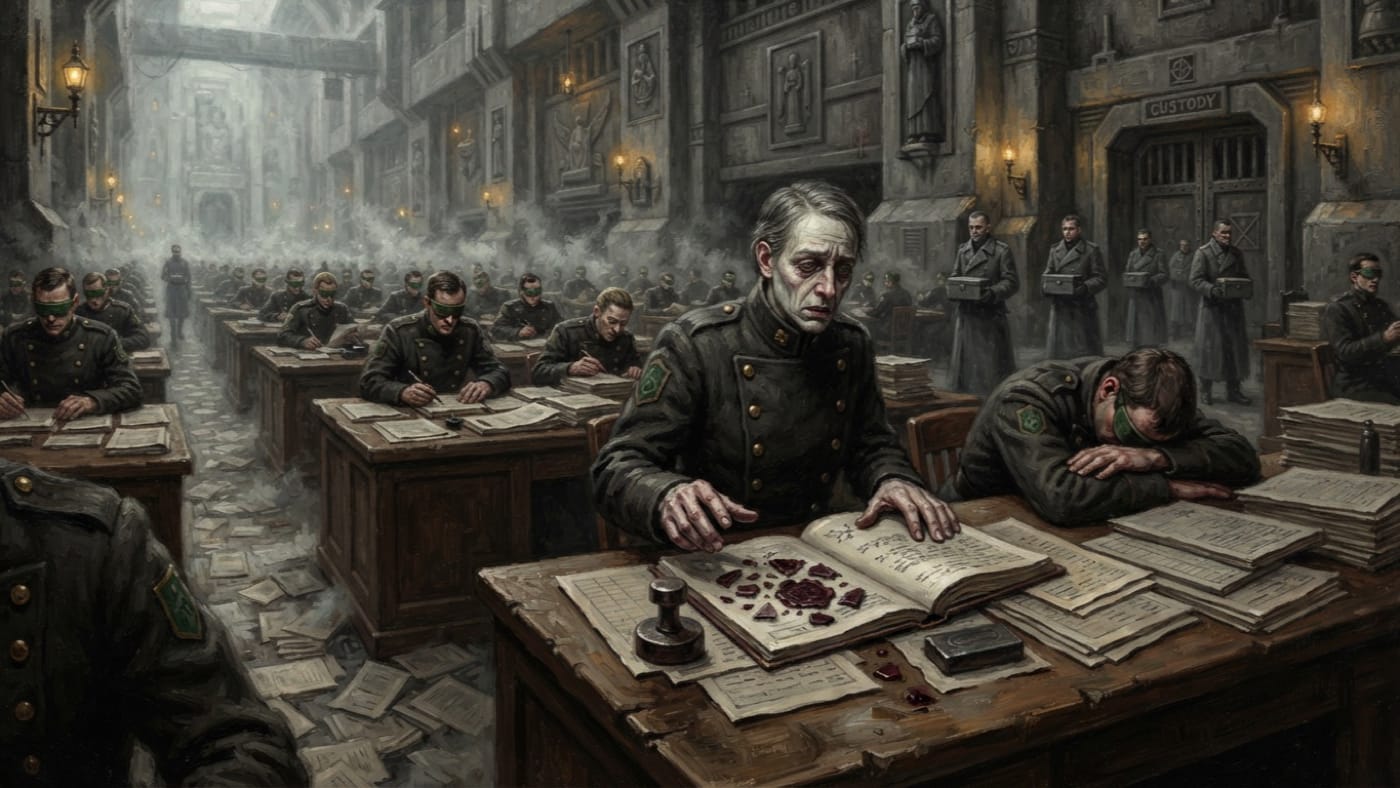
#On the Seal That Revises Its Origin
The name is shared, and that is the first misfortune. In the Sigillary's lawful usage, a counter-seal is the second impression pressed into the reverse of the wax. It is the Bureau's reply to its own obverse, a small extra certainty that the document was closed by the hand that claims to have closed it. This tract concerns that instrument only where the Shadow Court has learned from it.
The Court's counter-seal belongs to the Mock Liturgy, the parodic apparatus through which the Great Deceiver hands our forms back to us with teeth in them. It is the quietest of those instruments. It lies on a desk among forty other papers and waits to be recognised.
Recognition is the danger. The Church governs by authenticated documents: the writ, the warrant, the relic certificate, the execution order, the marriage bond and the transit pass. Each asks a clerk to look at wax and agree that authority stands behind it. A clerk does this hundreds of times a week. The habit is the whole of the clerk's competence. Against the Court, it is also the whole of the clerk's weakness.
#On Lawful Marks and False Provenance
Three instruments must be told apart, and the Bureaus tell them apart badly.
The lawful seal of the Bureau of Masks and Seals binds a document to its origin. Its die is registered and its impressions are guarded. When the die is retired, the retirement is witnessed at the furnace. If a lawful seal lies, then an official has lied, and the Church has procedures for officials.
The ordinary forgery binds a document to an origin it never had. In some port warehouse, the seal-forger carves punches, ages paper and copies a registry hand so that someone can pass a gate, claim a ration or bury a body without questions. The forger's lie is fixed when the thing is made. It can be caught by comparison: a mis-cut serif, a wrong shade of wax, an inspector with a good lens and a poor temper. Forgery is a crime of craft, and craft leaves tool marks.
The Court counter-seal is reported to do something else. The published account, which I submitted and Doctrine sealed, states that it revises its origin while the reader watches, then persuades the reader that the revision was already approved. The debriefs do not settle whether the wax alters provenance, memory, perception or some faculty the Bureau of Doctrine has declined to name. They settle only the result: a reader who has given assent and cannot find the moment of giving it.
Early Doctrine circulars described Shadow Court seals as counterfeit Synod instruments.
Corrected after the A.S. 174 debriefs. A counterfeit can be checked against the register. Checking it requires two things: the document must hold still while it is examined, and the examiner must still be the same person who began the examination.
#On the Forms Reported
The surviving descriptions fall into three families. I give them in prose and go no further.
The first family bears an episcopal mark reversed, as though struck from the mirror of its own die. The second carries a Bureau sigil cut through its centre. The register shows unbroken field at that point, and a lawful die takes such a cut only on the day it is retired and broken. The third shows the Triune Knot with angles pointing where no triangle should have a point. Witnesses agree that the marks look wrong, but no two agree on any measurement. Several report that they knew the geometry was wrong before they had finished looking at it.
The Armorial registers every lawful symbol of the Church and the permitted variations of each. It offers no approved correction for these marks. To correct a fault, one must first draw it, and drawing it is the one act the Bureaus have agreed to forbid.
#On the Counter-Warrant
The counter-seal is put to its fullest use in Anti-Synod proceedings, the tribunal-rites in which Court functionaries parody the Holy Bureaus and issue instruments of their own. These proceedings stamp minutes, try villages and annul baptisms. They also issue warrants.
A counter-warrant needs no perfection. It needs familiarity. The published account states the case plainly: a seal close enough to Synod form that a tired gate clerk reads it as lawful and opens the wrong passage at the wrong hour. That sentence names no clerk, no town and no date, and I will not supply them. The example is a type, and the Bureau has its reasons for preferring types.
The clerk has carried out the office exactly. They examined the warrant and recognised the impression. They compared it with the picture of a proper seal that every clerk carries in hand and eye, and then they acted on it. The gate opened under the procedure written for opening it. Every record of that hour will show a correctly processed instrument. If the Court's seal works as the debriefs report, the clerk's own memory will testify that the warrant was approved.
Here the counter-seal meets the wider appetite of the Mock Liturgy. In the confirmation of choice, a kneeling child is taught to answer I choose where the catechism says I submit. The counter-warrant asks for something smaller and more clerical: a signature given with the eye. A clerk deceived at a gate has not chosen damnation, and Doctrine forbids any sermon that suggests otherwise. Still, the Court's preference is consistent. It wants its passages opened by our hands, under our procedures, with our assent on file.
#On Custody and Refusal
Containment begins with refusal. Directive 77-C forbids reproducing the seal geometry, along with the formulas, melodies, response patterns and altar order of the wider rite. No counter-seal is drawn for training, and no impression is taken in fresh wax for comparison. No clerk is shown an example so they might recognise the next one. Recognition is the very faculty the Court exploits, and the Bureau will not sharpen it on the Court's behalf.
The field instruction is shorter. Field chaplains are told to break the wax rather than read a suspect seal, and to break it first. What remains is unsealed paper with no standing, and it goes upward with the shards. Breaking a lawful seal costs the Church a day's delay and an irritated bishop. Reading a Court seal can cost a passage.
This is field interruption, and custody is a separate matter. A chaplain who breaks the wax has only stopped it from being read. Containment belongs to the Bureaus, in order. The Bureau of Purity boxes the artifact. The Bureau of Rites witnesses the boxing. The Bureau of Records registers the box. The Bureau of Shadows then takes it into a custody that every office relies on and none will describe. From then on, the register entry points to a location that is, in the most exact archival sense, a gap.
I do not know where the boxes go. I hold the clearances to ask, and I have used the better judgement of declining. An archivist who knows the shelf can be made to fetch from it.
#On the Standing Prohibition
Directive 77-C remains in force, and the counter-seal falls within it. No separate classification has been issued for the instrument, and none is needed. The hazard of the Mock Liturgy covers its seals as it covers its hymns.
The approved public assertion stands: the Shadow Court has no jurisdiction over the faithful. Priests say it from the pulpit, and they are right to say it, because jurisdiction is a matter of law and the Court holds none. The sentence makes no claim about wax. A warrant without jurisdiction can still open a gate if the clerk believes in it. The debriefs do not tell us what the clerk believed, or when, or whose revision produced the belief.
The mechanism remains unknown. The procedure does not wait for it.