
#On the Incident and Its Arithmetic
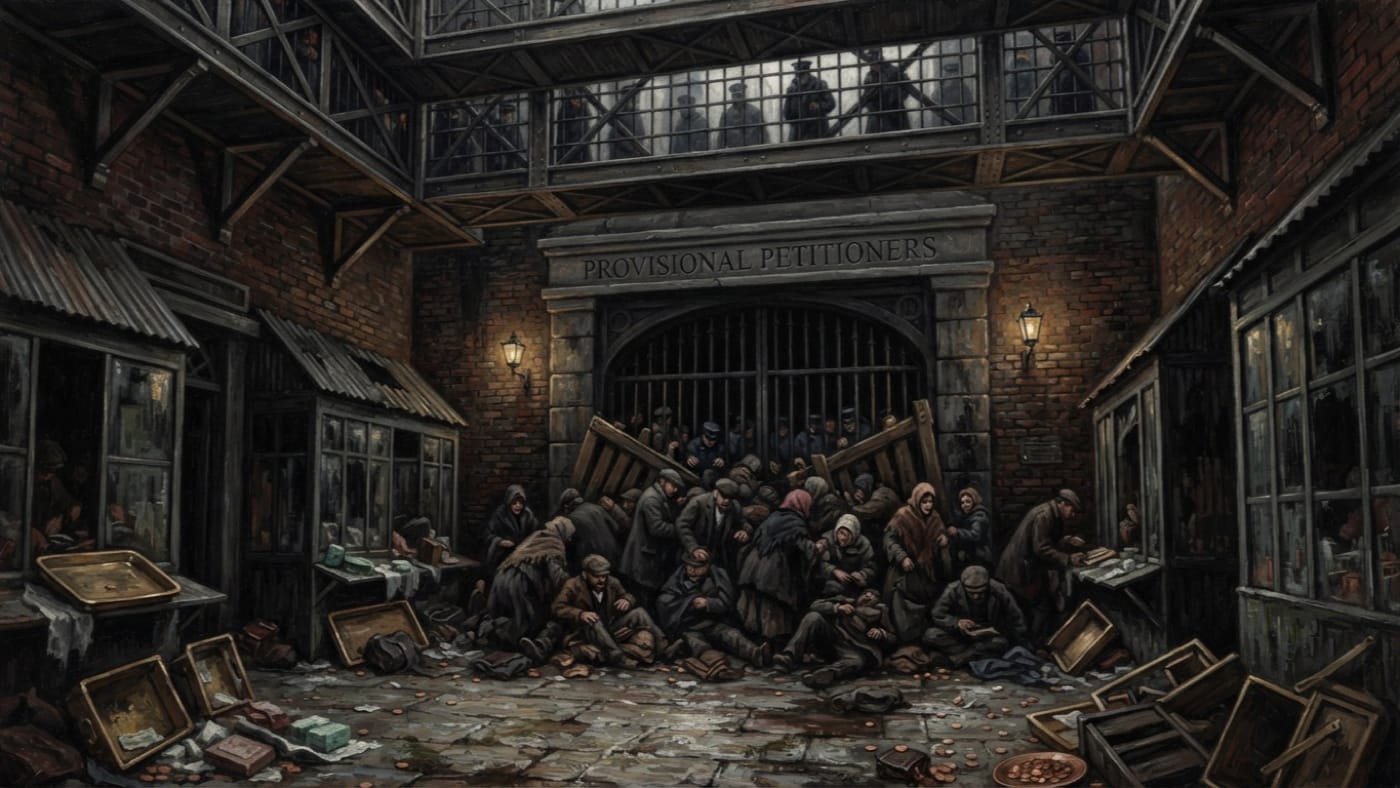
The Copper Saint Crush took place in A.S. 196, which is 1906 by the old reckoning, at Clipper's Market on the outer ring of the Crownwright Diehouses of Sable Court in Cologne. Nineteen petitioners died. The record places their bodies against the Widow Gate, where the Market keeps the people least able to step out of the way.
The Codex enters it as the worst recorded violence in the Market before the Face Theft crisis. I keep that qualification as carefully as a clerk keeps a receipt. The later crisis is larger and louder, and it is still open. A fresher catastrophe does not get to swallow an older one just because it produced more paperwork.
The cause takes one sentence. Someone said a stall had received copper bearing a saint's face. The copper bore no such face. Between the saying and the weighing, nineteen people were pressed to death.
#On the Crescent and the Widow Gate
The Market is a crescent of black brick between the public exchange access and the first interior assay barrier. The Mint-Chapter licenses it and the Wardenate supervises it. Every inch of it is lawful, and that is the trouble. The walls are stained silver at hand height by generations of citizens rubbing their coin clean before inspection. Soap sits in chalky bricks on the washing counters beside brass trays and edge-cloths. Overhead run the Warden Walks, iron grating with viewing slits, so that order can be corrected from above without anyone having to touch it.
On the flagstones below, order is rope. Rope lanes carry the queues from gate to table, table to bench, bench to exit. Rope keeps a crowd in single file and tells each petitioner where to stand, where to wait and when to move forward. It holds no one up.
In Sable Court a coin carries a face, and a face carries a person. A citizen comes to the gate clerk holding a coin that bears his household face. He recites his name-history. The coin is washed, edged, compared and weighed, and then the citizen pays the fee in the same metal that has just been doubted. If the household face has been recalled or disputed, or made unspendable by a clerk's slip of the pen, the household cannot buy bread in the ordinary way, and its petitions start from a deficit.
Those households go to the Widow Gate. Above it, a lintel reads PROVISIONAL PETITIONERS. The line under it moves slowly, because doubt questions are hard to answer for people whose standing is already in question. A petitioner who steps out of that line to breathe has given up their place in it.
The A.S. 196 record calls the dead petitioners. It does not say whose faces they had come to defend, whether they were widows, how old they were, or whom they left behind. I will not give them widowhood the clerks never wrote down. The gate's name is not a census.
#On the Rumour of the Carrier's Face
The rumour said that one stall had received a batch of copper bearing the face of Saint Ignatius the Carrier.
The choice of saint deserves a moment, though the rumour never earned one. Ignatius Brenner was a parish clerk of Cologne who carried holy things past inspectors under a covering of bread. The Church canonised him for it, and his patronage of smugglers has troubled the Bureau of Doctrine ever since. The Bureau files this trouble under devotional complexity, a heading roomy enough to hold any embarrassment. So the report put the patron of things carried past inspection on copper, in the one quarter of Cologne built entirely for inspection.
The record does not say what the crowd wanted from such copper. They may have meant to buy it, venerate it, spend it or simply look at it, and the clerks did not ask. It is also convenient to blame the rumour on the Clipped Choir, which runs its routes through the shadow stalls behind the licensed benches. No record does so. Convenience is not evidence, even inside the Bureau.
What the record gives is the damage. The crowd broke three rope lanes. It overturned two wash-stalls. It crushed nineteen petitioners against the Widow Gate.
That is the entire account of the crowd's movement: three, two and nineteen. I have filed longer entries for a stolen censer. There is no account of who ran first, which lane broke first, how long the pressure lasted, or whether anyone on the iron Walks overhead called down an order. I will not supply one. The numbers are enough. Three lanes of rope carried the weight of a market toward its narrowest and slowest gate, and the people in that line were the ones the Market had already marked provisional.
Reported in Clipper's Market, A.S. 196: one stall has received a batch of copper bearing the face of Saint Ignatius the Carrier.
Corrected. The batch was ordinary copper. No saint's face was found on it. The report is withdrawn. The nineteen petitioners remain dead.
#On Ordinary Copper and the Posthumous Fee
The copper batch proved ordinary. It had the usual weight, the usual alloy and the usual faces. It had no saint on it, no forgery and no wonder. It was the most unremarkable thing in Cologne that day, and nineteen people died trying to reach it.
After that, the dead were assessed posthumous inspection fees.
I set the sentence down plainly because it needs nothing from me. Still, a Hieromnemon of the Bureau of Records owes the reader an account of how an office arrives at such a thing. The Market's procedure ends at the seventh station, the fee. Each of the nineteen had entered a queue, and in Sable Court a queue is the beginning of an inspection. By that reasoning each of them had been inspected, or had at least been exposed to inspection for long enough to owe for it. Death halted the procedure. It did not cancel the charge.
The entry is in the passive voice. Fees were assessed. That grammar has protected its author better than the Widow Gate protected the petitioners.
The record I hold gives no amount for the fees. It names no household that received the demand and describes no method of collection. It records no appeal, no remission and no clerk reprimanded for issuing the charge. It mentions no inquiry, no compensation and no memorial, and the Codex will not invent any of them to make the office look better. The Great Ledger of Souls takes in deaths. The Market's fee books take in fees. The record does not say whether the two ever compared their columns.
I have served the Church's ledgers for a long time and I admire their thoroughness. I admire it less when it reaches past the grave to present a bill to people who came only to prove they existed. The copper was ordinary and the deaths were real. The charge was entered anyway.
#On the Market Since
Face Theft began in A.S. 199, three years after the crush. It is a separate crisis, larger in scale and different in kind. An emergency recall across seventeen denominations turned the crescent into a pen, and by A.S. 201 the Market was operating under Amber restriction with Face Theft protocols in force. The gates may be shut without warning, disputed coin is held for fidelity comparison, and the shadow stalls charge more than they used to.
The Market's present rules include a limit of nine coins counted aloud, a ban on showing a child their own face-coin in a recall line, and a bell rung seventeen minutes before opening to discourage surges. None of these is recorded with an adoption date that ties it to A.S. 196. It would be easy to cite the nineteen dead as the reason for them, and the Market would be pleased to be thought a reforming institution. I will not backdate a mercy the record does not show.
What the record does show fits in four lines.