
#On the Custody Object
Custody first. Flame after. — Trench Court instruction, attributed to no one willing to sign it
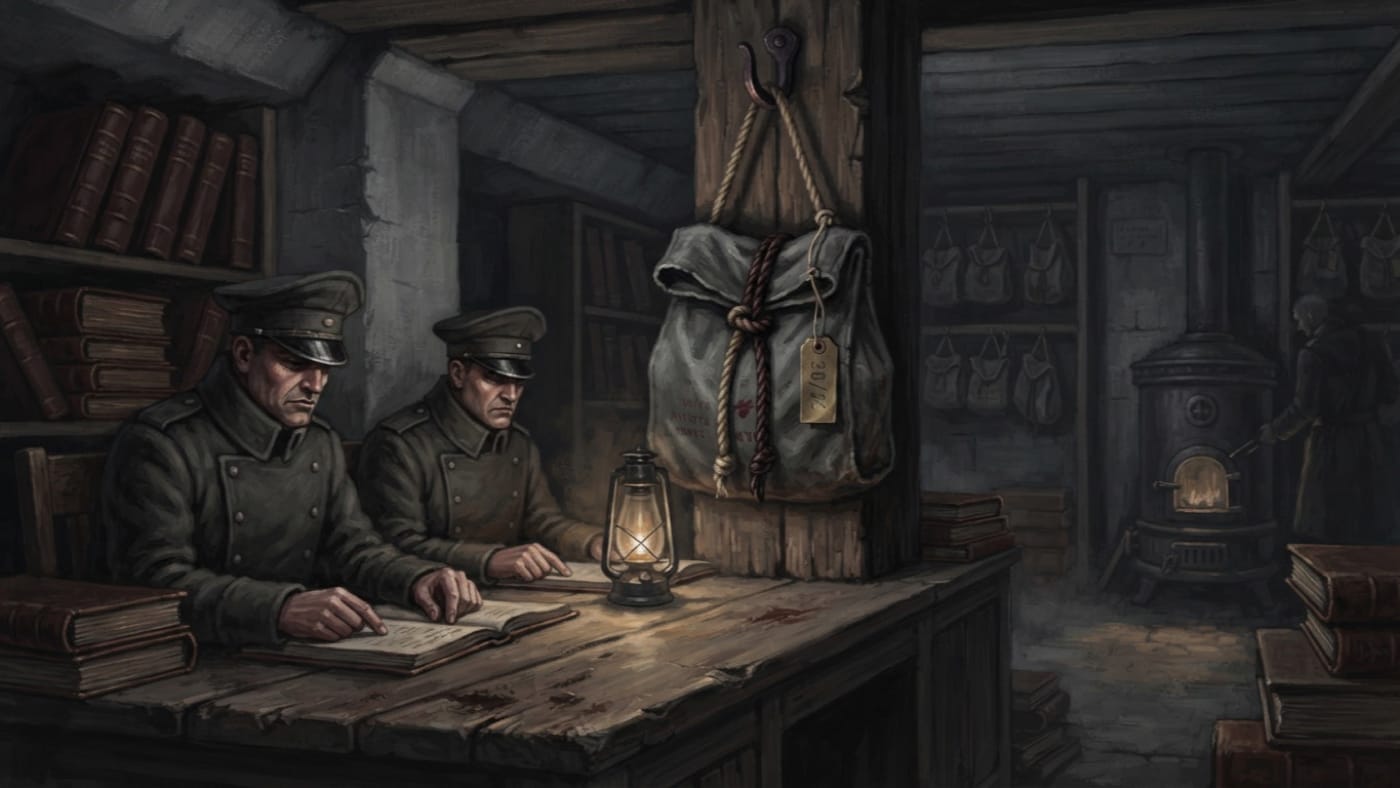
The contradiction pouch is the smallest piece of state machinery on the Line that can hang a captain. It is a waxed satchel issued to every licensed Trench Court, grey or black according to sector. It holds the final testimony the Synod has decided to hear once and keep nowhere. Civilians picture a reliquary. The object is closer to a mail sack that has been ordained.
Its purpose is custody. The Contradiction Doctrine, standardized with the Trench Courts under the Joint Mandate of A.S. 91, requires dangerous last words to be recorded, marked, sealed, routed and destroyed under authority. The pouch performs the third verb and makes the other four possible. Before the Uncounted Winter, the front lost its testimony honestly: to mud, frost, fire and the occasional helpful officer's pen. Fifty thousand dead without attestation taught the Bureau of Records that loss by accident produces riots, while loss by procedure produces a receipt.
Nobody recorded who stitched the first pouch. I have stopped asking. Men who invent such objects prefer anonymity, and Records is always glad to oblige.
#On the Mouth and the Mark
Burn Directive 7-C describes the early pouches as waxed cloth, and the wax is the point. Trench air ruins paper by the hour. A pouch that lets in damp also lets in an excuse: the ink ran, the page pulped, the contents can't be read and the burn order is moot. Wax refuses the excuse. A sheet that enters the satchel must stay fit to be destroyed properly.
The mouth closes with two ties, one belonging to the clerk and one to the supervisor. Each man answers for his own cord, and neither can later swear that the other sealed the bundle while he was away. Records calls this dual custody. Clerks call it sharing the blame evenly, which is the only fair distribution the front has ever managed.
The pouch hangs on a hook behind the clerk's table. The confessing man can't see it unless he turns his head, and most of them can't turn. The placement was justified as hygiene of morale. It also spares the clerk from watching a man's eyes follow his own sentence into the sack.
The mark is a coded slash beside the unit designation, kept distinct from the ordinary Records stamp. The whole system depends on that difference. An ordinary ledger proves a death, triggers a pension and moves a bequest. A slashed pouch announces that something has been taken out of that traffic. Sector code, doctrinal severity and bundle number travel with it, so an auditor can sort it, route it and count it without reading a word.
Contradiction pouches are never stored with ordinary ledgers. The rule sits in every clerk's catechism. The only men who break it are men who want to be caught.
#On the Number That Travels
The Trench-Court Clerk takes the testimony at the lantern table: name, unit, vow or doctrinal line, bequest, statement and category. Depending on training and the length of the queue, the clerk writes either a full transcript or a rubric compression. Most of what a dying man says is safe. Fear is safe, and so is grief. Calling for water carries no severity at all. Contradiction is the sentence that strikes the official account at a joint. The bell did not ring. The captain ordered the retreat and blamed the dead. The ration sacks were sold. The thing in the wire wore a missing man's face.
The clerk marks that sentence with sector code and severity and puts it in the pouch. Everything else stays where it belongs. The death attestation remains in the ordinary ledger. Under the profession's best practice, the bequest slip travels separately. Personal effects go on their own list and into their own sack. A man can therefore be fully dead in law, his widow notified and his boots reissued, while his accusation still hangs behind the table in wax.
The register entry is the elegant part. The bundle number goes down with no description, so the register proves that something dangerous existed and stays silent about what it was. The courier carries a sealed object and a number. A courier who opens one turns himself from transport into evidence.
The burn order arrives with bundle numbers, a date and a signature. Routine authority belongs to the Front Prelate or the War Registrar. I have seen one order that carried both signatures, which means either exceptional caution or two men who wanted to share the honour. The attendant feeds the testimony to the iron. The contradiction number is copied into the furnace log, and the ash is weighed and filed as waste.
So the number survives. It sits in the register, on the courier's docket and in the furnace log, reconciled across all three, audited, and countable for as long as Records keeps paper. The words it once identified are gone. The Synod considers this the correct ratio.
An instructional pamphlet of A.S. 104 described the Doctrine as "the humane preservation of morale-sensitive testimony."
Corrected. The pouch preserves testimony until the countersignature arrives. The only thing it preserves humanely is the number.
#On the Hands That Delay It
Between the hook and the furnace stand the Contradiction Custodians. They are senior clerks, ranked above supervisors, who reconcile pouch counts, run the burn cycles and decide which bundles go forward to the iron and which go rearward for Records review. A Custodian checks the wax, the ties, the code and the damp, and then chooses a route. Most pouches burn. Some wait under a pension-delay hold until the family notice has gone out. Some go rearward because an officer has enemies of equal rank. Some go to specialist review. Being sealed promises nothing, and a clerk who tells a dying man otherwise is lying in the approved manner.
The profession's factions fight over that waiting. Record-True Clerks hold that the Ledger owes the Creator its completeness. They keep duplicate slips under their blotters and delay transfers by pleading damp or a missing courier. They quote Saint Vell, patron of clerks, at Custodians who never asked. Some of them also call her patroness of pouch-keepers. That attribution is disputed, and the saint has filed no ruling.
Rubric Clerks want the pouch light and the queue short. Their compression reduces a long accusation to a severity code, and an exhausted man can route a severity code at the third bell of night. They will tell you, correctly, that a clean category keeps a widow's pension moving while a disputed one freezes it. A delayed pouch can stall an inheritance, and a hasty one can bury the only witness to a theft. In the rear, the Records Scribe inherits whichever mistake the front preferred.
#On Mercy, Purchase and Restricted Speech
Anything that can decide a pension acquires a price. A family pays to keep a son's doubt out of the pouch. An officer pays to get an accusation into one, or to have a particular bundle burned before audit. A clerk can sell a mercy seal by entering contagious doubt as grief. The words never reach the hook, and the children keep their bread. At Bastion-Przemyśl, lamp oil has bought that kind of reclassification. At Bastion-Constantinople, morphine and promises do the same business with better manners. Bequest slips are supposed to travel apart from confessions. The furnace accounts show that they don't always, and burning a bequest is a cheap way to keep boots in a quartermaster's store.
The Bureau of Purity watches the pouches for doctrinal danger and tolerates most of this. Perfect enforcement would teach the dying to stop talking, and the whole apparatus needs them to talk first. The Bureau of War shares the field mandate and takes a lively interest in which bundles contain officers.
Cadence material leaves the ordinary route. When a clerk suspects Cadence Anomaly, meaning speech or identity that doesn't fit the speaker, the exact wording is kept, nobody repeats it without authority, and routine burning stops until an examiner has reviewed it, unless contamination forces the fire. Field clerks report pages that resist the flame and ash with blue edges. Engineering reports nothing. My own report is that clerks talk too much near furnaces.
#On the Present Count
As of A.S. 201, every licensed Trench Court keeps its contradiction pouches apart from its ordinary ledgers, and inspectors count them before anything else. They ask how many hang and how many have left. They ask which courier carried each one, under which countersignature, in which furnace log it was entered and how long it took. Ash drawers are matched against bundle numbers. An unaccounted pouch is worse than a missing ledger. A missing ledger is negligence. A missing pouch may be travelling.
The clerk who lost it answers first. The supervisor whose tie closed it answers second. The two ties were made for this hour.