
#On the Industrial Class
"Quod intrat plus est quam quod exit." — the whole matter, in one line
This entry is a survey of the present, entered in A.S. 201 at the Bureau of Doctrine's commission. It covers a class of sites, not any single one. The Consuming Factories are human industrial works, the ordinary mills, foundries and workshops of productive labour, that have passed into Velmora's possession and kept running under a logic their builders never installed. The survey records the class as it is reported now: in operation, Velmoran, plural, and short.
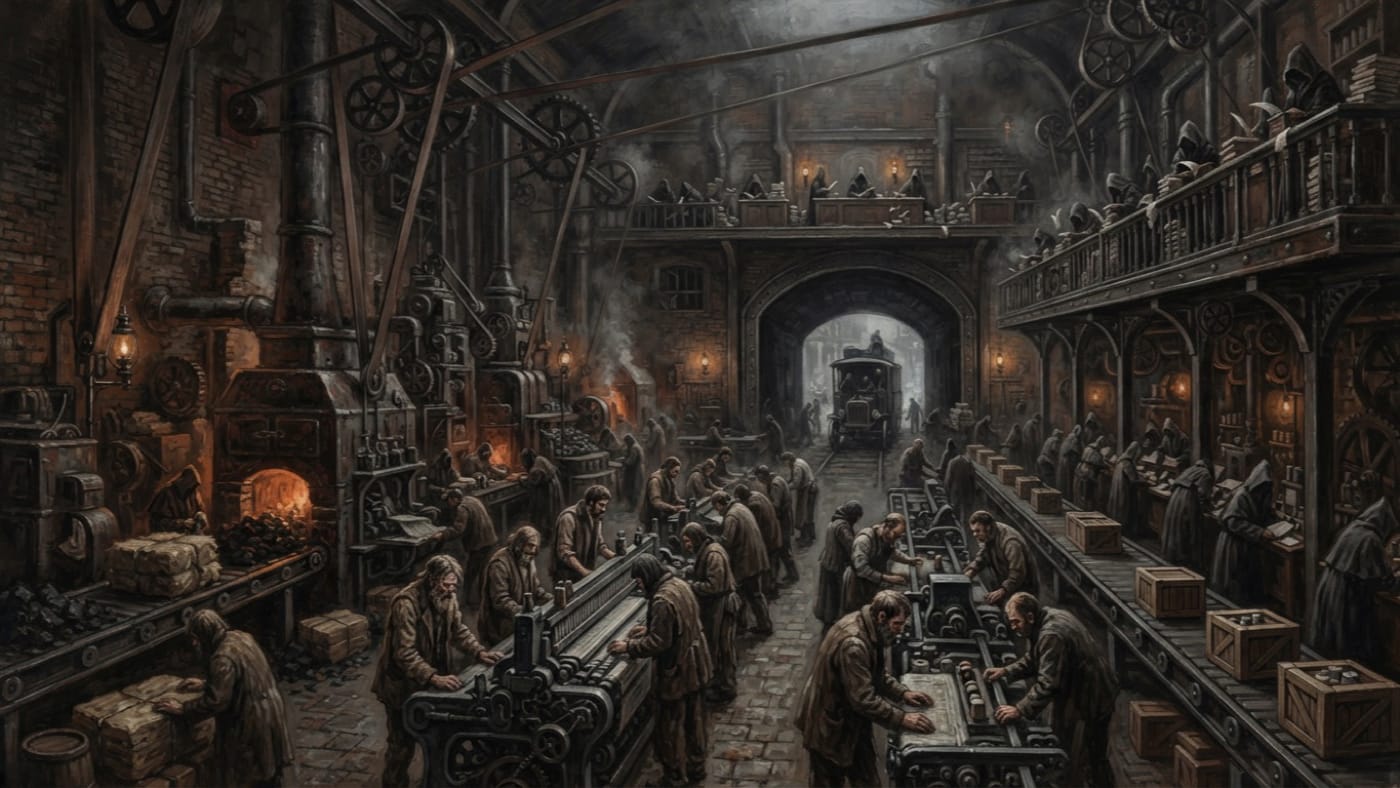
Short is the defining word. Raw materials enter. Finished goods leave. Fewer goods leave than the materials entering would account for, and the factory does not stop.
I stress that it does not stop because a clerk handed a report of a corrupted works reaches first for the word ruin. A ruin is easy to file. These works are no such thing. The furnaces are lit, the belts move, the shifts change, and at the end of the day something real is loaded out of the yard and sent down the road. The anomaly lies in the arithmetic between the gate and the dock, and that arithmetic never comes out in the worker's favour.
The Bureau does not know when or how any particular works was taken, and I will not supply a date to make the file look finished. Their capture is undated. Their first appearance in our records is undated. Whoever built the machinery was human and understood it. The corruption that followed changed its purpose, and no report shows that it taught the machines a new trade.
#On the Deficit
The Bureau holds one plain observation and one interpretation, and a competent archivist keeps them in separate columns.
The observation is that the factory consumes more than it produces. The stock the works was built to take goes in at a rate the output does not match. That is the reported productive condition of the class. It is also the only part of this entry a quartermaster could check with a cart and a tally.
The interpretation is mine. It was entered under the Covetous Serpent's file and is repeated here with my name beside it. The difference goes into the deficit, into the debt, into Velmora's ledger, as tribute paid continuously and never receipted. That reading follows from everything else the Bureau knows of her. She does not destroy what she takes. She draws on it, steadily and at interest, for as long as it can be drawn. A works that yields less than it swallows is a works paying someone, and the Bureau knows of only one creditor in those provinces with the patience for such a schedule.
I list what the record does not hold, so that no later clerk mistakes silence for findings. Nobody has measured what goes in against what comes out. Nobody has assayed the missing portion, observed a channel it travels by, or shown that raw stock becomes coin or credit or anything else on the far side of a demonic account. The ledger reading gives the shortfall a destination in doctrine. It does not describe a process, and anyone who hands you a diagram of one drew it himself.
#On the Labour Account
The reports give the factory's cost to its workers in three terms: labour, health, years. They come in that order, and each is worse than the one before.
Labour is the cost any works takes, sanctified or damned: the hours sold at the gate. Health is what the hours leave behind in lungs and hands and backs. Years are what has gone once the first two have been spent long enough, the part of a life that went to the floor and will not be given back. The reports tie all three to the factory's hunger. They make no claim that a man ages at the bench before his foreman's eyes. A worker in a Consuming Factory loses his years the way workers always have, shift after shift, except that no slack season comes, because the works never once reports itself satisfied.
The demands rise. The factory needs more input: more raw material, more hands, more hours. My Velmora entry says it grows hungrier as it produces. I set that down as a direction, not a rate. Nobody has found the point at which a works calls for its next shift, and anyone who offers a ratio invented it at his desk.
Here the matter needs saying bluntly. A ledger can record every wagon of stock received and every crate shipped, and work out the variance to the farthing. It has no line for the cough a carder takes home, or the decade a smith will not get back. The deficit the Bureau can see is a deficit in goods. The deficit that matters is entered nowhere, which is exactly the sort of account the Covetous Serpent prefers to keep.
Why do they stay? The honest answer has several parts. Velmora's servants in those provinces practise extraction as a creed. They press every source to its limit, they offer relief that arrives as credit, and they turn desperation into debt and debt into habit. The gifts are real. So is the wage, or the ration, or the forgiven rent. Then the arrears compound and the alternatives narrow. Threats come from people who know where the worker's family sleeps. In time the next shift starts to look less like a choice than like weather.
It is still a choice. Doctrine is fixed on this, and I hold to Doctrine even where it costs me a better sentence. No demon abolishes a human will, and no contract, however venomously drafted, truly binds the soul that signed it. Duress bends a decision. Deception poisons it. Addiction makes the wrong answer feel like hunger. None of them takes away the person who decides. In ground she holds outright, a body can be chained. The Bureau has no report that factories of this class keep their hands in chains as a rule, and I will not invent one for colour.
The workers are not a congregation, either. Some of her cultists may stand on a factory floor, but the survey cannot say which or how many. Most of the people at the machines are what the poor have always been at machines: tired, in debt, and short of better offers. To file them as Greed's faithful because Greed owns the building would be its own kind of shrinkage.
#On the Associated Instruments
The paragraph of my Velmora file that names the Consuming Factories also names four other captured machines, and clerks have begun treating all five as departments of one plant. They are separate entries.
The Counting Engines count coins that are absent and debts not yet incurred, and their harm is enumeration. The Binding Presses print contracts, and their product is obligation on paper. The Vault Trains gather wealth along the track and never offload. The Assessment Engines put a value on whatever is fed to them, objects and persons alike. None of them is a component of a Consuming Factory, and the survey has no report of one standing inside a factory.
The useful comparison lies across the border. Kargath's captured works are hungry too, so the confusion is natural. His Hungry Machines burn whatever is shovelled into them and make nothing at all. His Processing Plants make food in abundance, and the food does not satisfy. A Consuming Factory falls between the two and matches neither. It makes real goods, in a real but insufficient quantity. Kargath's machines devour. Velmora's collect. She would call his furnaces wasteful, since a works that produces nothing leaves nothing to tax.
#On the Present Survey
At the time of this survey, the class is reported in continuing operation within Velmora's domain: the Moldavian and Wallachian provinces and the Transylvanian highlands facing Bastion-Sibiu. That describes her territory. It is not a list of addresses. The Bureau holds no inventory of sites, no measured deficit, no proven account of where the missing portion goes, and no dated history of how any works was taken.
It holds no remedy either. The Bureau of Records keeps its contract readers at their desks against Velmora's paper in general, and the Debt Tribunals annul what they can prove, which is little. Neither has been shown to shut down a Consuming Factory, reclaim one, or give back a single year to anyone who worked in one. I record that absence because a survey that lists only its findings is a sales prospectus.
The factories run. The shortfall persists. The people feeding them pay in labour, health and years. The Bureau's best tool for describing any of this is an account book that balances the goods to the farthing and leaves the workers off the page.