
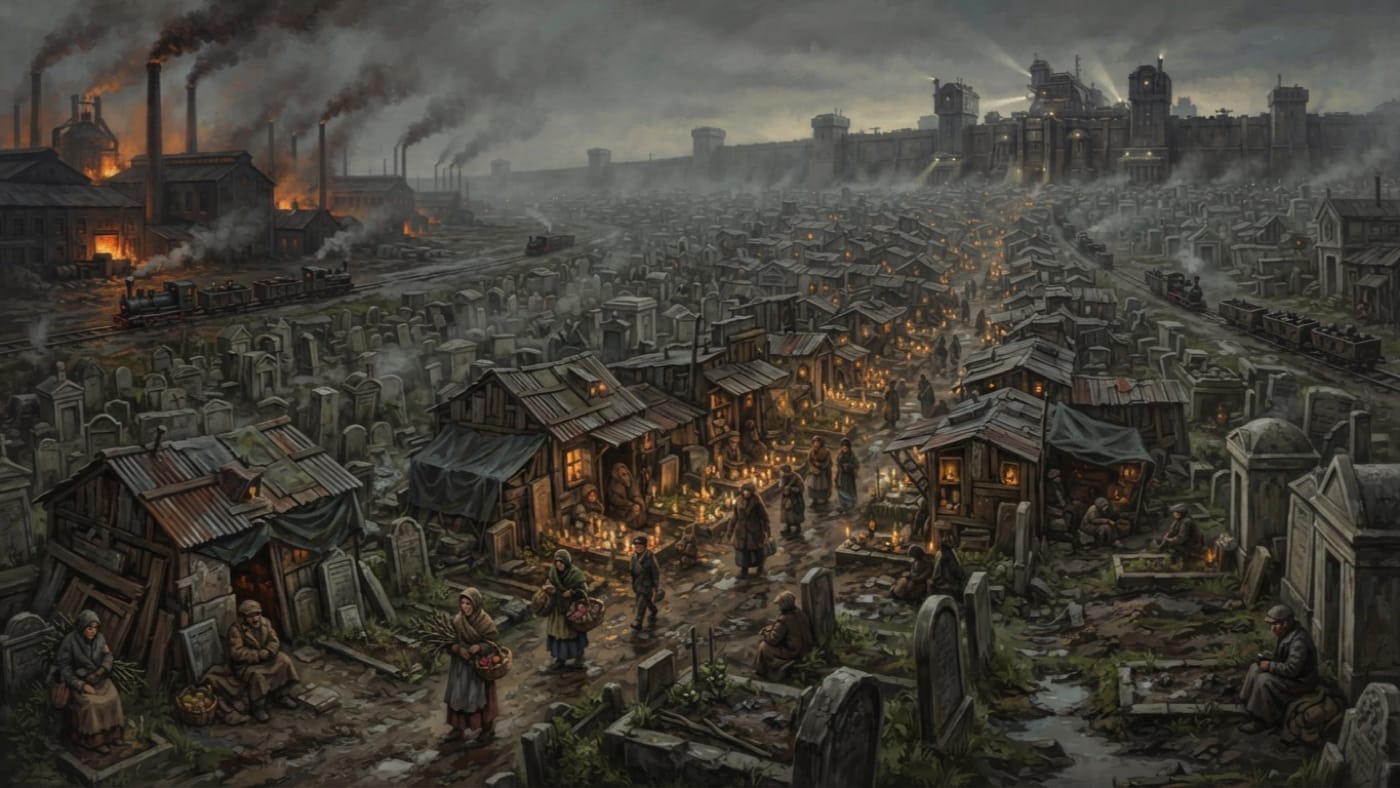
#On the Hinterland of the Southern Anchor
Every fortress has a back, and the back of the Last Lock is the Hintermark. Bastion-Constantinople holds the Bosphorus at the southern end of the Sagittal Line, with the sea on both its flanks and the Black Sea sending its attacks down from the northeast. The Hintermark lies behind it, west of the walls, along the road-and-rail throat through which the southern anchor gets its food. Clerks write Constantinople Hintermark when they fear confusion with some other rear country. The qualifier adds a fortress to the name. It adds no new territory. There is one Hintermark, and a clerk who files it twice will learn how long a mis-indexed folio takes to die.
It is a country of orchards, foundry-towns, levy-villages and grave-fields. For generations it has fed the southern hinge, and in return it has received more widows than roofs. Its foundry-town Edremit is entered in Zone 3, and the fortress it serves sits in Zone 4. The maps redraw the line between them with every printing, and I decline to certify any of them. The trade villages on the Black Sea coast have their own files and suffer their own raids. Do not confuse them with the Hintermark.
Bastion-Lorraine, the western anchor of the Line, draws its orchards and its dead from the Hintermark.
Corrected. Bastion-Lorraine is the retired name of Bastion-Constantinople, not a second fortress. The Line runs north to south, and its southern anchor is at the Bosphorus. The orchards stay where they always were.
#On What the Hintermark Supplies
The orchards come first because the Bureau of War forgets them first. Their fruit goes to the garrison and their prunings go to the stove. Old trees past bearing become coffin boards, and some of those boards later come back as roofs. In autumn the village women pick under levy escort while their men are entered in the rolls for the Line. The rolls are honest about who left. They are much less honest about who came back.
The levy-villages pay in sons. Each household's obligation is recorded and each departure is stamped. Each return arrives as a tag, a boot or a letter from a chaplain who could not spell the village name. The widows stay and keep their obligations. A woman does not stop owing the Ledger because her husband stopped being able to pay it. Her land still owes its quota, and her household is still entered in a levy-village that now has too few hands.
Edremit shows the industrial half of the account. Records first entered it as Furnace Station E-3 in A.S. 118. It was Edremit Works by A.S. 146 and became a municipal casting ward after the census of A.S. 160. It casts boiler throats, rivet stock, furnace collars and casing rings for the Foundry Quarter, the Carrier Yard and the southern repair chain. Its workers cough cinders, and they are told it is piety. The town is productive and hoarse, and it is watched. Further description belongs to its own entry.
#On Habitation Among the Graves
The displaced came from every direction the war pushes people. Levy widows came, and so did families from the eastern pressure, and households whose streets moved under them while they slept. All of them wanted entry to the bastion's ossuary housing, where walls of mortared bone give the tithed families a roof and a lineage at once. Few were admitted. The rest made camp in the one ground that construction law forbade and patrols disliked entering, which was the consecrated grave-fields.
The grave-field lane and the ossuary apartment must not be confused. The apartment is built from the dead, sanctioned and tithed, and the household lives inside it. The lane is a row of timber shacks set between the dead on wet earth, with no sanction except whatever the paperwork can be made to imply. One is housing. The other is tolerated trespass in a cemetery.
The Grave-Field Shanty Broker turns that trespass into tenancy. The Broker acquires interment rights, lawfully or by forgery. The Broker then anchors a lane with real graves, keeps genuine death certificates ready for inspection and leases the spaces between the stones as caretaker housing. Boundaries are kept with chain and bribery. When an audit is rumoured, families are rotated out of sight. The anchor graves are what keep the lane legal. As long as the dead are there and are visibly tended, Rites sees maintained ground rather than squatters.
Custody of the ground is shared. The Bureau of Rites holds the consecration, the Bureau of Records holds the interments, and the Bureau of Tithes holds every candle and chit it can find. The Bureau of Settlement entered the field late, with Memorandum 14-R in A.S. 178, revised in A.S. 194. It classified such structures as caretaker shelters, put for purposes of maintenance or mourning. It marked residency as unacknowledged and recommended a temporary tone. A family may live in a caretaker shelter for twenty years and remain, on paper, a mourner who has stayed late.
Caretaker classification confers residence upon plot-attached households in the Hintermark.
Withdrawn. The classification recognises the maintenance of a grave. It does not concede human habitation. The family keeps the grave, and the grave is all the paper protects.
So cemetery tenancy has become durable housing in the Hintermark while staying insecure. It lasts because the pressure that filled the lanes has never let up. It stays insecure because its only protection is a document stating that nobody lives there.
#On the Brokers and Their Mercy
Not every lane is gentle. The Stone Sharks keep the lanes that pay best, and they run them for what the stones will yield. The Ossuary Allies stay close to the corpse-handlers, where a tenancy can be turned back into an interment once the tenant has died. Among them, and despised by both, are the Caretaker Saints. These are Brokers who decided that a lane could survive on a lower rent.
The title is street speech. No committee canonised them, and Hagiography would rather eat its seals than admit that the word came up from the mud. They are landlords. They collect rent, carry debts and decide which family gets the dry wall. Their rents are lower, though, and can be paid in forms a Hintermark household actually has: ration chits, fuel chits, foundry shift tokens, grave-washing, fence repair, days in the orchard at picking time. They tolerate arrears by the season. After a fever winter a Saint may wait until spring. A Shark sends the sergeant.
Every new grave gets a candle, including graves that exist mostly to make a row of shacks legal. At dusk the names are whispered along the lane. They include tenants' names, permit names and the names of levy dead whose tags came back without bodies. When the Saints hear that an audit is coming, they warn the families first. Sometimes they hear it from a bribed Night Wagon Driver and sometimes from a clerk with a bad conscience and a good memory.
The trade gives its rites to Mother Vell of the Crooked Stones. They involve three crooked stones before a new lane, a candle covered by the hand and a stake bent at the corner. The Saints say Vell sold the same plot fourteen times because fourteen families needed it. That is their hagiography, and I record it as such. It does not prove any land transaction in the Hintermark, and Vell did not found the region.
This mercy has material costs. Low rent means fewer bribes paid. Fewer bribes mean less warning before a sweep and more risk that a rival lane gets offered up in place of one's own. The Bureau of Purity keeps lists of lanes where compassion can be seen from the road. Sometimes a sweep finds grain from a Grain Keeper cache under a coffin lid, and the report then treats the whole lane as a conspiracy. Low rent and hidden bread do not make a household a cult cell. Only Purity's filing habits make them look like one.
#On Clearance, Subsidence and Present Toleration
The ground is the first threat. Graves collapse under the weight of shacks. Sinkholes open in lanes where the pits were dug in a hurry. Burial tags turn out to be mismatched when a wall falls in. Disease travels on the wet wool, and lime holds it back only as long as someone can afford the lime. Tenants report whispers in the fog, stones that seem to have moved overnight, and water rising inside houses built over unmoved graves that, they say, was never rain. Rites calls these subsidence and Purity records who reports them. I classify them as reports and leave them there.
The paperwork is the second threat. Rival claims to one plot, denunciations between lanes, a surveyor's single signature or a bribe owed after a sweep can each empty a row. The redrawing of A.S. 188 cost Edremit ground. When a boundary moves on the map, the households on that ground still have to go somewhere, and in the Hintermark they went into the grave-fields.
The authorities tolerate the lanes because they need them. The lanes keep refugees off the roads to the fortress and the cemeteries nominally tended. The tenants can be taxed indirectly through candles and chits, and the Bureaus can deny that anyone lives there. Clearing the lanes without replacement shelter would put the same families onto the same roads that carry the castings, the fruit and the levy. In winter the Hintermark's foundries keep working, its orchards are pruned and its graves stay lit, and between the stones the lanes go on without licence.