
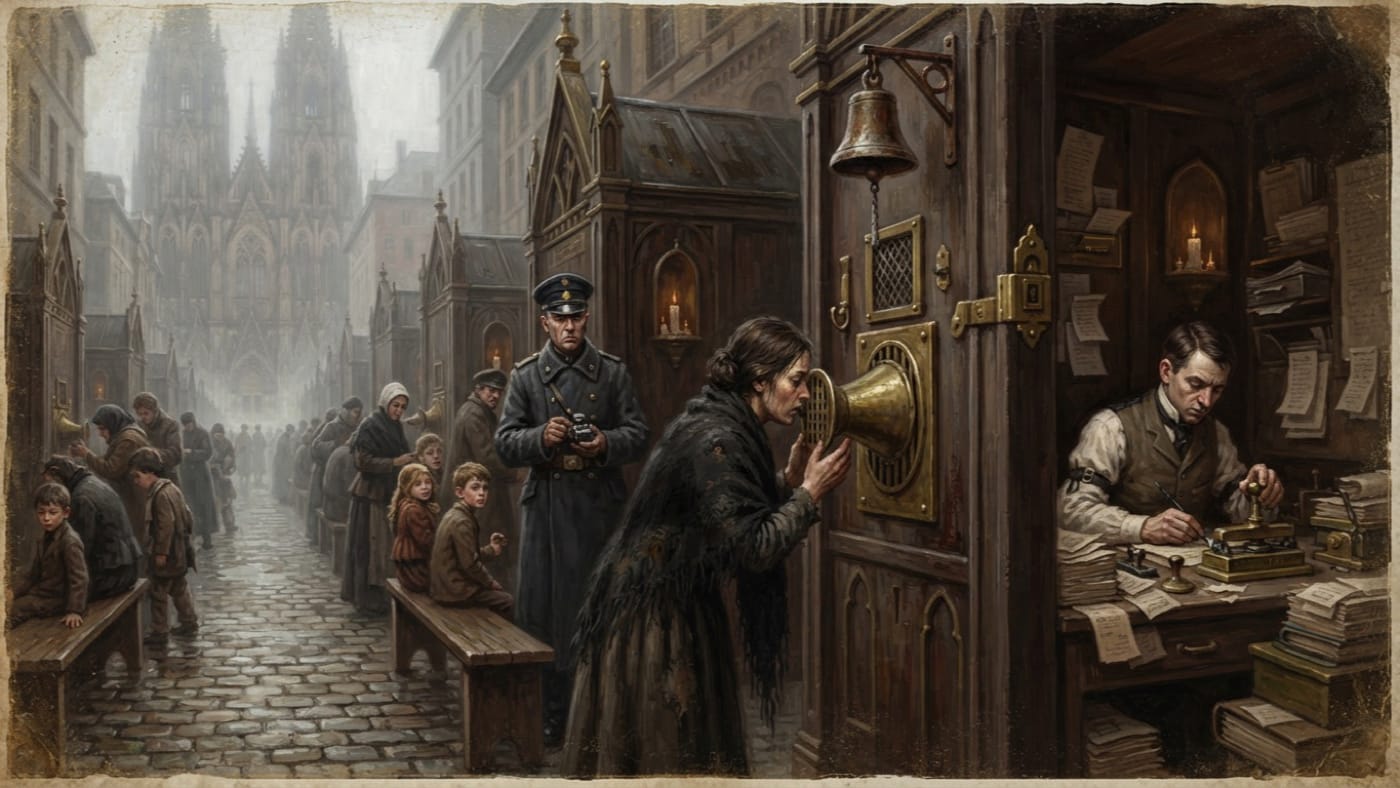
#On the Station and Its Queue
A pilgrim coming up from the river reaches the kiosks before reaching the saint. They line the Kiosk Lanes of Cologne in crooked file along the approach to the Cathedral of the Holy Column. Each is a wooden booth about the height of a tall deacon, with a screen, a grille, and a brass funnel at mouth level. The wood is always damp. Above the lip the brass is never polished, and breath has dulled it to the colour of a pewter plate left out in the rain.
The queue forms before Lauds. A bargeman with tar under his nails. A widow in borrowed black. A die-sweeper from the southern quarter who needs a clean receipt by noon or loses the week's pass. Children whose mothers cannot spare the morning. They stand at the outer edge of the narrow benches. When the iron bell above the shutter sounds they move up one place, and each in turn speaks into the funnel.
Everything about the arrangement suggests privacy: the screen, the candle in its niche, the lowered voice meant for the Creator's ear. None of it is private. Every word that goes into the brass leaves the booth as an entry.
#On the Cologne Precedent
The cathedral chapter's account is the plain one. During the high relic seasons, the crowds who came for the seventeen femurs of Saint Aldebrand packed the close past bearing. Penitents blocked the processional routes while they waited for priests inside the nave. So the chapter built small screened booths along the routes, where a sinner could be heard without ever going through the west door. The pilgrims kept moving. The nave stayed clear. The plate came back fuller.
Three Bureaus object to the word invented, and two of them object to Cologne. I decline to rule between them. Each outranks my patience in a different direction.
The existing Cologne account records the expansion in three milestones. The booths had become civic furniture by A.S. 112 (1822 CE). By A.S. 134 (1844 CE) they carried oath-slots, tithe apertures, and drawers for denunciations. By A.S. 160 (1870 CE) the Bureau of Purity had placed listeners behind every third screen. The operative word is by. No register names the first booth or the carpenter who built it, and the chapter has never asked for either to be found.
Booths elsewhere, especially the street booths of the crowded bastions, follow a similar logic: too many sinners, too few priests, and a ledger standing ready to make up the difference. Whether those booths descend from Cologne or simply resemble it is a question Records has filed and left unread.
#On the Passage from Voice to Record
The Lane procedure, as it can be observed, goes like this. The penitent speaks into the funnel. The confession comes back through the brass in a distorted voice. A clerk on the far side of the partition writes it down on parchment.
The wider booth practice, as Lane clerks also run it, does the rest. The clerk checks identity against a token, a name, or a household mark. The clerk picks a rubric category: minor, moderate, contagious, or escalatory. Penance follows the category, set as recitation counts, attendance, or labour slips. Where a fee applies it is collected in coin, salt, or ration chits. Then the clerk stamps a receipt. Every case goes on a tally, and anything that troubles the clerk goes into a concern bundle, sent up on a fixed cycle to a Street-Vicar or a Codex Auditor.
Cologne gives this its own accent. Citizens of the Rhine confess like merchants settling an account: the item, the date, the witness, any aggravating circumstance, and the penance requested. Nobody has made this form compulsory. Cologne simply speaks that way, and the rubric cards seem to prefer it.
The receipt proves that the penitent was processed. Absolution is a separate matter, given by a licensed confessor who comes into the booth through the priest-door when the schedule allows. The receipt is what the city actually asks for. Gatewardens want it. Ration halls want it. Street-Vicars stop people in the Processional Square to check its impression against the date. In the Sable Court quarter, the local offices file some confessions as declarations of intent and attach them to exchange permissions. Clean paper opens doors that a clean soul cannot.
Confession abstracts end up with the Bureau of Records, in archive-bank folios on the northern rows, beside dowries, wills, and face plates.
#On the Hands Behind the Screen
The clerks are lay people. They hold low-tier licences and are audited closely. They record, categorize, stamp, and escalate, and nothing more. Giving moral advice through the grille counts as priestly overreach among them, and it is reported faster than theft.
You can spot a clerk in a tavern by the hands: ink on the thumbs, knuckles cracked from brine. Each shift begins with brine wiped over the grille, a count of the receipt blanks, and three taps of the stamp. Each shift ends with a sealed day ledger, scrap notes burned, and a pinch of salt left in the corner of the booth. Officially the salt is for cleanliness. Clerks say it is for the things that listened.
Under the clerks come receipt runners and sweepers. Above them is a booth supervisor, who takes a share of whatever there is to take. Queue marshals keep the line on the benches, and the bell rings at their discretion. Behind certain screens sit the Purity listeners, who answer to nobody in the booth and are not counted on its staff list.
Every incentive points toward speed. A clerk who clears the queue is praised, and a clerk who escalates too often starts a riot. The auditors cannot be satisfied either way. Inspectors count the blanks, test the stamp impressions, and compare the tallies against district figures, and they always start with the clean stamps. Why so many?
#On the Returned Confession
The distortion is not in dispute. Clerks hear it, the listeners hear it, and the penitent hears a faint version back through the brass. The confession comes back thinner, a little late, sometimes doubled. The cadence is flattened, as if someone were reading it off a list while thinking about lunch.
The additions are disputed. Penitents say the returned confession sometimes includes things they never said: a sin they deny, a neighbour they never mentioned, a date that means nothing to them. Most of those who say so are peasants and pilgrims. A few are not. Nobody has collected their testimony, and nobody has refuted it.
The Bureau of Doctrine calls these additions "Heaven's interpolations." In this reading the Creator fills in what the sinner left out, so the brass is more honest than the mouth. Doctrine gives this as its position. It has not explained how such a thing would work, and I will not explain it on Doctrine's behalf.
The clerk writes down whatever reaches the clerk's side of the brass. I have found no regulation telling the clerk to check whether that matches what went in on the penitent's side.
"...then inscribed by clerks who never look up from their parchment." — earlier Codex description of the Confessor-Kiosks
Corrected. The clerks do look up. They look up to count the queue, to match a face against a household mark, and whenever the funnel returns something the penitent did not say. The earlier wording described their training. It did not describe their eyes.
The clerks have their own fear, and they do not joke about it. Rumour in the trade says that a clerk who takes in too many confessions starts speaking other people's sins, at supper or in sleep, in a voice not quite their own. "Never listen twice" is offered as advice and kept as a superstition. Nobody has shown that it does anything. No clerk in the Lanes willingly breaks it.
#On Present Application
As of A.S. 201 the kiosks are operating, full, and profitable. They take in sins at a rate that impresses even Strasbourg, which is not easily impressed by anything it did not seal itself. Pilgrims still use them to avoid the nave. Citizens use them to keep their papers current. Records gets its abstracts. Purity gets its listening. In return Cologne gets a receipt in every pocket and a census nobody had to call a census.
The distortion continues, and so do the complaints about additions. Doctrine's explanation stands on the books. No inquiry has been opened into the brass, and no Bureau has asked for one.