
#On the Drawer
The Circle of Nine Wicks keeps its gravest liability in a piece of furniture a child could carry, provided the child had a key and no wish to grow older.
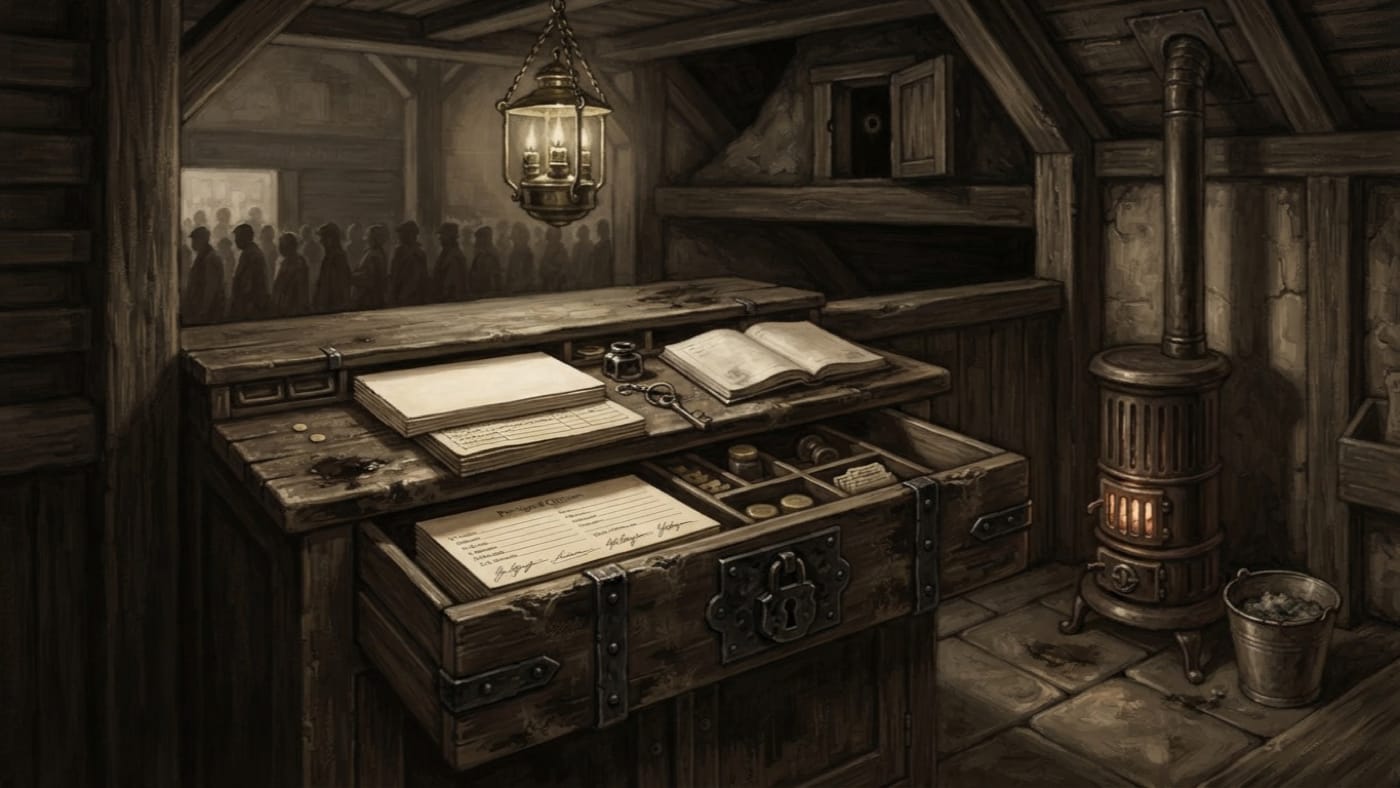
The Confession Closet is a cache of blank confessions and pre-signed citations. It sits in the locked drawer of the Permit-Chapel of Saint Varr, and the Circle draws on it whenever a proof quota reaches dawn unfed. It is small. The papers are ordinary stock, the kind that pass through any market ward by the ream: ruled, folded, greasy at the corners where a thumb has waited. Their danger lies in their sequence. Every sheet in that drawer was prepared before the offence it would later describe.
The Lantern Brotherhood's own charter calls the cache a toleration-killer. The charter is right, which happens rarely enough in Brotherhood paperwork to deserve a candle. If Wardens or Synod auditors open that drawer, Nine Wicks becomes a criminal gang in a single morning. Thirty licensed members at sunset would be felons before the bread is cut, and the only thing that would have changed is how someone read their stationery.
The Confession Closet is a closet.
Struck. It is a drawer. The Brotherhood names its furniture with the ambition of men who have never been allowed a room.
#On the Permit-Chapel
The chapel is a shuttered side-shrine wedged between a ration hall and a market court. It is near enough to the first that its walls hold the smell of old bread, and near enough to the second that whoever sits at the altar can hear the scales. Lamp oil has soaked into the timber. The air has the staleness of a place where frightened people have stood too long in wet wool.
The altar is a desk. I have consecrated altars and I have signed papers at desks, and I can report that the furniture accepts either use without complaint. In a shrine of honest pretension a reliquary would stand there. Nine Wicks keeps a locked drawer instead, holding wax permit dots, confiscation tags awaiting their goods, and the pre-written confessions that gave the Closet its name. Above it a narrow loft holds the Echo's ledgers and a peephole onto the queue lanes, so the one who writes the report can watch the people the report will be about.
Count the objects: a desk, a drawer, a ledger and a hole in a wall. A junior Records Scribe could inventory the whole apparatus of market terror in the time it takes to sharpen a quill. No junior Records Scribe has been sent.
#On Confessions Prepared Before Accusation
Three kinds of paper share the drawer. The differences matter to anyone who hopes to be hanged on the correct one.
The blank confession is unused stock, and by itself it is as innocent as a clean plate. Every Confessor-Booth Clerk in the Church handles blank intake sheets by the hundred, in booths that are licensed, audited and allowed to be tedious in public. Nine Wicks holds no such licence for its sheets. Its blanks wait for names.
The pre-written confession supplies the words. These are scripts, with the offence already phrased, the contrition already measured, and a sentence or two left loose for particulars. They spare the accused the labour of composition.
The pre-signed citation carries its signature before any accusation exists. The charter does not say whose hand made it, or whether that hand belonged to its owner, and I will not improve on the charter. The signature comes first. The crime is assembled beneath it afterward.
These papers serve the Circle's ordinary night. Permit dots are sold early in the curfew. Midnight brings the staged seizure: one public proof and one private payoff. Late at night names are gathered and the rumour map is redrawn. Before dawn the scrap notes go into the stove, and the confiscation totals are reconciled to match the story. The Brotherhood pays for its toleration with weekly seizure theatre and monthly riot-prevention statistics. Statistics, like ration bread, must be produced whether or not the harvest came in.
When the harvest fails, the drawer opens.
The Triangle of Witness keeps it tidy. The Anchor stands at the choke point to be seen. The Blade works the queue and conducts the searches. The Echo, who by charter never intervenes, writes the first report from the loft and marks the next seizures. Three positions yield consistent testimony, and the Bureaus prefer consistency to the sort of truth that needs a second witness to find it. A prepared confession is consistency bought in advance.
#On the Citizen Required by the Form
A form with an empty line needs a person to fill it.
That person starts in the queue. A crowd-hook settles at the elbow and draws the citizen out of the line without breaking it. The queue shuffles forward one place and acts as if it had always been that length.
Queue Penance comes next. The citizen stands at the front of the line and recites a scripted confession until the crowd accepts it. Where does a market ward find a script at two in the morning? In a drawer. One mouth speaks the words, forty stomachs approve them, and they are filed under a signature that dried before the speaker learned what the offence was.
Permit Revocation is the quieter instrument. A stall loses its light for seven nights. For a grain-seller, seven unlit nights are ruin delivered in instalments, and the Circle offers terms: pay for the permit, accept the citation, or supply a name. Names age better than bread, and a stall that brings the Echo a neighbour may find its own window properly lit again.
This is where the Closet earns its keep. Each confession needs someone to make it, and each confessor, questioned with patience, knows others. The drawer does more than store guilt. It hands guilt out, sheet by sheet, down the length of the queue.
#On the Hand That Opens It
Every interested office already knows where the chapel stands. Knowing about a drawer and opening it are separate sacraments.
The Bureau of Tithes wants markets it can count, and Nine Wicks delivers counted markets. The Bureau of Shadows watches the Circle, as it watches everyone, and has never been heard to mention furniture. The Bureau of Purity keeps the Circle under observation, having found that market wards without it breed illicit sermons, bread theft and whispered sympathy for the Mercy Preachers. Each office profits while the drawer stays shut.
Opened, the drawer changes owners. A Warden would find a gang, and the Circle's licence can be revoked without notice or appeal. Purity, in my own assessment and under no ruling yet issued, would find a heretical apparatus: an engine that turns out the Church's confessions without the Church's licence. That is a graver charge than turning them out falsely. The Bureau of Records would check the forms for procedural adequacy first. I suspect several would pass.
The charter's threat is conditional, and the condition is a hand. That hand has no name in any file. The Curfew Ordinance of Quiet Hours of A.S. 94 taught the Brotherhood the useful sin of subordinate permission. In all the years since, that permission has never required anyone to look at what the permitted keep in their desks.
#On Continued Toleration
As of A.S. 201, the year of this survey and of no recorded event in the drawer's history, the Circle of Nine Wicks remains conditionally tolerated under Purity observation. The chapel still stands between the ration hall and the market court. The altar is still a desk, and the Echo still writes from the loft.
No paper I have seen records when the drawer was first stocked, or by whom. I have not held its key.