
#On a Committee That Asked
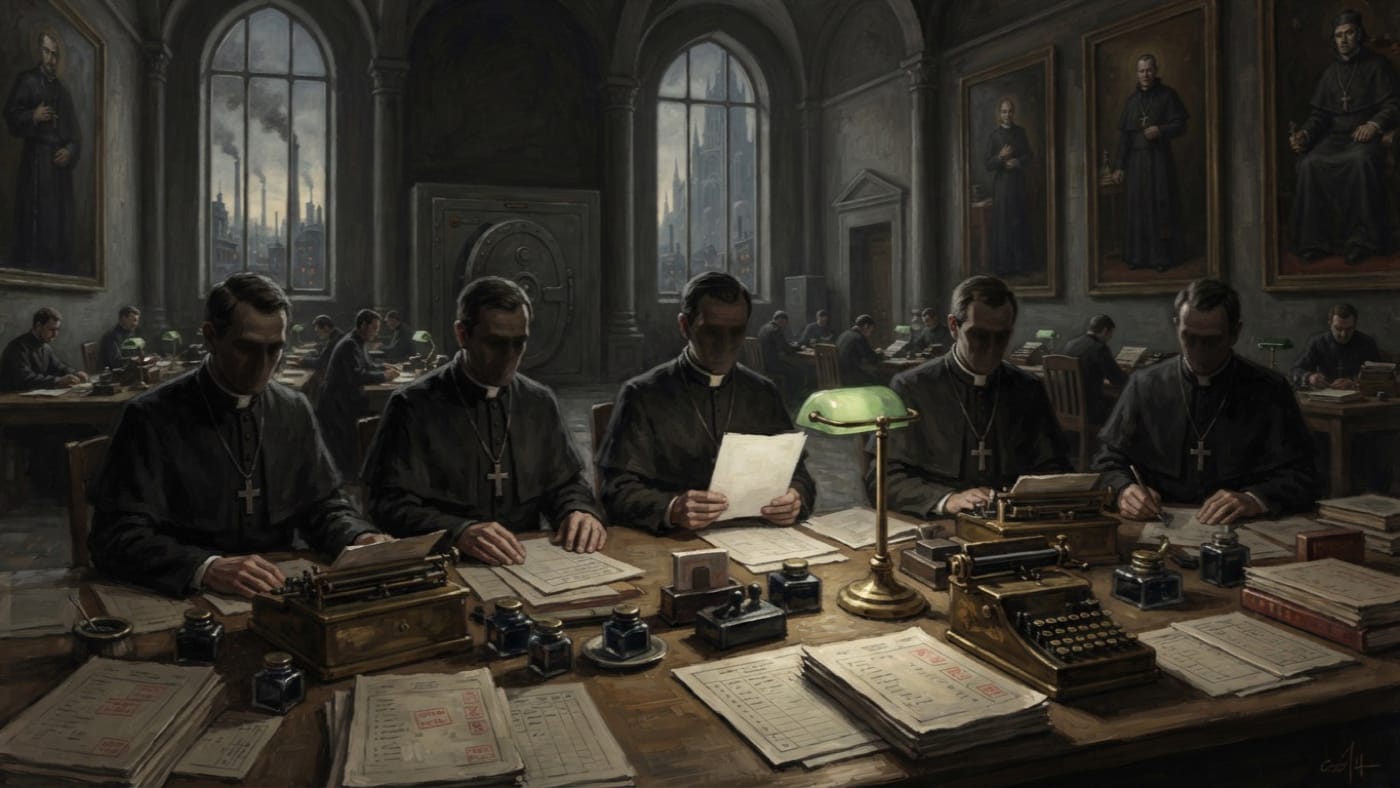
The Committee on Public Serenity was an organ of the Bureau of Orison and Song, and it is remembered for one act of diligence. In A.S. 194 it asked the faithful of the western provinces what they feared most. The faithful answered. Their answer is the reason this entry exists, and the reason it is short.
I have signed off on a great many returns. I know the particular silence of a clerk who has added a column correctly and wishes he had not. Everything that follows rests on the account given in my entry on the Penitential Shadows, and on nothing firmer, because nothing firmer has been put into my hands. I have asked. Once.
#On the Office
Orison licenses the hymnals. It licenses the choirs and the devotional broadcasts, the sermons flung over the trenches from the high towers, and the litanies tuned at the front to burst the eardrums of a riot. It is the Bureau charged with what the Theocracy sounds like. A committee charged with what the Theocracy feels like fits easily into such a house. It sits between the precentors and the signal engineers, with a modest table and a supply of tally sheets.
I cannot tell you what the Committee was chartered to do. No charter has reached my desk. No document I have been permitted to read gives its founding year, its seat, its membership or its seal. Nor does any record name the official who first decided that serenity could be counted. I will not supply these things from imagination. The Bureau of Orison already has choirs enough for invention.
What the Committee did is attested. It conducted an inquiry into public fear. One can picture the return it was expected to produce. It would show that the faithful slept soundly under the bells and that their dread was properly directed outward, toward the Line. It would show the Church standing between them and the Deceiver's hosts, as the hymnals promise. Such a return would have been bound in good calf and quoted at feasts.
#On the Return of A.S. 194
The inquiry covered the western provinces. Seventy-three per cent of respondents named the Penitential Shadows as the entity they feared most.
The Great Deceiver placed second.
I leave that line alone on the page because the Committee, presumably, left it alone on the table for rather longer. Famine placed third. The Inquisitors came fourth: the White-Mantled officers who pronounce guilt in open tribunal and drag men from their beds. My earlier entry called that fourth place "distant."
Here the record stops being generous. Only the first figure survives. I have no share for the Deceiver, none for famine and none for the Inquisitors. I cannot say how close second place came to first. I do not know how many people responded, what questions were put to them, whose hands recorded the answers, which parishes were visited or what form the returns took. I will not invent a sampling method that the number never showed me. Seventy-three rests on a single account, and I have seen better-documented miracles.
Consider what the ranking meant to an administrator. The Committee belonged to the Bureau whose purpose is to make the Church audible as protection. Read plainly, its finding was that the faithful of the west feared one of the Church's own instruments above the enemy of the Creator. The Great Deceiver came second to a figure in a doorway. A return like that cannot be quoted at feasts. It can only be filed, and then filed somewhere deeper.
"The common folk of the Theocracy fear the Shadows more than they fear demons. This is not hyperbole. This is survey data." — from my own entry on the Penitential Shadows.
The survey concerned the western provinces only. Its surviving figure records what respondents said they feared. It is no census of the whole Theocracy's heart, and it establishes nothing about how the Shadows work. The Codex regrets its enthusiasm. It regrets very little else in that entry.
#On the Object of Their Fear
The Shadows belong to the Bureau of Purity, and I add nothing here to Purity's account of them. The faithful are told, and tell each other, that the Shadows are faceless and voiceless. They are said to be raised from the broken and the discarded and stripped of their names. Their eyes are said to be replaced with glass holding the ash of martyrs. Neighbours are said to vanish once they are marked. Children speak of ash footprints beside the bed.
The Lictors of Purity are a separate matter. They work in plain sight, and their verdicts are cut where a crowd can read them. The Inquisitors stand apart again, since they pronounce in tribunal and the faithful can at least put a name to them. Nor should anyone confuse the Penitential Shadows with the operatives of the Bureau of Shadows. I correct that error in correspondence about twice a season and expect to go on correcting it until I die.
The distinction explains the ranking better than any theology could. An Inquisitor's victim leaves a trial record, a sentence, a grave and a widow with a grievance. A demon's victim is mourned in the parish roll. The popular report about the Shadows is that their quarry leaves nothing to mourn. Whether that report describes a method or a rumour is Purity's business, and Purity has not consulted me. The Committee measured neither. It recorded what people said when asked, and they said that the worst thing in the world was something the Church kept.
#On Classification and Denial
The account I have runs in three clauses, which I give in the order received. The return was classified. It was then leaked. It was then denied.
Each clause is a sealed folio. I do not know who classified the return. It may have been Orison, or Purity, or some higher desk in Strasbourg with an interest in both. The account does not say who carried the return out, or to whom. I cannot establish who issued the denial, in what words, before what audience, or how long after the leak. I have no memorandum to quote, and I will not write one for the reader's convenience. I cannot even say where any of this fell against the Committee's dissolution.
What remains is the outline of the thing, which anyone who has served a Bureau will recognise. An office is asked to certify that the people are serene. It counts, and finds the people afraid of its own colleagues. The return goes into the vault under wax. Vaults leak when a figure is short enough to carry in the head, and seventy-three is very short. The Church is then obliged to say that the return does not exist, or does not say what it says, or was never commissioned. I do not know which of these it said. Any of them would have served.
A denial is a curious instrument. It has to be issued in public, which means the public must already have heard of the thing being denied. The Bureau of Orison, of all houses, knows how far a sound carries once it has been rung.
#On the Committee's Dissolution
The Committee on Public Serenity was disbanded in A.S. 195, the year after its inquiry.
Committees are disbanded every season. Their tables go to other committees and their quills go back to the stores. Their members move to a neighbouring desk, where the same men count different things. The Bureau of Records notes the transfer in a single line. The line is dull, and that dullness is the whole comfort of the institution.
The Committee's members were not reassigned. After the dissolution they were simply no longer mentioned in Bureau correspondence. That is all the evidence I have, and I set it down plainly.
I do not know what became of them. The account says nothing of arrest, trial, pension, exile, death or retirement to a quiet cloister. It records an absence from the letters. That is a fact about paper, and only by inference a fact about men. I have searched my own correspondence for their names and found none. I never had their names in the first place, so the search proved only that I am a careful man.
The reader will notice that the Committee's fate, as far as the paperwork goes, resembles the fate the faithful attributed to the thing the Committee asked about. I have noticed it too. I have filed the observation under coincidence, in a drawer I keep shut, and I advise the reader to keep a drawer of the same kind.