
#On the Classification
Code Seventeen is a restricted administrative classification of the Bureau of Records. It appears on transfer orders in the box where a man's previous posting would normally be written, and it puts a number and a lock in that box instead. The bearer has encountered, survived, witnessed, or come back from something the Bureau will not dignify with a public category. Fog that kept a sergeant for fifteen years. Bells that went on ringing after the brass had stopped. A face drawn from life that should never have held still for the drawing.
The Bureau does not say what happened. It says where the man will sit, which hours he will keep, and who may not question him. The event gets no name. Its consequences get a folio, a desk and a pension line, and the Ledger is satisfied, as it always is when a wound can be shelved.
Nothing I am permitted to quote says what the number signifies, why it is seventeen rather than sixteen, who first wrote it, or in which year. I will not invent a pedigree for it. The archives already hold enough forgeries signed by better men than the ones who would forge this one.
#On the Modified Form
The code and the instrument that carries it are different things, though half the regional clerks of the Church confuse them before lunch. The classification marks the man. Standard Form 17-C(MODIFIED) sets the terms on which he is handled. Of the unmodified form I can tell you nothing: not its contents, its author, its sealing year, or how many offices issue it. I have read the modified version only in extract, and the extract is all I will give you.
Read it the way a confessor reads a penitent who is lying.
Administrative puts the matter in the hands of ink rather than physicians. In every clerk's experience, paperwork draws fewer visitors than a wound. Indefinite means no review date appears anywhere on the instrument. I looked twice and then had a junior look, since juniors are cheaper. Restricted means the man's past still exists but has been moved somewhere a general reader cannot reach it.
The night-duty clause needs no explanation for anyone who has stood a watch facing Shipka. The questioning clause does two jobs. It spares the transferee the officer who wants the story told again for his own entertainment. It also spares the Bureau the story, which matters more to the Bureau. One sentence keeps the man safe and keeps what happened to him hidden. I have never met a more efficient piece of vellum.
The Annex's own account of the form adds one more requirement: housing within walking distance. That clause is missing from the extract above, and I record the gap rather than fill it. In practice the requirement rules out carriages, billets across the river and night roads. A transferee walks home in daylight.
My own conclusion is that these humane provisions got into the form by accident, when some exhausted copyist carried a convalescent template into a transfer instrument and nobody senior read past the first line. That is my opinion and I cannot prove it. The form does not record how tired its authors were.
#On Those Transferred
I take four cases from the Sofia Filing Annex. I give no names, because the form forbids them and because each of these men already has a name and has had enough taken from him.
The first is a sergeant of the 14th Bellwarden Cohort. In A.S. 181 (1891 CE) he entered the fog of a Drag Corridor near Shipka. He came out in A.S. 196 (1906 CE) carrying fresh rations. By then his wife had remarried, and his daughter had served out her own enlistment and been discharged. To him it was a march. To the Ledger it was fifteen years. The ration tin is the one document in his file that no clerk can amend, and nobody has found a column for it. Whether he is owed fifteen years of arrears or charged with fifteen years of absence is still a question of pension law, and pension law is in no hurry to settle it. I do not settle it here either.
The second is a Bellwarden in the late stage of bell-sickness. He counts pages. Phantom peals and compulsive counting are well recorded in his profession, and the Annex makes no claim to cure either. It gives him paper, which can be counted and does not ring back.
The third is a soldier who once sketched a Still One. He keeps pension ledgers now, and there are no drawings in his drawer. I do not know what happened to the original sketch. I have not asked, because Form 17-C forbids it and because I did not want the answer.
The fourth is a Cadence Examiner from Cologne. In a street chorus that sang too perfectly for six hours, he recognised a Pale Chanter unhymn pattern. His file records the identification and then the transfer. It says nothing about what happened to the singers, and I will not supply anything in its place.
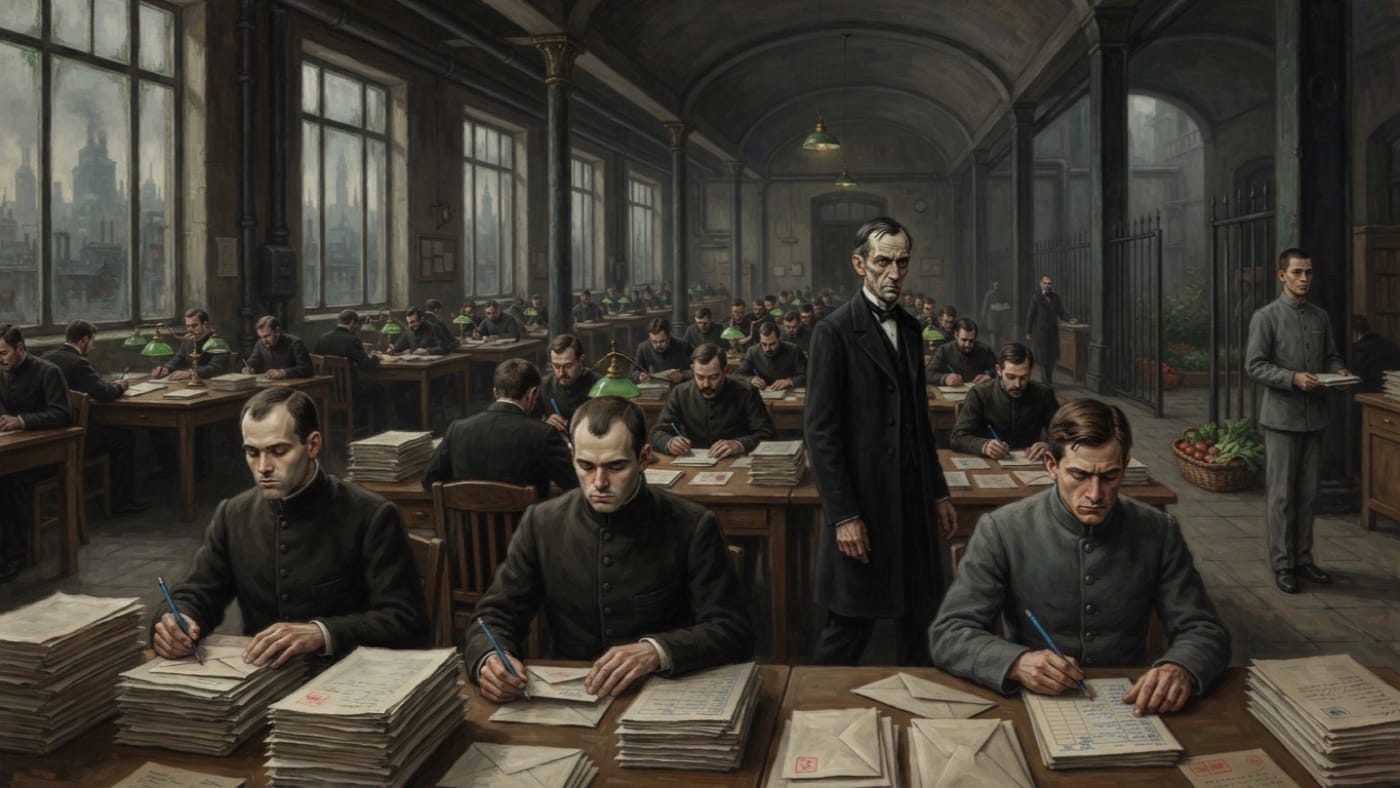
All four do real work: transfer abstracts, levy reconciliations, widow claims. They sit among ordinary clerks who know exactly what they are. None of them is a patient, and the horror of the arrangement is how dull it is.
#On Custody at Sofia
At the Annex, Superintendent Horvath gives his transferees desks, lamps, blue pencils, linen envelopes, predictable hours, muffled clocks and a courtyard garden. He forbids bells inside the building, with no exceptions. The day begins at Prime with no bell rung, and messages from the citadel come by runner. Runners at the Annex learn to walk softly or are not sent again.
Horvath will not let the place be called a hospital. A hospital draws the Bureau of Mercy, whose ward-sisters keep honest bedside care and diligent case notes in the same hand. Case notes draw diagnosis, and diagnosis eventually draws the Bureau of Doctrine, late as ever, carrying a vocabulary. That chain is Horvath's fear and my account of it. I know of no statute that forbids a transferee treatment. The Annex avoids attention, which is the cheapest protection there is.
I cannot certify that these practices go with the code to other postings. Whether a Code Seventeen clerk in some other town gets tomatoes, silence and a walking route home depends on that town's superintendent. The form guarantees none of it.
Colonel-Prefect Dzhurova exempts the Annex building from billet seizure, night searches and emergency muster drafts. She grants this because the Annex returns her personnel summaries within the hour, and I respect her for not calling it charity. The exemption covers the building. A bearer of the code anywhere else in Sofia carries no such letter.
The paperweights deserve a line. The people of Sofia leave baskets at the side gate, and the Bureau logs what is in them under a heading that commits it to nothing. It is the first category in this article that anyone chose out of kindness.
#On Dates and Restricted Indices
The code keeps a man legible while keeping his experience illegible. Any Records scribe will tell you that a personnel entry decides whether a man draws pay, whether his widow draws a pension, and whether, in the Bureau's eyes, he exists at all. A transferee whose prior posting was simply struck out would vanish from the rolls. A transferee whose prior posting was written out in full would become evidence. Code Seventeen keeps him on the rolls and keeps the evidence locked away.
This is why the Annex's restricted indices hold misdated service files, contradictory discharge rolls, and cabinets for men who came back from fronts under Syrion's pressure on dates their orders do not allow. The arithmetic has to balance, and where it cannot, it is filed under seventeen.
Records summaries stated that all Annex anomalies are "clerical complications produced by battlefield stress."
Corrected, as entered in the Annex record. Battlefield stress produces errors, and errors can be amended. Some of what the Annex receives are events, which cannot be amended and have to be housed instead.
The Annex's own paper sometimes fails to stay classified.
ANNEX EAST STACK INCIDENT — A.S. 198 Seven transfer forms corrected themselves overnight. One listed Superintendent Horvath as transferee. Destination: ███████████████. Date of reassignment: prior to birth. Cabinet sealed under local order.
I do not explain it, and Records has not either.
#On Its Present Application
In A.S. 201 the code is still in use. Its duration is still indefinite. Transferees still arrive at the Annex in folios whose prior postings say nothing, and the work still gets done: southern levies reconciled, widows paid, impossible dates entered in a hand steady enough to pass audit from Irongate to Strasbourg.
What protection exists is local and easily lost. It rests on one superintendent's rules, one colonel-prefect's exemption, one garden, and the continued indifference of anyone in Strasbourg ambitious enough to read the staff count. The form preserves the person, and the restriction hides what happened to him. The Creator, the Great Deceiver, and the efficiency auditor will each judge in time which of those matters more. Of the three, I fear the auditor.