
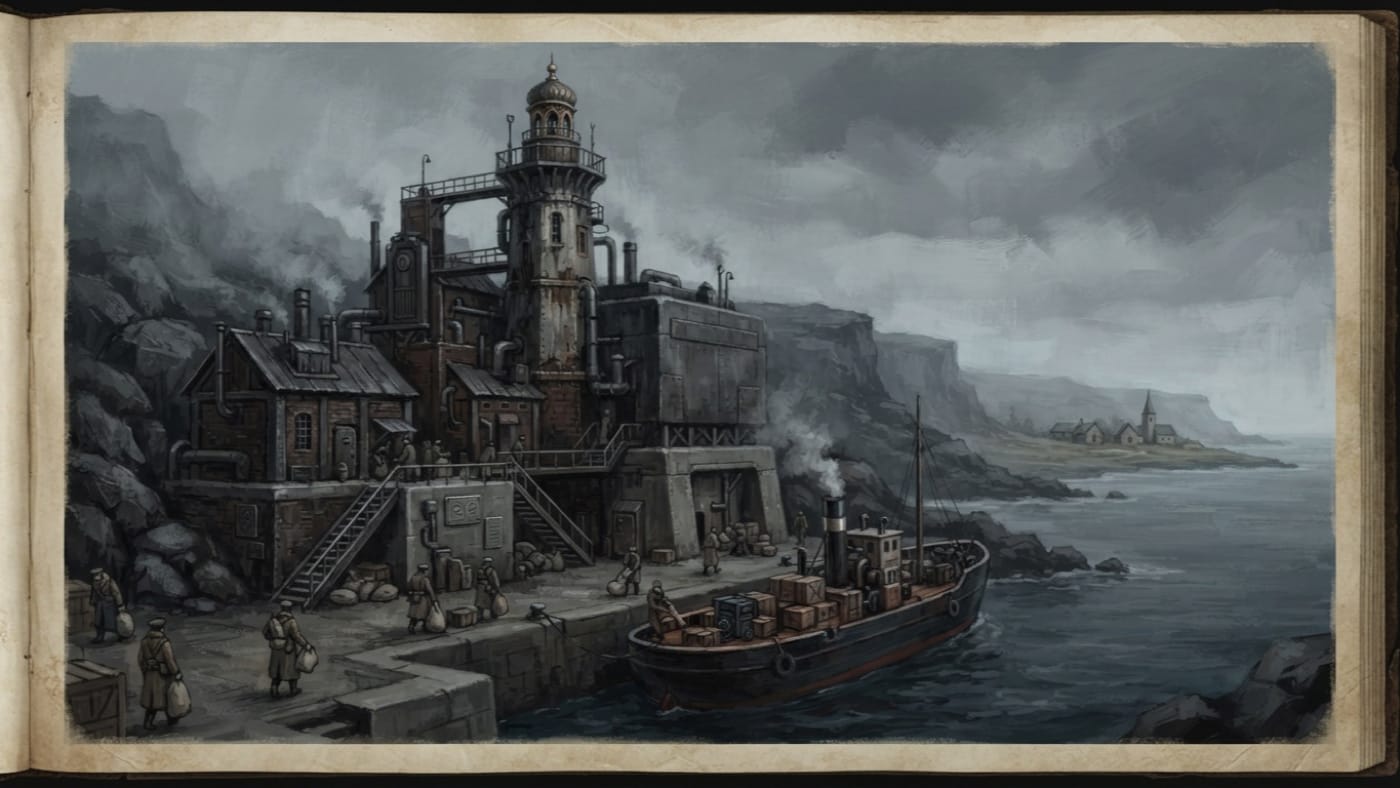
#On the Survey and Its Two Witnesses
I am Valerius Drax, Hieromnemon. What follows is the survey of Coastal Station Theron ordered for A.S. 201 (1911 CE). It is a documentary review of the surviving Pilgrim's Coast records in which the station is named. Nothing more was commissioned, and an honest clerk would not offer more.
The file is thin. I say so first. Dressing a thin file as a thick one is the commonest fraud in the Theocracy, and I have spent a career stripping the costume off it. Two independent accounts name the station. The Codex entry on Bastion-Constantinople mentions the harbour master's log kept at Coastal Station Theron, and mentions it only because of what that log does not contain. The entry on the Bureau of Settlement uses "the Coastal Station at Theron" as a fixed point from which to measure the distance to something else.
So there is one witness to a register and one witness to a position. From these I will build exactly as much station as the ink allows.
#On the Coast It Keeps
The Pilgrim's Coast follows the Anatolian shore south and east of Constantinople. The Bastion is fed and visited by this approach. Grain convoys come up from the Anatolian prefectures, and pilgrim vessels come to look upon the holy war at a safe remove. Along the shore lie villages, sanctuary towns and causeways that carry the faithful and the frightened in a single column, which no inspector has yet sorted. Communities along this shore grew up to supply Synodal fortifications, and they kept growing after the fortifications had what they needed.
Somewhere on that shore stands Coastal Station Theron, or something recorded under that name. The surviving references give no bay, no headland, no road and no distance from the Bastion's chains, and no plan of a quay. The Constantinople account mentions its log in a passage about the coast's eastern stretches. The Settlement account places an eastern-coast settlement twelve miles from it. That is the whole of the station's geography in the papers before me. I decline to improve it with a cartographer's guesswork.
Theron is the station's name, and I record it as nothing else. Readers acquainted with Constantinople's escarpment command will recall a Legate-Inspector who bears the same word as a given name. The coincidence establishes no founder, no patron and no appointment. Any clerk who files it otherwise will answer to me.
#On the Harbour Master's Log
Here is what the Constantinople account actually says. The organic garrison towns of the eastern Pilgrim's Coast lie where the inspectors of the Bureau of Records do not reliably reach. They trade with vessels that do not appear in the harbour master's log at Coastal Station Theron. The account then adds, like a man shutting a drawer, that these vessels presumably trade in things the log would not approve.
This sentence gives the station its one certain office. A harbour master kept a log there, or keeps one still, since the account gives it no date. A harbour log records hulls, masters, arrivals and departures. Theron is therefore a coastal registry point, a place where the Synod's knowledge of the sea is written down.
It is mentioned at all only because of what its log leaves out.
Note carefully what an absence proves. A vessel's absence from a register does not prove that the vessel exists. A witness asserts that the vessel exists and in the same breath asserts that it is missing. The Constantinople account does not say these vessels put in at Theron, crossed its waters, came under its staff's eyes or were struck from its pages. It says they trade along the eastern coast and are not in the log. A ship never entered and a ship erased are as far apart as negligence and crime, and the file supports neither charge against any person.
The cargo has no name, and neither have the ships or their masters. The suspicion of prohibited trade is mine. I wrote it into the Constantinople entry with presumably attached, and the qualifier stands. A Hieromnemon may suspect what he likes, but he certifies only what he holds.
#On Whose Coast It Is
Settlement's entry explains how a station can keep a log and still miss a coast. The organic garrison towns of the Pilgrim's Coast are forts raised for garrisons of two hundred, with villages of twelve thousand grown around them, and they fall under three mandates at once. The garrison belongs to the Bureau of War. The market belongs to the Bureau of Tithes. The permanent population belongs, in theory, to Settlement. Records reaches the eastern stretches when it can, and by Settlement's own account it cannot reach them reliably.
Those figures describe the region's communities. They are not Theron's garrison or Theron's population, and no surviving reference assigns the station either one. No reference says which Bureau holds the station's seal, who appoints its harbour master or where the log is sent once filled. I have looked. The answer is absent, not hidden, and a man in my office lives by that distinction.
Settlement's account records eighteen reports on this coast's jurisdictional trouble since A.S. 185. Each was read, stamped and returned to the filing room without action. Acting on them would require a Bureau with neither soldiers nor revenue to assert itself where War considers itself supreme and Tithes considers itself indispensable. The reports therefore rest where such reports rest: in a drawer, filed in order.
On such a coast, a registry point is one ruled column in a ledger whose other columns nobody has been ordered to keep.
#Twelve Miles Off
Now the second witness. A margin of the Settlement entry places a settlement on the eastern Pilgrim's Coast approximately twelve miles from the Coastal Station at Theron. It gives no bearing. It does not say how the distance was measured, whether by road, by shore, by sea or on the word of whoever answered the question.
That settlement is not Theron. The record gives it no name, and I give it none. Its particulars belong to it alone. It has approximately eight hundred inhabitants, a church, a market and justice administered by a retired sergeant, and it has been continuously inhabited for some thirty years. It appears on no Bureau map. Asked about the place, Settlement produced a map printed in A.S. 190 (1900 CE) that describes the location as rocky shoreline, uninhabitable. The church was built in A.S. 184 (1894 CE).
Six years before the cartographer declared the ground empty, someone had put a church on it.
The station's part in this is purely a matter of measurement. The reference treats Theron as a known point and counts twelve miles out from it. At the end of those twelve miles, the Bureau's map records rock. A fixed point is not a census. The station's presence in the files shows that one coastal place was known. It shows nothing about what the country around it contained.
Bureau of Settlement map, A.S. 190: the location approximately twelve miles from the Coastal Station at Theron is "rocky shoreline, uninhabitable."
Settlement's own account corrects this. The location is inhabited by approximately eight hundred persons, with a church raised in A.S. 184, a market and a retired sergeant's justice. The shoreline may well be rocky, and the Bureau of Records will accept "rocky." It will not accept "uninhabitable" for ground with a church on it.
#On the Present Condition of the Record
As of this survey, Coastal Station Theron exists in the Codex as a name, a log and a measuring point on the Pilgrim's Coast. This survey holds no record of its founding, its designation, its construction, its first register or its staff. The log itself was not among the papers furnished, and I will not describe the binding of a book I have never held.
What remains is enough to state the station's use to the Synod: it is one of the places where the sea is supposed to be written down. On the eastern stretches, by the Constantinople account, the writing does not keep pace with the sailing. Twelve miles off, by the Settlement account, eight hundred subjects keep a church on ground that a printed map calls rock.
The station has done what a station does and kept its log. Whether the coast agrees to be logged is a question for three Bureaus. Each of them is certain it belongs to the other two.