
#On the Provisional Distinction
The Church allows its servants to call the Great Deceiver's creatures closer. It allows this only so they can be killed, and it has not yet decided what to say when the killing turns a profit. This survey was commissioned in A.S. 201. It examines a ruling that is in force, is obeyed and is unsealed, which in coastal administration is the most common condition a ruling can be in.
The Demon-Lures entry prints the determination in four lines. The same entry says, in its narrative portion, that the Bureau of Doctrine ratified the distinction in three memoranda and one sermon. The stamp printed beneath that boast says seal pending. Where a boast and a stamp disagree, this survey follows the stamp. I wrote the boast, and I am entitled to outrank myself.
The ruling is a test of intention. A man who calls to the thing beneath the pier because he wants its company is a heretic. A man who calls it so that a battery can open it like a wet sack is zealous. Both men use the same lantern, the same salt and the same false number. Only the reason for the call is different, and Doctrine has staked its theology on the reason as if a reason could be weighed on a dockside scale.
#On the Saffron Instrument
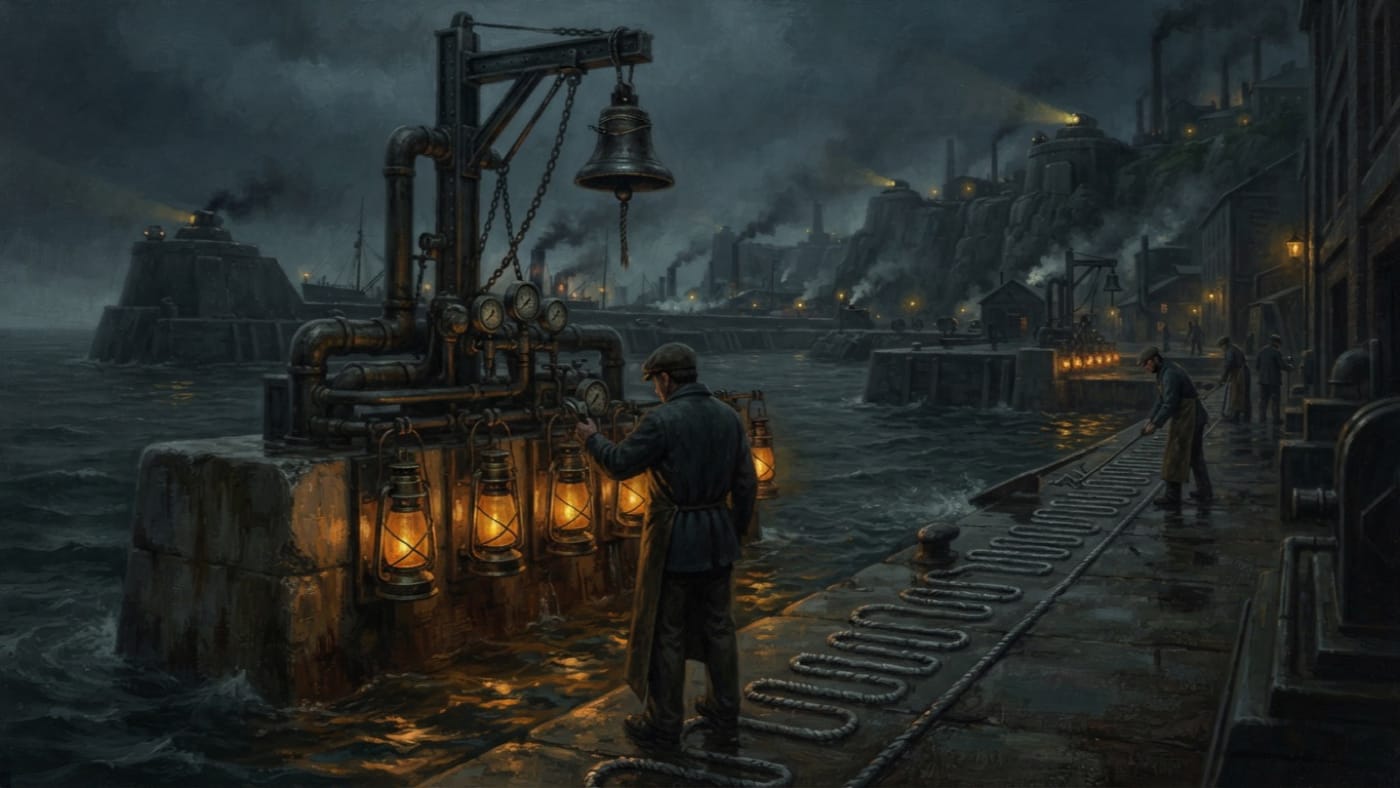
The term carries two meanings at Saffron Bastion, and they have to be kept apart before anything else can be said. Dockworkers use Demon-Lure for the waterline entities themselves: voices under the boards, flames bending against the wind, the dead sister asking a man to lean a little lower. Harbor Marshal Command uses the same word for the licensed instruments that draw those entities into prepared lanes. Attracting a creature and worshipping it are separate acts. The vocabulary does nothing to help anyone tell them apart.
Saffron sits on the Adriatic near Ragusa, in Zone 7, well behind the seven principal bastions of the Sagittal Line. It has a deep harbour, quarantine piers, breakwaters and cliff batteries, and it keeps grain, salt and pilgrims moving through a coast the war cannot do without. That is why the lures are tolerated. A port that has to stay open at night needs some way of thinning what comes up from the water at night.
The apparatus grew out of mistakes. In A.S. 68 work-lamps hung under unfinished piers went with three missing caulkers. That was during the surveys the later Synod would claim as its own, and the formal body did not exist until A.S. 90. By A.S. 72, when Saffron received its designation and the breakwaters went in, crews had learned that some lights call and some calm.
The attested Saffron pattern has five parts. The Light is a set of low lanterns with saffron glass facing the sea and pale panes facing the town, giving a controlled stimulus. The Line is a series of salt bars laid with deliberate breaks, which steer movement toward the lane. The Name-Muffle puts a dead number, a false number or a cargo number in place of any living name. The Tone uses bell-shard and sung cadence, which draw entities and draw jurisdictional quarrels in about equal measure. The Closure brings chains, withdrawal posts and ranged guns. The pattern depends on tide, wind and glass that has not cracked. It is a local practice. It can fail, and it has.
#On Custody and Intention
Who operates the apparatus and who judges it are separate matters, and Saffron has a great many claimants for both.
Harbor Marshal Command holds primary jurisdiction. The Lanternline Chandlers' Lodge controls the oil, glass, shutters and pattern books, which means it controls the first movement of every lure and invoices for the rest. The Quarantine Prefecture supplies sanitary materials, holding space and the casualty category under which lure dead are filed as marine incidents. The Bureau of Bells claims the bell-shards. The Bureau of Orison and Song separately claims the sung registry cadence, so that the Tone alone has two masters. Strasbourg has received petitions from all of them and answered none.
Doctrine supplies the theological defence. The Bureau of Purity watches for drift, and drift is where the ruling actually lives. A rigger who starts saying he answers the water instead of drawing it gets a visit. A provost who dreams in registry numbers is moved inland if his family has money and downward if it does not. Purity cannot inspect a heart. It inspects verbs. So the boundary between instrument and bargain is policed largely through grammar.
#On Useful Heresy
The Brine Choir goes under the piers to listen to the waterline voices, translate them and commune with them. Its stated aim lands it in the first line of the determination with no need for further proof. That is the doctrinal danger. The difficulty is something else: it has sometimes helped.
The South-Pier Incident of A.S. 199 is the case that cannot be filed away. A sanctioned lureline was running. Two lamps guttered. According to the incident account, the bait number was answered by the deceased man who had once held it. I record the answer as the account records it and offer no mechanism, since the Bureau has issued none. The lureline failed. Battery Twelve could not lower its guns far enough. The Brine Choir, gathered illegally under the gutting racks, sang. The water lowered and six men survived. Four singers were arrested, and two of them later disappeared into quarantine. Their condition is not entered in any record I have been shown.
The first report credited corrected lantern pressure.
Earlier Harbor Marshal digests described Brine Choir participation in lure suppression as "unsubstantiated dockside superstition."
Corrected under the sealed A.S. 200 addendum recorded in the parent entry. Brine Choir participation is substantiated, illegal, and never to be requested by uniformed personnel. This addendum is a separate instrument from the coastal determination, which remains unsealed.
The incident proves three things Doctrine would have liked to keep in three separate rooms. A sanctioned instrument can fail. A heretical practice can coincide with survival. And the fact that something worked confers no approval. The determination never asks whether a call succeeded. It asks what the caller wanted. The Choir wanted communion, and in Doctrine's ledger the six survivors do not cancel that.
Stories under the piers say something more was paid that night. They remain stories under the piers.
#On Recovery and Comparison
The third line of the determination sits under review because Saffron's Insurance Courts earn money and leverage from what lure incidents leave behind: claims, salvage, liens, repairs, labour writs and exceptions. A controlled lure produces those papers in order. A failed one produces them with more screaming. The Courts have every reason to prefer a predictable bite, and the Lodge has every reason to keep its lamps profitable.
A profit is not a bargain. Doctrine says the creature summoned for destruction is summoned with zeal whoever cashes the writ afterward. Doctrine has also declined to say so under seal. The difference between those two positions is the survey's whole subject. Purity may suspect that a lure was timed for a writ. It has not been authorized to call every convenient disaster manufactured, and this survey does not do so. It does note that the people under review are the ones who write the claims.
The parent entry puts the Demon-Lure in the same doctrinal drawer as the bell pattern that attracts before it repels, the Script Wall readings, and the defence against the Undertide at Calais. The drawer is a comparison. It is not a manual. Calais accounts describe mandatory nightly readings meant to keep names from sinking into the chalk, while the Undertide gathers during those readings. Its bells drive the entities back, though sound also draws them. Calais officers have denied any causal link in a circular that has since been corrected, and the Unread heretics claim every reading is bait. Those are competing accounts, and observed gathering is not a proven mechanism.
The two places point in opposite directions. Saffron hides its names from the water. Calais reads them aloud at the cliff. Both defend themselves by doing the thing that attracts. I once wrote of Calais that it feeds the wolves at its door. That was a figure of speech, not a procedure, and I ask the Quarantine clerks who copy my work to remember it.
#On Present Application
As of the A.S. 201 survey, Saffron's lurelines still operate under existing forms. Full names are still illegal on open piers after chain-drop, pattern books stay in oilskin, and the Bureau of Rites still calls the entities Category Three Waterline Anomalies. Custody is still contested. The Choir is still illegal and has been studied without anyone saying so.
The ruling has no signer. It has no further clauses, no appeal and no proven effect beyond the piers where it is applied. Its first two lines are clear enough to burn a man. The third is still waiting on the recovery money.