
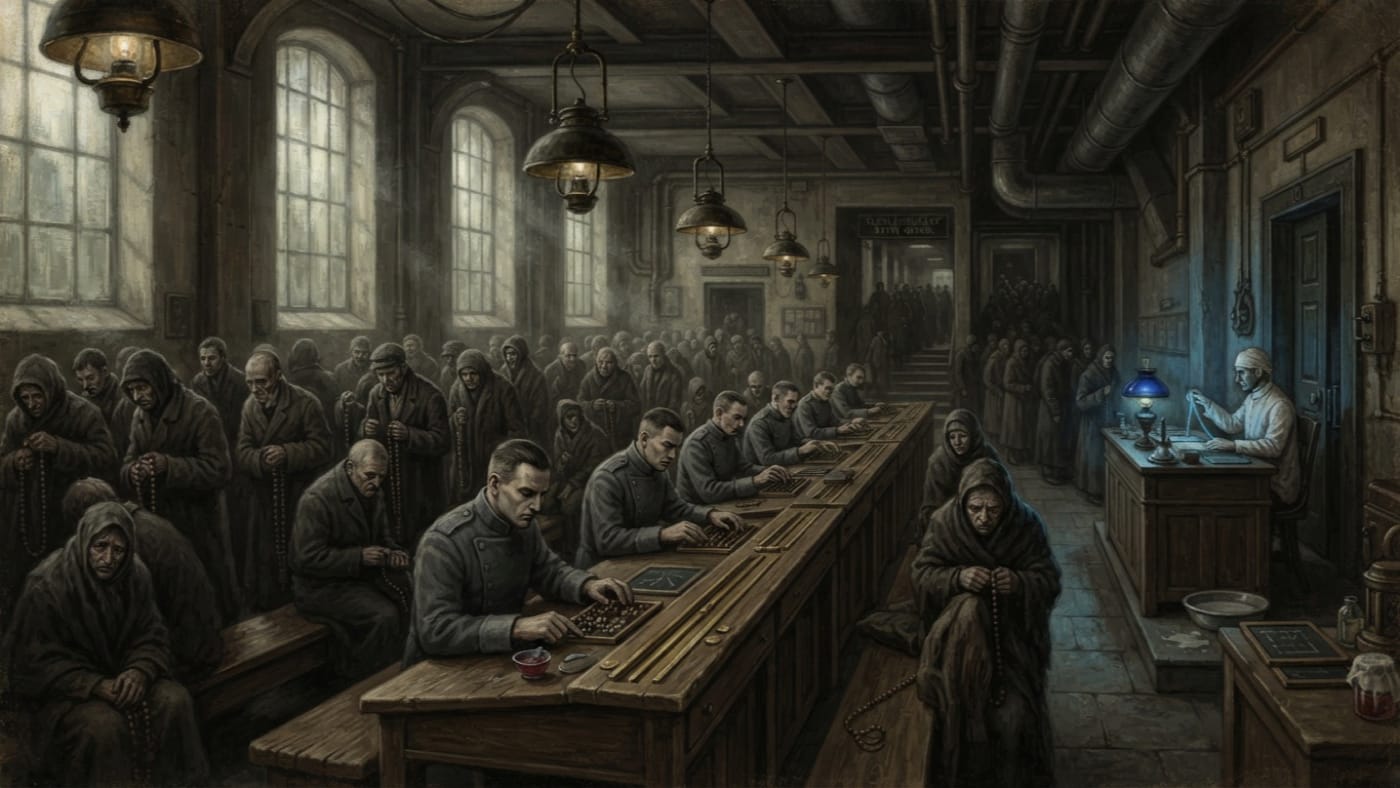
#On the Name and the Hall
The Clickery is the Counting Hall of the Cloister of Miscounted Beads. In the Chapter's registers it is the Reconciliation Spine. Everyone who has waited inside it names it after the noise. There is one room under two names: the formal one goes on seals, and the other belongs to the people who sit on its benches.
It lies on Strasbourg's outskirts, in the safe heartland the survey maps mark as Zone 2, between the Intake Gate and the Chapel of the Second String. No pilgrim reaches the altar without first passing the arithmetic. Through the wall, along the south spine toward the dormitory passage, sits the Supplementary Entry Office. Its clerks say "the Clickery" when they mean upstream and "the Counting Hall" when they write to Strasbourg. Readers puzzled by the Office's own record may take this as their answer. The two names describe the same oak, the same lamps and the same queue.
The account already entered in the Codex says the name began as derision. Beads click on desk wood and abacus counters click on their wires. Seal wax cracks under thumbs. Clerks click their tongues when a count fails, a small dry sound that has ended more pilgrimages than fever. The Chapter tolerates the nickname because suppressing it would require a circular, and circulars cost paper.
Twelve desks serve the entire intake. A dozen clerks can stall thousands. They do so daily, with the calm of men who know the queue has nowhere else to go.
#On the Count
A pilgrim's string is portable evidence, a confession you can thread. It records where he walked, which licensed stations received him, who walked beside him, who died on the road, what he confessed and where, and which substitutions a marshal permitted when a shrine flooded or a bridge fell. Customs differ from road to road. Some stations add a bead and some checkpoints strip beads off and tally them. A clerk who expects every honest string to grow by one bead per station is a clerk who has never read the slates. The beads mean whatever the route regulations of that road said they meant in the year they were threaded.
The pilgrim lays his string in the brass groove at the desk's edge. Decades of the same gesture have polished the groove, and it runs one way only, from his hand to the clerk's.
The grey-cuffed clerk wets a thumb in the vinegar bowl and the sequence begins. Every clerk of the Spine can recite it in his sleep, and several recite it in mine.
The pilgrim knows his road. The clerk knows his slate, a grey board chalked with the stations that were licensed and the order in which they were licensed. When the two disagree, the slate wins. The slate bears a seal, and the pilgrim has only his knees.
The air on the benches smells of stale wax and damp wool steaming over bodies that have not been dry since the Lost Procession Yard. Paper shuffles. Somebody coughs. Beads go on clicking. The count is spoken aloud so the queue can hear it fail.
#On What Passes to the Office
The Clickery has a narrow job. It detects a discrepancy, pronounces it and decides the disposition: clear, hold, refer or send on. It has no interest in why a pilgrim's string is short. It is interested only in the fact that the string is short, and that fact is recorded, under the joint authority of the Bureau of Records and the Bureau of Pilgrimage, with the speed and indifference of a stamp coming down.
The explaining happens next door.
A sealed disposition marked for supplementary handling goes through the south spine to the Office, where it becomes Form S-1, the record of the discrepancy as the Hall pronounced it. From that point the case grows. The pilgrim is invited to explain and the explanation is assessed. Witnesses are requested, including dead ones, who make poor witnesses. Unsatisfied discrepancies become clerical debt, and appeals are filed and then answered. The Office turns one sentence from a desk clerk into a file thick enough to stand up on its own. That file holds confession addenda, route corrections, identity amendments and sponsor reviews, and every one of them carries a fee.
The arrangement is neat, and it lets each side keep clean hands. The Hall can say it only counted. The Office can say it only recorded what the Hall had already found. Debt starts at a desk and is papered in a corridor, and each room is free to point at the other. The Pilgrim Reconciliation Statutes, as revised in A.S. 187, govern both rooms. They do not say exactly where counting stops and pricing starts. That gap is deliberate.
#On the Price of Waiting
Time in the Clickery can be bought, though nobody calls it buying.
Sponsor seals go to Desk Four, which hears the petitions of families and patrons who have wax and money. A seal does not change a count. It changes when the count happens, and to a pilgrim sleeping upright on a bench that comes to the same thing. A heel of bread pushed across the oak improves a clerk's memory. A flask of clean ink speeds the comparison of slates. A coin folded under the groove can turn three weeks into three days, unless the clerk has already sold that mercy to someone else.
The poor pay as well, only more slowly. Every night of delay is a night in the Dorm Rows, and every night in the Dorm Rows is a charge. Unpaid charges become clerical debt. Clerical debt becomes compulsory labour: copying rosters, scrubbing vinegar off the desks that detained you, carrying sealed packets for the clerks who sealed them.
The Sponsor-Seal Brokers work this gap with real skill. They sell faster correction, kinder wording and a word in the right ear at Desk Four. They have nothing to sell once a string has gone blue. An active anomaly does not answer to ordinary payment, and the brokers know it. When the lamp changes colour they leave the room quickly.
The Missing Pages Ring belongs to the Office and does its work there. Its reconstructed pages flow back upstream all the same. A replacement page, newer and kinder to whoever paid for it, comes back to a desk for reconciliation, and the clerk counts against it as if it had always existed.
#On the Blue Lamp
Desk Eleven stands nearest the Chapel door and furthest from the public benches. Its lamp is blue-glassed. Its clerk wears finger-cots of treated linen and never touches a string with bare skin. Its ink stays covered. Salt basins sit within reach, with vinegar cloth folded beside them, and strings arrive in salt-wax sleeves. Names that need recording are written backward on slips.
Desk Eleven receives the strings that misbehave. Clerks have reported strings warm to the touch. They have reported counts that differ from one handling to the next and names on intake slips that read differently by morning. They have reported the names of the dead coming back up in the registers, entered in a clean hand on a line no living clerk wrote. Precision matters here. These reports concern names returning to records. The Bureau certifies nothing about the dead returning in the flesh, and readers who confuse the two will be corrected by persons with less patience than I have.
Circular 881-R, which bears the year A.S. 199, governs how the desk may speak. Beads do not change by themselves. The circular denies it and so does the Hall. What the clerk records is handling deviation, warmth irregularity or roster seep: a fault in the handling, never a will in the bead. This is administrative language. It explains what a clerk may write. It explains nothing about what is happening on the desk.
Hall training material described unexplained count changes as "bead drift."
Withdrawn under Circular 881-R. Drift implies motion without a handler. The approved terms are handling deviation and warmth irregularity. Junior clerks who still say "drift" will be told it has always been called deviation, which is now true.
Severe cases leave the Hall. The string goes into a salt basin, and the backward slip goes under escort to the Chapel or down to the Bead Vault, where Archivist Keth takes in what the desks cannot hold. The procedure is laid out in the anomaly protocols and the dedicated entries. I decline to repeat it here for readers who are only passing through.
#On the Present Count
As of A.S. 201 the Clickery runs beyond the capacity it was built for, and the Office records that intake has exceeded design since A.S. 198. Benches that seated a procession now seat three. Clerks wet their thumbs in vinegar until the skin splits. Clearance stays in the hands of Prior-Scribe Erem Vale, who alone may suspend it. He dreads a scandal less than an irregularity so plain that it shows the record cannot hold what it is asked to hold. Twelve desks are cheaper than that admission.
The south spine keeps receiving whatever the desks send. Every disposition sealed for supplementary handling is one more S-1 on a copyist's pile, and the pile grows faster than it can be bound.
Night watchmen tell of a desk that moves, one place down the line before dawn, so that a case filed at one number wakes up at the next. The oldest clerks, when drunk, call it the Thirteenth Desk. Records has surveyed the floor. The survey found twelve desks, and twelve stays the number of record.