
#On Clean Paper
“A clean paper doesn’t stop rot.” (Marrowgate street saying, unlicensed)
In A.S. 199, Marrowgate learned something every intake clerk on the corridor already suspected and kept stamping regardless. Its Health Clearance Certificate, the document the city calls Clean Paper, could be bought, copied and carried by a dying person. That year, forged health certifications were exposed across the corridor. People the city had officially declared healthy died while their clearance was still valid. Marrowgate named the affair after the document and left the sickness unnamed, which tells the careful reader where the city's sympathies lie.
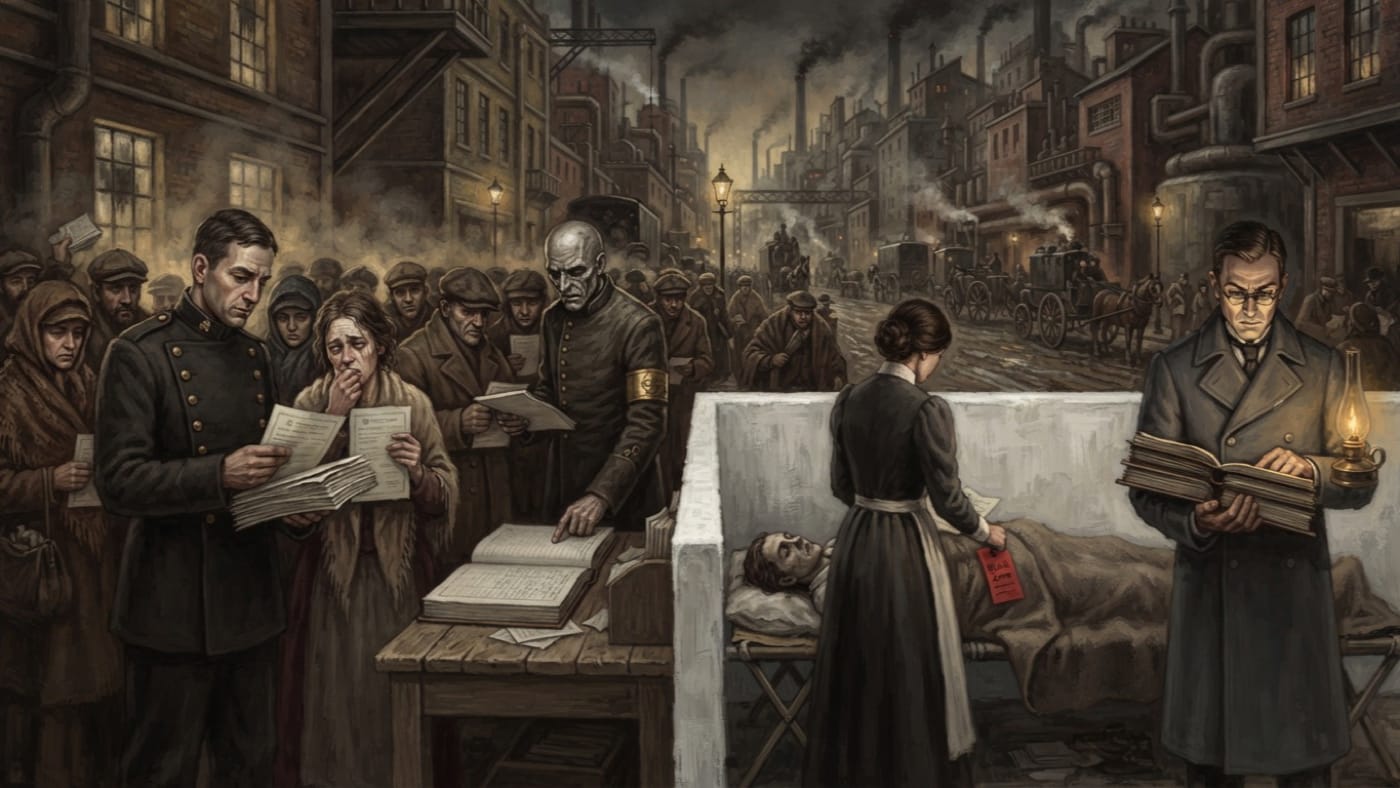
Marrowgate needs little introduction to anyone who has been wounded in a useful place. Three wagon roads and a rail spur feed it. The Wagon Quays smell of wet canvas and horse sweat. The White Ward breathes vinegar smoke and boiled linen through every shutter. At dawn the intake bells ring, the wagon queues lengthen, and crews repaint the whitewash lines of the Inner Cordon. Crossing one of those lines without papers is a crime, and a well-kept clearance is better protection there than any prayer.
The Clean Paper Plague did not empty the city or stop the wagons. Something smaller happened, and it was worse for the Bureau. People who were officially well were seen to die, publicly, on the clean side of the line.
#On the Authority of Clearance
The Clean Paper's value is easy to state. In Marrowgate, medical paperwork decides who may move, what they may enter and where their body goes afterward. Sanitation Chapter inspectors, ward sentries and tribunal clerks check papers at every gate and corridor. A Clean Paper takes a person through the lime trenches of the Outer Cordon, past the inspection gates and over the whitewash. Further down the corridor it gets a carter onto a convoy and a convalescent out of quarantine. Marrowgate exports stamped health clearances and fit-for-duty certificates the way other cities export grain.
Three authorities lean on that document, and none of them trusts the others.
The Sanitation Chapter holds the gates, the cordons, the inspections and the power of quarantine. It wants a city sorted into clean and unclean, and it keeps the sorting for itself. The Civic Triage Tribunal holds the beds. It assigns bed windows by bell and decides who is salvageable. It also issues the mercy rulings that turn a medical judgement into a legal one. Between the two stand the Sealhands, Marrowgate's licensed surgeon-notaries, whose brass seal rings make every cut and every finding a legal act.
Then the patient reaches the ward, and the Mercy Ward-Sister and Ward-Brother receive what the papers have already decided. Their intake triage weighs three things: symptoms, papers and behaviour. From those they assign a zone. Clean is for the recoverable, grey for the uncertain, black for the terminal, the contagious and those beyond allotment. The careful student will keep three things separate. The clean zone is a ward classification. The White Ward is a district of the city. The Clean Paper is a certificate. In Marrowgate all three can describe the same patient for an afternoon and still disagree with each other.
Under the Ledger Laws of A.S. 112, every ladle, dose, linen length and death tag has had to carry an accountable signature for eighty-seven years. The system works because each hand acts on what the previous hand wrote down. Records exist so that the next official does not have to examine the body again.
The Bureau's position, which I have defended in print, is plain. A body certified clean is clean. The Chapter certifies it, the Tribunal allocates beds on that basis, and the Ward-Sister feeds accordingly. In a properly governed city, health is whatever the documents say it is.
#On the Cleared and the Dying
What the ward-hands faced can be described without inventing anyone.
In this representative case, a woman comes in through the intake lane with a valid Clean Paper and a fever her papers do not mention. The Ward-Brother checks her gums, smells her breath and watches her eyes. Everything he finds says grey. Her paper says clean. If he marks her grey, his signature contradicts a seal, and that seal belongs to someone with more rank, more friends and better protection against an audit. If he leaves her clean, she gets full broth and decent linen and stays in a clean room among the recoverable, who may not stay recoverable for long. A convalescent who was cleared for release coughs at the gate. A carter on the convoy road holds his paper out like a relic while he shakes.
The record does not say what these people died of. It says they had been cleared.
Ward-hands have always lived with two ledgers. One lies on the desk, string-tied, sealed and ready for audit. The other is kept in memory and in favours. Through it, decent people stay decent inside an indecent system. That second ledger contains ghost bowls, entries for patients who do not exist, so that broth can reach the ones the schedule has abandoned. It contains salt hidden in apron seams, and a clean-zone tag held back an hour for a family that needed one. It also contains bought recovery slips, exemptions traded for fuel chits and coin taken at the service door. The Clean Paper Plague lived in that second ledger, and so did the ward-hands who tried to stop it. An auditor holding the second ledger by lamplight cannot easily tell which hand wrote which line.
Some Ward-Sisters signed what their senses told them and accepted the consequences. Some signed what they were paid to sign. Most worked the full intake crush, smelled the wound, looked at the wax and chose under a clerk's gaze before the next cart arrived. The Bureau calls that discretion. The ward-hands call it the ninth bell.
#On the Audit
The forgeries came to light and the audits intensified. That much is on record. Every further detail the reader may have heard in a tavern near Notary Row is the tavern's own work.
A forged clearance attacks the whole machine at once. The Tribunal's bed windows assume that the papers describe the bodies in front of them. The Chapter's cordons assume that it knows who stands on which side of the whitewash. Above both sits a figure the city does not openly sell: its low numbers, the plague tallies by which Marrowgate's administration lives or dies. If a certificate can lie, the tally built from certificates can lie too, and every auditor arriving from Records knows it.
The two authorities responded as expected. The Sanitation Chapter said that its gates had honoured notarized paper in good faith. The Tribunal said that the gates and the inspections belong to the Chapter and always have. Each found the scandal useful in its long argument over quarantine authority and legal primacy. No public record shows that either has won.
The Stitchmarket trades forged clearances in the Suture Slums. Its smugglers call them “clean lies”. Seal-forgers supply blank stock and counterfeit rings to anyone who pays. These trades are real and documented. They do not show who organized the forgeries of A.S. 199, or whether anyone organized them. A genuine seal can also sit on a false finding, and the wax looks the same either way.
“A body certified clean is clean. In a properly governed city, health is whatever the documents say it is.”
Corrected: a certified body is lawfully cleared, which is a separate condition from being well. Clearance governs movement, allotment and disposition. Ward-hands are to treat the body in front of them. The Bureau regrets that this distinction required corpses.
Local people add a story of their own. Near the Lime Yards, they say, chalk dust has turned up in sealed ledger rooms, and ward lists have been found amended overnight in a hand nobody owns. The Marrowwind has its own file. These reports are recorded here only as reports, from people who are not qualified to make them.
#On the Continuing Service
Two years on, the Clean Paper is still issued, checked, honoured and suspected at every gate in Marrowgate. Ledger audits are still active in the wards, as the Ledger Laws require. The market in clean lies remains as condemned and as useful as before. The Chapter still wants the gates, the Tribunal still wants the beds, and the Sealhands still press brass into wax over findings that someone, somewhere, has paid for.
The ward-hands keep working. They ladle, wash, smell wounds, check papers and then check faces, in whichever order the line allows. The Bureau of Mercy has issued no declaration that the Clean Paper Plague is over, and I will not invent one in its place. The forgeries were exposed. The audits grew. The intake bells still ring at dawn, and the whitewash still has to be repainted over the footprints from the night before.