
#On the Report's Office
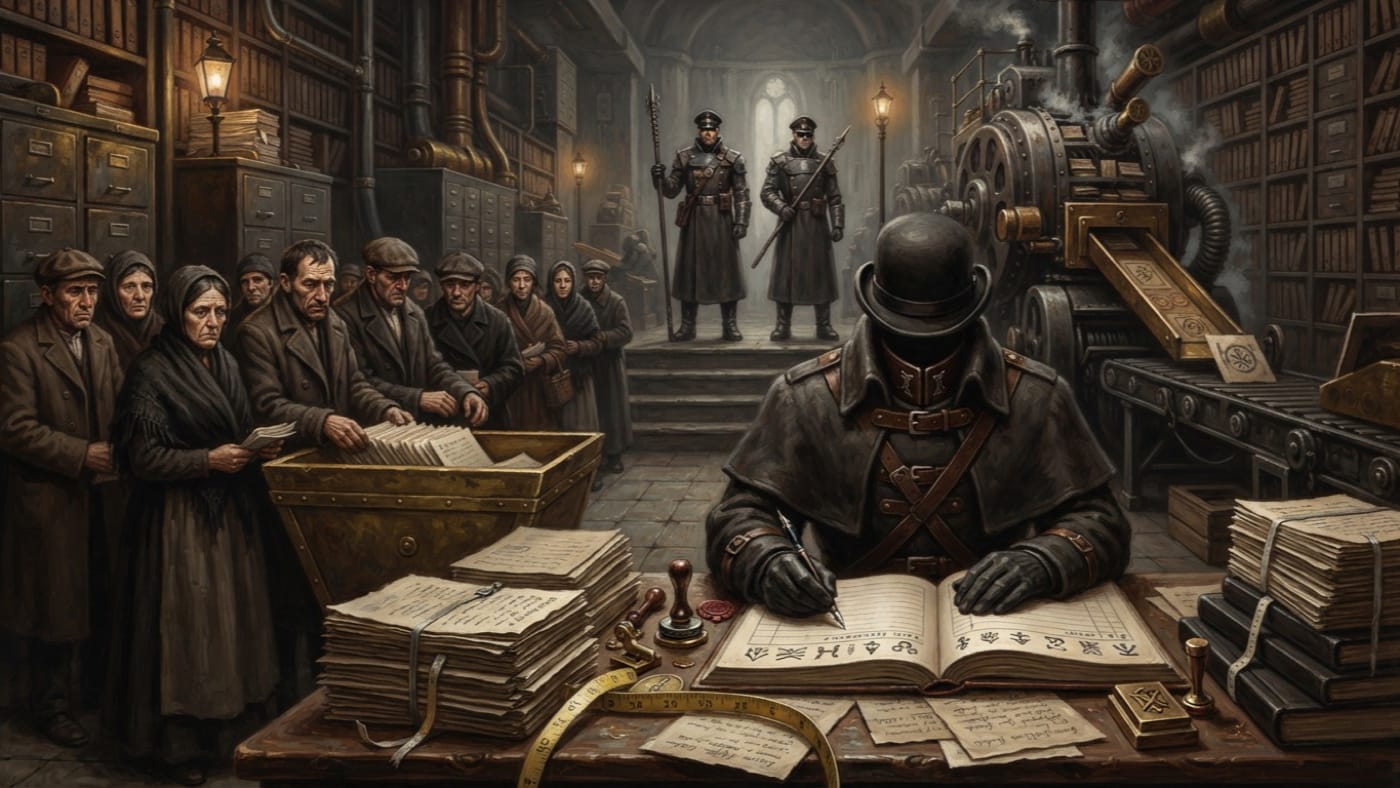
Every inspection ends at a table. Whatever the Assessor has paced, counted, sniffed and declined to drink on the road to a shrine gets written down there, on ruled paper, in ink the local committee will spend the rest of its life disputing. That paper is the Classification Report. A Shrine-Assessor of the Bureau of Pilgrimage writes it about one pilgrimage destination, and it goes to the Bureau of Records.
It has a sibling. After the same inspection the Assessor writes a second paper, the Purity Recommendation, and sends it to a different address. Both are composed at the same table with the same pen, usually before the same supper has gone cold. They must never be confused. Every inspected parish confuses them at once.
The Report describes a place. It asks how wide, how many, how wet and how paid. Its verdict is a grade, and the grade settles who may walk to the shrine, with which token and from how far away. A parish learns its own fate from the Report. It learns its priest's fate from the other paper.
#On What Is Entered
The Report holds measurements, receipts, route impact, relic status, crowd numbers, mortality, lodging capacity, tariff compliance and the final grade. The order of entries varies from hand to hand. The substance does not. I group them here in three files, as a sensible archivist would.
The site and its road. The Assessor enters approach width, drainage, stall density and bell audibility. Each one bears on traffic. An approach that takes two files of pilgrims in August and one in February is entered at its February width, because the Creator sends February every year without fail. Drainage decides whether the queue stands or wades. Stalls narrow the road by the breadth of their awnings and the greed of their keepers. Bell audibility is entered because a crowd that cannot hear the hour cannot be moved by it, and an unmovable crowd is a crush with candles.
The pilgrims and their beds. Crowd numbers come from the blackwood counter-rod, laid against the queue and read in handbreadths of compression. Mortality is entered as a number with no adjectives. Lodging capacity is checked against the lodging rolls. A shrine that draws a thousand and beds three hundred has seven hundred faithful asleep in the ditches of its neighbours, and those neighbours appear in the Report under route impact. They usually have opinions about the shrine.
The money and its manners. The Assessor opens votive ledgers, inspects donation-chest seals, counts candle racks against candle receipts and compares token compliance with the tariff schedule. Tariff compliance gets its own line. Revenue adequacy is one of the measures of classification, and the Bureau does not apologise for it. A shrine that cannot pay for its own latrines will soon be paying for its own funerals.
#On the Grade
The last entry is the grade. There are six.
A Local shrine may receive bronze-token pilgrims from within one province. A Provincial shrine may receive silver-token traffic from adjoining districts. An Inter-Provincial shrine goes into the published itineraries. A Reliquary House displays authenticated sacred material under joint notice with the Bureau of Relics. A Bastion-Access shrine may appear in the Great Passage schedules toward the Sagittal Line. A Suspended shrine is shut.
Laymen picture these as rungs on a ladder that a diligent parish climbs one by one. They are permissions, each with its own purpose. A Reliquary House has no superior claim over a Provincial shrine. It has a different licence and a co-signatory with stronger opinions. No shrine is promoted for good behaviour. It is classified.
The line for relic status needs firm handling, and Assessors are trained to give it that. The status is copied. Whether a bone is genuine, and whether it rates Ward-safe, Votive, Contaminant or Fraud, is decided by a Relic Authenticator under the authority of Relics. The Assessor may watch the Candle Proof when Relics turns up to perform it. The Assessor may not perform it, may not repeat it, and may not write so much as an approving comma on an Authenticity Writ. Pilgrimage grades houses. Relics grades what is kept in them.
That division produces the Report's most hated sentence. A Ward-safe relic can sit in a chapel with one doorway, a stair worn smooth as glass, and a crowd packed twelve to the space of six. The relic stays holy. The house stays dangerous. The Report records both facts on the same page and gives the grade to the house. A Writ can certify that the bone is genuine. It cannot widen the stair.
#On Pronouncement and Filing
A downgrade is written, then read aloud before witnesses, with two Peregrine Wardens standing close enough to be noticed and far enough away to look like courtesy. The reading takes effect at once. When the last syllable leaves the Assessor's mouth, the shrine holds the grade it was just given, and any token sold after that moment is sold against the Report.
Pilgrimage circulars once described a downgrade in a Classification Report as advisory to the shrine committee.
Corrected after the A.S. 151 Deutz Candle Riot. A shrine committee treated an advisory downgrade as a suggestion and kept selling silver-token access. Thirty-seven pilgrims were injured in the crush, and local testimony credits the candle rack with "independent motion." Assessment is now binding at utterance.
The Report then travels to Records, sealed, and Records gives it the form Records gives to everything: place, count, receipt, grade. Filing does not make the grade binding. Utterance already did that. Filing makes the grade findable. It cross-indexes the shrine against its route, its province and its earlier inspections, and it keeps the paper in the custody of a Bureau that has long held the right to arrange accounts into coherence. Most Reports come out of that custody as they went in. The Bureau would never say all of them do.
#On the Companion Recommendation
The Report has measurements in it. The Recommendation has names.
The reason for two papers is simple. Drainage cannot be interrogated. A vendor can. Width, mortality and lodging capacity belong on a shelf, where a later Assessor can compare them with the next visit. The man who sold splinters of the True Crutch from a booth on the approach belongs with the Bureau of Purity, which has its own shelves and different uses for them.
The Recommendation may ask for supervised correction, relic seizure, shrine suspension, examination of the operators, review of sermons or dissolution of a guild. It is sealed under Pilgrimage authority and cross-filed with Records. From that moment Purity can act on it without waiting for anyone else to complain. The Report supplies the count. The Recommendation supplies the culprit. Purity has a habit of reading both together.
The grade does not choose the punishment. A Suspended shrine may come with a mild Recommendation, and a shrine left at its old grade may come with a sharp one, because a well-drained chapel can still shelter a preacher with private theories. The Assessor writes each paper to its own purpose. Purity decides what the second one is worth.
Several civic guides say Purity cannot act on a Shrine-Assessor's findings without a separate doctrinal complaint lodged by a third party.
Corrected. A Purity Recommendation sealed under Pilgrimage authority and cross-filed with Records already counts as complaint, witness and preliminary finding. The Classification Report remains a separate instrument and does not count as any of these.
#On Contradictory Certification and Present Application
The seal is a single instrument, and the Church expects a single result from it. In A.S. 174 at Lyon, an Assessor's seal softened during an inspection and printed three contradictory ratings on one reliquary door. The door stayed Triply Certified for nine months. All three ratings carried proper wax and a proper hand, and none could be struck without admitting the other two were real. Pilgrimage sold special tokens. Assessors have refused candles from shrines under inspection ever since.
The Report also classifies traffic apart from its destination where the case requires. At the Cloister of Miscounted Beads, by attributed account, an Assessor found the overflow queue better ordered than the chapel it served and graded each on its merits. The queue prospered. The chapel was invited to learn from it.
Today the Report still travels the same road it always has: written at the table, read aloud at the door, carried to Records under seal, with its sibling a half-step behind on the way to Purity. Parishes still petition against it, and the petitions are filed beside it. In matters of tariff, the Bureau of Tithes reads the receipts with an interest that borders on devotion.